



AI-based Autonomous Firefighting System Presents a New Paradigm for Ship Fuel Fire Suppression
 Published2025.11.06 11:32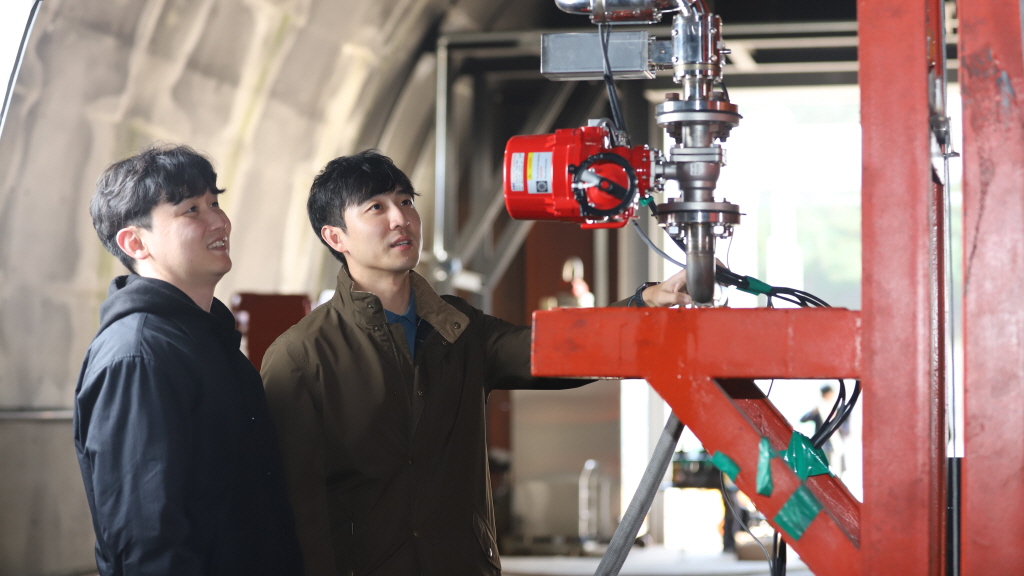
Lee Hyuk, a senior researcher at the Korea Institute of Machinery and Materials (right), is inspecting the fire suppression system equipment for the initial suppression of oil fires on naval vessels.
Domestic researchers have developed the world's first next-generation fire suppression system capable of autonomously detecting and precisely extinguishing oil fires on naval vessels. This technology is expected to dramatically improve the survivability and combat capabilities of ships by determining whether there is an actual fire based on artificial intelligence (AI) and enabling accurate targeting even in a maritime environment.
A research team led by Senior Researcher Lee Hyuk at the AX Convergence Research Center of the Korea Institute of Machinery and Materials (KIMM) announced on the 6th that, as part of the 'Civil-Military Commercialization Linkage Project,' they developed an autonomous initial suppression firefighting system specialized for oil fires on ships and successfully completed actual ship tests.
This study was jointly conducted by the Agency for Defense Development Civil-Military Cooperation Promotion Agency, Korea Institute of Construction Technology, Chungnam National University, Super Century Co., Ltd., and the Korea Military Academy.
Existing fire extinguishing systems for naval vessels discharge extinguishing agents across the entire affected area upon the occurrence of a fire, which resulted in damage caused by false alarms and limitations in targeting in maritime environments.
On the other hand, KIMM's autonomous fire extinguishing system combines AI-based precision fire detection with reinforcement learning algorithms to reflect waves and hull movements in real time, and sprays extinguishing water intensively only to the actual fire source.
This system consists of a fire detection sensor, a fire extinguishing monitor, and an analysis and control device, and boasts a fire detection accuracy of over 98% and a spray distance of up to 24m.
It has been verified to operate stably even in sea state 3, and in full-scale tests on the LST-II class amphibious assault ship 'Ilchulbong', it succeeded in accurately aiming at a fire source 18m away under wave height of 1m.
The research team constructed a large-scale land-based simulation facility that replicates the actual ship environment and conducted AI training and performance verification by simulating various oil fire and non-fire situations.
It demonstrated excellent performance in open-field and shielded fire suppression tests, increasing its potential for practical application.
Senior Researcher Lee Hyuk said, “This technology is applicable not only to warships but also to ammunition depots, munitions warehouses, and aircraft hangars, "It is applicable to various fields such as offshore plants, and will be expanded to civilian vessels and petrochemical facilities in the future to significantly improve fire safety at sea and industrial sites," they stated.

Comments
Related news
Korea Mechanical Engineering and Construction Co., Ltd. Strengthens Cooperation with Europe and Eastern Europe
Korea Institute of Machinery and Materials (KIMM) has signed a Memorandum of Understanding (MoU) for research collaboration with the University of Maribor in Slovenia and the German Aerospace Center (DLR), and has expanded cooperation with the Institute for Machine Tools and Factory Management (IFW) at Leibniz University Hannover in Germany on the development of autonomous machining systems.
2025.04.04by 명세환 기자
Expanding the scope of in vitro diagnostics through solid sample liquefaction pretreatment
A research team led by Senior Researcher Kim Kwan-o from the Nanolithography Research Center at the Nano Convergence Research Division of the Korea Institute of Machinery and Materials (KIMM, Director Ryu Seok-hyun) and a research team led by Professor Lee Yoon-ju from Sejong Chungnam University Hospital have developed an ultra-compact high-speed preprocessing system capable of emulsifying and homogenizing solid biological samples within one minute, which is expected to contribute to the practical implementation of field-oriented technology in the in vitro diagnostics sector.
2025.04.30by 명세환 기자
.jpg)
Development of a highly efficient and stable robot hand with simple control
A research team led by Senior Researcher Shin Min-ki at the Medical Robotics Laboratory of the Daegu Convergence Technology Research Center under the Korea Mechanical Engineering Research Institute (National Science and Technology Council) has developed a ultra-lightweight robotic hand that enables amputees to stably grasp various objects with simple commands by applying a linkage-wire hybrid actuation method and an under-actuated mechanism, and has completed practical user testing and evaluation.
2025.05.29by 명세환 기자
Korea Mechanical Engineering and Machinery Research Institute Launches Corporate Collaboration Platform ‘K-Partners’… Establishing a Sustainable Industrial Collaboration Ecosystem
Korea Institute of Machinery and Materials (President Ryu Seok-hyun, hereinafter referred to as KIMM) has launched a new platform 'K-Partners' to promote inter-company collaboration, and is pioneering a new path for industrial technology advancement through the establishment of a sustainable industrial cooperation ecosystem.
2025.06.13by 명세환 기자
AI-based machine diagnostic technology talent search
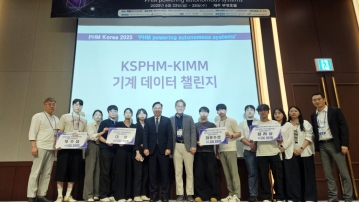
The Korea Institute of Machinery and Materials (KIMM, President Ryu Seok-hyun) successfully concluded the 'KSPHM-KIMM Machine Data Challenge,' jointly hosted with the Korean Society for Prognostics and Health Management to develop AI-based machine diagnosis technology. The grand prize was awarded to the SSbearing team from Korea Aerospace University (led by Baek Hyun-jin), followed by teams from Korea Engineering University, Ajou University, and Hongik University among the award-winning teams.
2025.06.30by 배종인 기자











