


The Key to Physical AI Success: ROI
 Published2025.11.17 08:31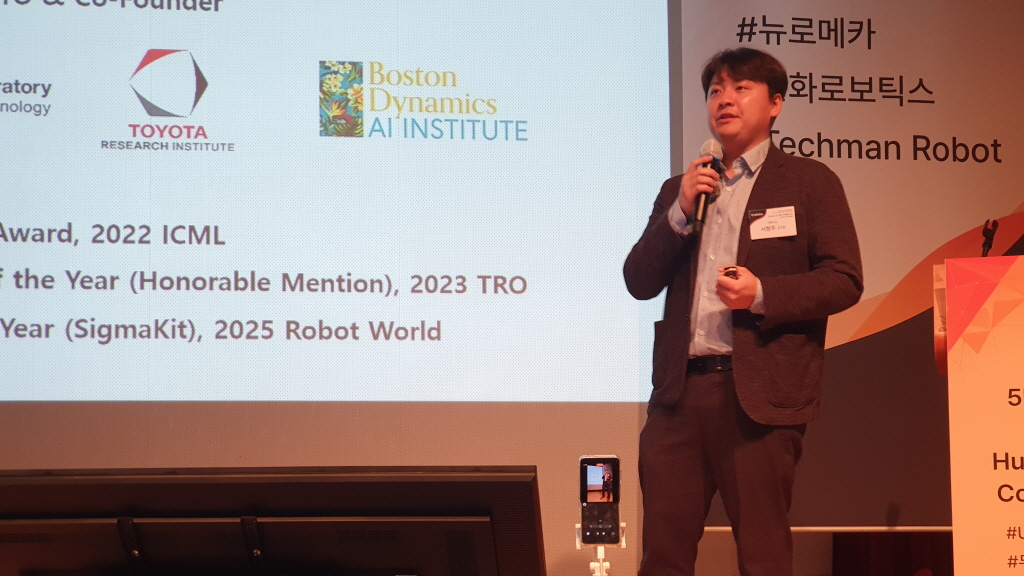
▲ Carbon Six CTO Seo Hyeong-ju is giving a presentation.
Optimal efficiency through a mix of rule-based systems and AI, not limited to specific robots.
"ROI is key for AI to take hold in manufacturing."
At the seminar 'Physical AI, a Game-Changer that Transcends the Limits of Robots' held on the 11th and hosted by Safetics, Seo Hyeong-ju, CTO of Carbon Six, announced the 'world's first industrial Physical AI Kit'.
CTO Seo Hyung-joo stated, "Manufacturing has long been evolving through innovative technologies like optical inspection, specialized welding, and suction pad transport. However, the recent trend is moving away from 'humanoid robots' that simply mimic humans, and toward solving industrial problems through the combination of creative technologies and AI." He added, "I am skeptical of the argument that we must unconditionally move toward humanoid robots. He emphasized, “True innovation is possible only when existing engineering achievements and AI intelligence meet.”
He continued, “For physical AI to be fully adopted into the manufacturing industry, three ROI conditions must be met: cost, tact time, and yield.” He added, “Mere technical feasibility is not enough; actual investment value must be proven.”
To this end, companies are developing standardized robot software and customizable systems that can be applied to various industrial sites, it said.
In this regard, CTO Seo Hyeong-ju unveiled a demo, focusing on solving practical problems in the manufacturing industry.
The vinyl stripping task demonstrated that the industrial robot arm delicately removed the vinyl and was able to adapt in real time to irregular tasks, and the ring hanging task in the painting process demonstrated that the robot could accurately hang the ring in an irregular position after only 100 learning sessions.
Additionally, the film attachment process in the smartphone assembly process was completed reliably even after repeated abuse using a suction gripper.
These examples demonstrate the potential for robots to perform human-like tasks through intelligent adaptation and real-time judgment, rather than simple automation.
Physical AI solutions are not limited to specific robots. They can be applied to a variety of equipment, including existing gantry and SCARA robots, and can be combined with rule-based systems and AI intelligence to achieve optimal efficiency.
It is also designed to provide a UI/UX that is easy to use even for non-experts, so that field engineers can utilize it without any advanced knowledge.
In particular, it provides a practical effect of reducing construction work by reducing the burden of data collection according to model changes. This is a significant step forward in addressing one of the biggest barriers to AI adoption in manufacturing.
Ultimately, the goal of this technology is to transform manufacturing from a traditional rules-based language to a data-driven one.
This enables a new concept, not just simple automation, but the High-Variance Ready Factory.
In other words, the goal is to create a factory where AI can flexibly respond even in industrial settings where various variables exist.
CTO Seo Hyung-joo asserted, “Physical AI is driving fundamental innovation in the manufacturing industry, going beyond simply ‘robots replacing people.’” He added, “Meeting ROI, diverse application cases, scalability, and transitioning to a data-driven language are the key to solving the challenges facing the manufacturing industry.”

Comments
Related news
[Serial Project] Physical AI: Redefining the Future of Industry ①, "The Success of Physical AI Depends on the Design of Interactions Between Humans and Intelligent Machines."
While conventional AI has focused on inference and generation within digital data, Physical AI acts and responds directly in the real world through sensors, edge computing, robots, and control systems. The implementation of Physical AI can significantly advance industrial innovation and automation since AI directly acts and solves problems in the real world, interacting directly with the physical environment. Accordingly, global companies including NVIDIA, Tesla, and Google are making massive investments in Physical AI, and the related market is expected to grow explosively. To implement such Physical AI, perception technologies including sensors, edge computing and embedded systems for local computing to process real-time data, as well as robotics and control technologies are essential. In response, e4ds news has prepared a series of articles to examine core technologies and implementation strategies ranging from the concept of Physical AI to market outlook, related technologies, and practical cases.
2025.10.20by 배종인 기자
.jpg)
AMD Platforms: A Perfect Fit for Physical AI
Robotec.ai will unveil a fully autonomous warehouse robot powered exclusively by AMD Ryzen™ AI processors at ROSCon 2025 held in Singapore, in collaboration with AMD and Liquid AI. The robot is equipped with agentic AI technology that performs tasks through real-time inference and natural language understanding, moving away from traditional hardcoded command methods.
2025.10.27by 배종인 기자
.jpg)
[Serial Feature] Physical AI: Redefining the Future of Industry ②, "The 'Physical AI Market' Will Become a $1 Trillion Ecosystem by 2030."
According to some experts, 'Physical AI' is projected to become the greatest revolution in human history, surpassing the Industrial Revolution. While it will have significant impacts on society, culture, and economy, since we cannot predict the entirety of these effects, from an economic perspective, citing forecasts from global market research institutions, Physical AI is expected to establish itself as a key driving force that will reshape industrial structures, with the market reaching approximately one trillion dollars by 2030. Below is an examination of the Physical AI market size by industrial sector.
2025.10.27by 명세환 기자
.jpg)
Hanwha Robotics and Mind AI accelerate the commercialization of autonomous robots.
Hanwha Robotics and Maum AI signed a "Memorandum of Understanding (MOU) for cooperation in the Physical AI field" at Maum AI's headquarters in Seongnam, Gyeonggi Province on the 28th, and announced that they will begin full-scale joint projects to develop next-generation robotics platforms and strengthen verification systems.
2025.10.29by 배종인 기자

DeepX: "AI must become a 'real-world intelligence' that transforms industry and society, not just a server-side technology."
Kim Nok-won, CEO of DeepX, an ultra-low-power AI semiconductor specialist, was recently invited as an official speaker to the 'New Drivers of Industry Transformation Meeting 2025' hosted by the World Economic Forum (WEF), where he presented the technology vision for 'Physical AI' alongside global innovation leaders.
2025.11.04by 배종인 기자











