


Panesia Establishes Its Position as a Leader in AI Data Centers and Next-Generation HPC Interconnects
 Published2025.11.24 11:07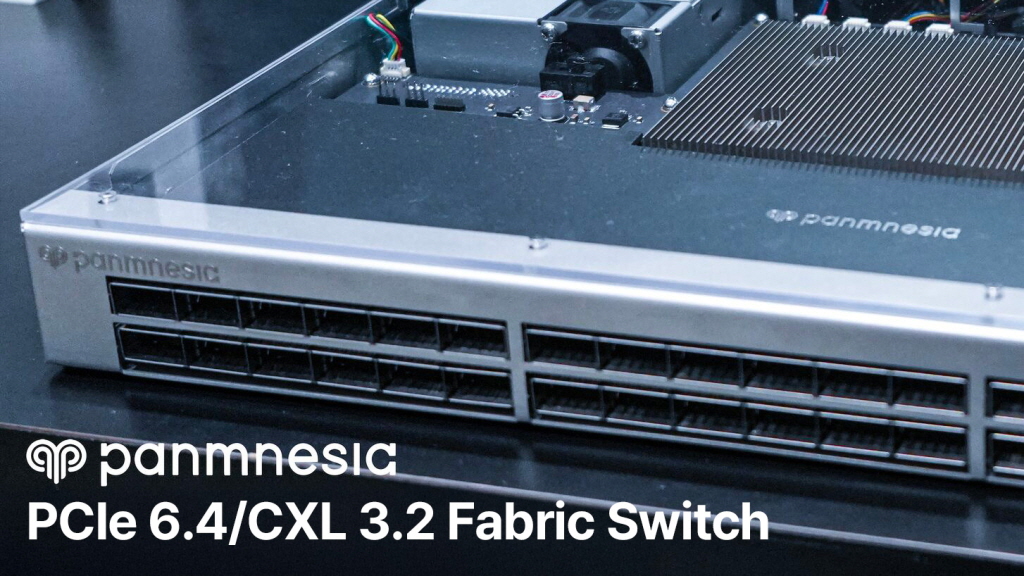
▲PCIe 6.4/CXL 3.2 fabric switch node exhibited by Panesia
Panesia (CEO Myeongsu Jeong), a core link solution company in the AI infrastructure and HPC (high-performance computing) field, has established itself as a leading next-generation interconnect technology company in the global AI data center and HPC market by presenting a new paradigm for AI/HPC workload acceleration with its self-developed CXL 3.2/PCIe 6.4 fabric switch and MPI-over-CXL solution.
Panesia announced on the 24th that it unveiled its next-generation CXL 3.2/PCIe 6.4-based fabric switch solution at the world's largest supercomputing event SC25 (St. Louis, Missouri, USA) and the global data center event OCP Global Summit 2025 (San Jose, California, USA).
At this exhibition, Panesia actively participated in international standardization activities by presenting on the official panel of the CXL Consortium together with Intel, AMD, and Micron.
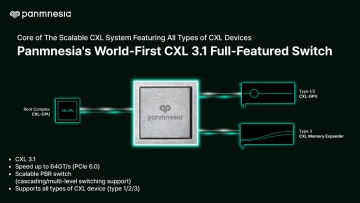
The PCIe 6.4/CXL 3.2 fabric switch node introduced by Panesia features innovative technology that integrates thousands of devices into a single fabric for large-scale AI and HPC applications.
Panesia said, “It effectively accelerates desired applications by making devices distributed across multiple server racks work as if they were one giant accelerator.”o; explained.
This solution offers two key capabilities: connecting thousands of devices and optimizing fabric-wide performance. Specifically, it enables ultra-low latency connectivity using only CXL-based interconnects, bypassing the network, resulting in a dramatic performance boost over traditional Ethernet.
Panesia switches support port-based routing (PBR), allowing you to freely configure various data center topologies such as torus and dragonfly.
This is what differentiates it from existing CXL switches that only support tree structures. Additionally, when the connection method is changed, the internal routing structure is automatically reconfigured, minimizing manual work by engineers and significantly increasing operational efficiency.
The Panesia switch supports PCIe 6th generation 64GT/s transmission speed and is equipped with a self-developed ultra-low latency CXL controller to achieve double-digit nanosecond latency.
Additionally, the cache consistency guarantee function minimizes unnecessary data movement and reduces performance degradation due to communication.
Based on this, we have proven that various workloads such as augmented search generation (RAG) and MPI-based scientific simulation can be effectively accelerated.
At the SC25 event, Panesia presented its MPI-over-CXL solution in a panel session titled “How To Leverage CXL Memory Pooling and Sharing for AI and HPC Workloads” with Intel, AMD, and Micron.
The existing MPI (Message Passing Interface) method had the problem of performance degradation due to data copying between CPUs, but Panesia's solution minimized data copying by applying a memory sharing-based pointer exchange method.
A Panesia official emphasized, “We can innovatively accelerate HPC applications by utilizing the memory sharing function of the CXL 3.2 controller, which we developed using domestic technology.”

Comments
Related news
Panesia, CXL Interoperability Verification Demonstration...Spurring Domestic Fabless Overseas Strategy
Global big tech companies are intensifying their competition to develop ultra-large-scale AI. As these massive AI models evolve into larger and more complex architectures, the demands for AI accelerators and memory expansion become inevitable. Compute Express Link (CXL), which addresses these challenges, is positioned as a next-generation interface technology, and global enterprises are racing to develop CXL technology and build its ecosystem.
2024.04.23by 권신혁 기자
Panesia Targets Global Market with CXL Solution
Panasonic recently participated in the 1st CXL Consortium Developer Conference 2024 held in Santa Clara, California, USA, where it demonstrated CXL interoperability verification.
2024.05.07by 명세환 기자
Panesia, “CXL 3.1 Switch Chip to be Released in the Second Half of 2025”
Recently, large-scale machine learning-based services such as ChatGPT have become widely utilized. In order to achieve higher performance, the latest machine learning-based service operators are competitively increasing the size of models and data, which has led to a sharp increase in memory capacity requirements in data centers. In response, major technology companies are seeking solutions through CXL, a memory interconnect technology.
2024.07.23by 명세환 기자

Panesia Unveils CXL-Equipped AI Cluster at OCP Global Summit
As competition intensifies among enterprises in AI services, recent attempts have been repeatedly made to achieve high accuracy by increasing the size of AI models or utilizing more data. This is driving increased memory demand from enterprises, and as companies add servers to expand memory capacity, their expenditure burden is also rising in tandem.
2024.09.27by 명세환 기자
Panesia secures KRW 80 billion in Series A funding, bringing total funding to KRW 100 billion.
CXL fabless startup Panesia announced on the 19th that it has successfully secured Series A investment of over 80 billion won.
2024.11.19by 명세환 기자











