


Coupang's personal information leak sparks a joint government-private investigation, with 30 million accounts affected.
 Published2025.12.01 09:12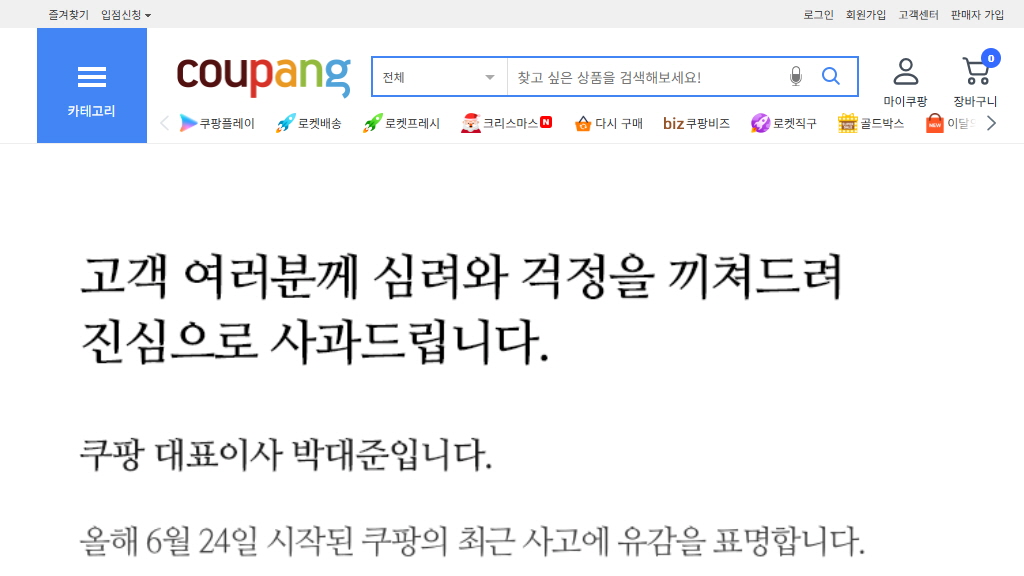
▲A personal information leak occurred at Coupang. (Photo: Coupang homepage capture)
There is a high possibility of secondary damage such as smishing and voice phishing.
The Coupang breach and personal information leak were revealed to be far more serious than initially reported. Initially reported, customer information from 4,536 accounts was compromised. However, the investigation revealed that personal information, including customer names, email addresses, addresses, and phone numbers, was compromised from over 30 million accounts. Consequently, the government launched an emergency response.
The Ministry of Science and ICT (Minister Bae Kyung-hoon, Vice Prime Minister) and the Personal Information Protection Commission (Chairperson Song Kyung-hee, hereinafter referred to as the Personal Information Protection Commission) held an emergency meeting at the Government Complex Seoul on November 30 and decided to form and operate a public-private joint investigation team. The investigation team will closely analyze the cause of the accident and prepare measures to prevent recurrence.
The Personal Information Protection Commission has been conducting an investigation since November 21 after receiving two reports of data leaks from Coupang (on November 20 and November 29).
In particular, the company plans to focus its investigation on whether Coupang has violated its safety measures (access control, authority management, encryption, etc.) under the Personal Information Protection Act, and if violations are confirmed, strict sanctions will be imposed.
A government investigation revealed that attackers exploited an authentication vulnerability in Coupang's servers to access a large number of accounts without following the normal login process, stealing personal information. This resulted in the leak of contact information and addresses for a large number of citizens, increasing the risk of secondary damage, such as smishing and voice phishing.
To prevent the spread of damage, the Ministry of Science and ICT and the Personal Information Protection Commission issued a public security notice through Boho Nara (www.boho.or.kr) and will operate a three-month period of enhanced monitoring of illegal distribution of personal information on the Internet and dark web.
The types of secondary damage expected include smishing, which uses keywords such as “compensation request” and “refund” to induce users to click on malicious URLs, and phishing sites, which use search keywords such as “damage fact inquiry” to induce users to access the site by displaying it at the top of the portal. Additionally, voice phishing can be used to call victims and induce them to install a remote control app under the pretense of providing compensation or refund procedures.
The government advised the public to refrain from clicking on text messages or website addresses of unknown origin, and if in doubt, to check through the 'Smishing/Phishing Verification Service' on the Protection Nara KakaoTalk channel.
As a preventive and response method, it is required to utilize the spam reporting function when receiving text messages, report through the Voice Phishing Integrated Reporting and Response Center, and apply for a free mobile carrier number theft text message blocking service.
In addition, you should check your mobile payment history and report any damage to the cyber investigation unit of the police station. If you are infected with a malicious app, you should visit a mobile antivirus or service center to delete it. When using financial services, you should discard and reissue your public certificate or security card.
Additionally, it is important to inform those around you that you have been victimized, as malicious apps can use your address book to resend smishing messages to your acquaintances.
Minister of Science and ICT Baek Kyung-hoon said, “Citizens should be especially cautious of phone calls or text messages impersonating Coupang,” and emphasized, “The government will do its best to resolve the inconvenience and concerns of the public caused by this incident.”
Coupang CEO Park Dae-joon publicly apologized at the Seoul Government Complex on November 30th and also posted an apology on the company's website.
Meanwhile, the suspect who committed the information leak is known to be a Chinese national who worked at Coupang.

Comments
Related news
.jpg)
Coupang, Kakao, Equinix Disaster Management Obligations Apply... “Preventing a Second IT Disaster”
The Ministry of Science and ICT held the 3rd Communication Disaster Management Council meeting in 2024 on the 23rd. Following amendments to the 'Broadcasting and Communications Development Basic Act' prompted by the Pangyo data center fire incident, starting this year, 11 major telecommunications operators including SKT and KT, 7 value-added telecommunications operators such as Naver and Kakao, and 8 data center operators including SK C&C are implementing disaster management obligations for the first time.
2024.07.24by 김예지 기자
.png)
Databricks Unveils Open AI Security Monitoring 'Lakewatch'
Databricks entered the security market on March 24 by unveiling LakeWatch, an open-source agentic SIEM. The core functionality of this product is to integrate and analyze security, IT, and business data in a single environment to support AI-based threat detection and investigation. The company explained that it reduces the limitations of existing security operations centers, which have had to forgo some data due to high cost structures, and enables large-scale data analysis and automation based on open formats and ecosystems. LakeWatch is currently offered as a private preview, with Adobe and Dropbox mentioned as early customers. Databricks also announced an expanded partnership with Anthropic as well as the acquisition of Antimatter and SiftD.ai.
2026.03.26by 배종인 기자
Kaspersky Unveils Revamped 'NEXT' Combining SOC Integrated Management and AI Analytics
As enterprises increase demand for integrated management and automation in the construction and operation of Security Operations Centers (SOC), Kaspersky has disclosed updates to its B2B security product suite 'Kaspersky Next'. This update expands EPP, EDR, XDR, and SIEM integration through a single console based on OSMP, incorporates AI capabilities such as DLL hijacking detection and suspicious account takeover behavior identification, and includes integration with generative AI assistant tool KIRA. The company stated that in large-scale deployment environments, EDR Expert can reduce resource requirements by up to 30%, and XDR Expert by up to 60%.
2026.03.25by 배종인 기자
Samsung Electronics Smart Monitor Acquires First International Certification… Expanding Application Scope Following TVs
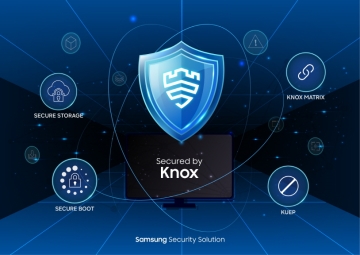
Samsung Electronics has received Common Criteria (CC) certification for 'Samsung Knox,' a security solution applied to its 2026 smart TVs and smart monitors. The smart TV has achieved certification for 12 consecutive years, while the smart monitor obtained industry-first certification this time. The evaluation was conducted focusing on core functions including kernel integrity monitoring, phishing site blocking, and unauthorized execution prevention. The company plans to expand the scope of security certification beyond TVs to monitors, responding to growing personal information protection requirements as connected devices proliferate.
2026.03.25by 배종인 기자

Teori Selected as AI Voucher Supplier… Supplying LLM Security Solutions
Cybersecurity company Theori has been selected as a supplier for the 2026 AI Voucher Support Program. The company plans to address information leakage and regulatory compliance issues that arise during generative AI adoption through its LLM security solution 'AlphaPrism'. The solution is designed to analyze the context of prompts and source code to identify sensitive information such as personal data and authentication keys, and to continue AI utilization through masking methods rather than simple blocking. The government's AI Voucher Program supports demand enterprises with up to 200 million won per project for solution purchase costs. Based on recent application cases at POSCO DX, Theori plans to respond to expanding demand for enterprise AI security.
2026.03.24by 명세환 기자











