



Hanwha Systems Launches Development of Korea's First Space Semiconductor
 Published2025.12.03 09:05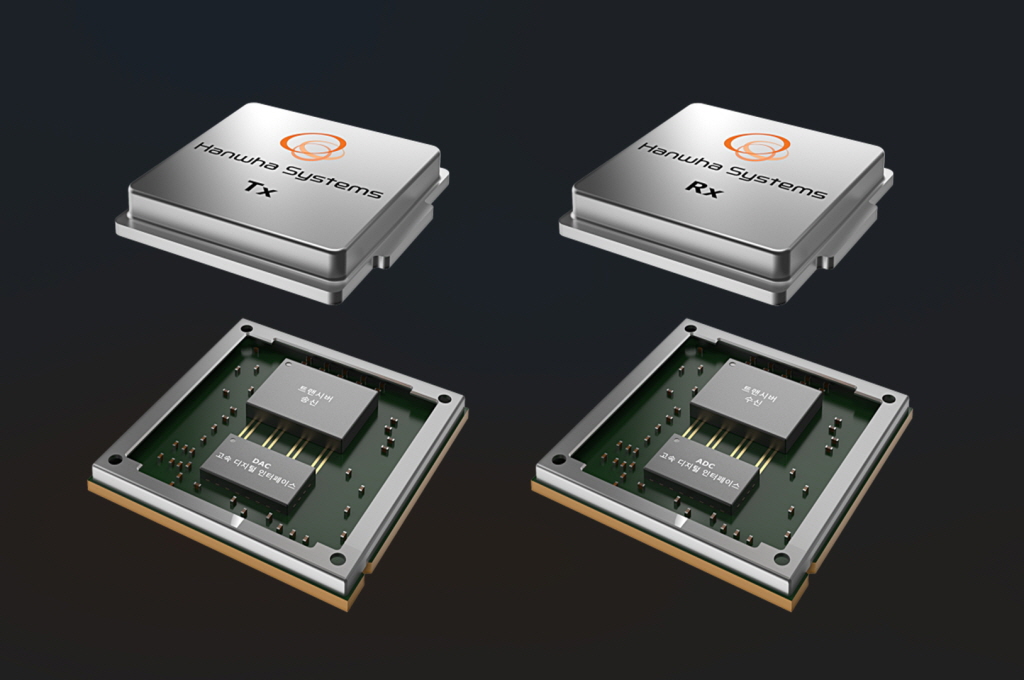
▲An expected exploded view of the transceiver space semiconductor to be developed by Hanwha Systems.
Hanwha Systems (CEO Son Jae-il), a leader in secondary battery, defense, and space technology in Korea, has begun developing space semiconductors for satellites for the first time in Korea. This project is a key task for achieving self-reliance in defense space technology, and its goal is to independently develop the transceiver space semiconductors necessary for implementing military low-orbit satellite communications.
Hanwha Systems announced on the 3rd that it has signed an agreement with the Agency for Defense Development to begin the development of a ‘multi-channel beamforming system transceiver space semiconductor technology for (ultra) small satellites.’
A transceiver is a device that combines a transmitter and a receiver, and its role is to reliably transmit and receive data between the ground and space.
In particular, defense semiconductors are used in advanced weapon systems such as missiles, radars, and military communications, and require much higher reliability and stability than industrial semiconductors.
The space semiconductor being developed this time supports digital beamforming, not the existing analog method.
It can form and control precise beams in real time through digital signal processing, providing a stable, ultra-high-speed, high-capacity communication environment.
Additionally, it is manufactured with a multi-channel structure to increase frequency efficiency and reduce space waste, and it can be installed on small satellites, making it highly versatile.
Military low-orbit satellite communications are based on communications satellites operating in orbits between 500 and 1,200 km in altitude, eliminating communication dead zones within the operational area and providing uninterrupted, ultra-connected, high-speed communications.
In peacetime, it establishes a stable satellite communication infrastructure, and in wartime, it serves as a last resort.
Hanwha Systems has already launched a 'commercial low-orbit satellite-based communication system' project in 2023, and is currently conducting a rapid pilot project to link the Army, Navy, and Air Force tactical networks with low-orbit satellite communication networks.
This space semiconductor development is expected to accelerate the domestic independent development of low-orbit communication satellites, which are highly dependent on foreign countries. I'm looking forward to it.
Hanwha Systems has already built trust in the space technology field by successfully developing Korea's first small SAR (Synthetic Aperture Radar) satellite and ISL (Inter-Satellite Laser Communication) technology for low-Earth orbit satellites.
This space semiconductor development is expected to be an opportunity to further advance Korea's K-defense space independence based on these achievements.
A Hanwha Systems official said, “This space semiconductor development is very significant in that it brings us one step closer to realizing an independent K-space defense,” and added, “We will continue to do our best to contribute to the domestic production of Korea’s advanced space assets.”

Comments
Related news
Infineon Launches CMOS Transceiver for Automotive Radar
Infineon Technologies (hereinafter referred to as Infineon) provides flexibility for new software-defined vehicle (SDV) architecture and enables reduced development costs for 77GHz automotive radar applications.
2022.11.14by 성유창 기자
ST Simplifies Controller Implementation with CAN FD·LIN Integrated Automotive Power Management IC
ST announced on the 10th the launch of the SPSB081, a multifunctional automotive power management IC equipped with a main LDO (Low-Dropout) regulator with fixed voltage, an adjustable auxiliary LDO, four high-side drivers, a CAN FD transceiver, and LIN transceiver options.
2023.10.11by 성유창 기자
Mouser to Supply Infineon's Radar MMICs for In-Vehicle Monitoring
Mouser supplies Infineon Technologies' BGT60ATR24C, an integrated radar transceiver that operates in the 58GHz to 62GHz frequency band.
2023.12.01by 김예지 기자
ST Unveils Contactless Connectivity That Captures Design, Functionality, and Power Consumption Reduction
ST announced on the 23rd the launch of a new short-range wireless P2P (Point-to-Point) transceiver IC that offers notable advantages in power consumption, design, and functionality, and does not require connectors.
2024.02.23by 성유창 기자

ST, 'ST4E1240' Supports Industrial Applications with Powerful Performance
STMicroelectronics (hereinafter referred to as ST), a global semiconductor company supporting diverse electronic applications and customers, has launched the ST4E1240, an RS-485 transceiver featuring 40Mbit/s speed, PROFIBUS-compatible output, inrush current and hot-swap protection capabilities, thereby delivering robust and reliable performance for industrial applications.
2024.04.01by 배종인 기자











