



Sensor Fusion: Safe Navigation, Opening the Future of Autonomous Ships
 Published2025.12.05 15:57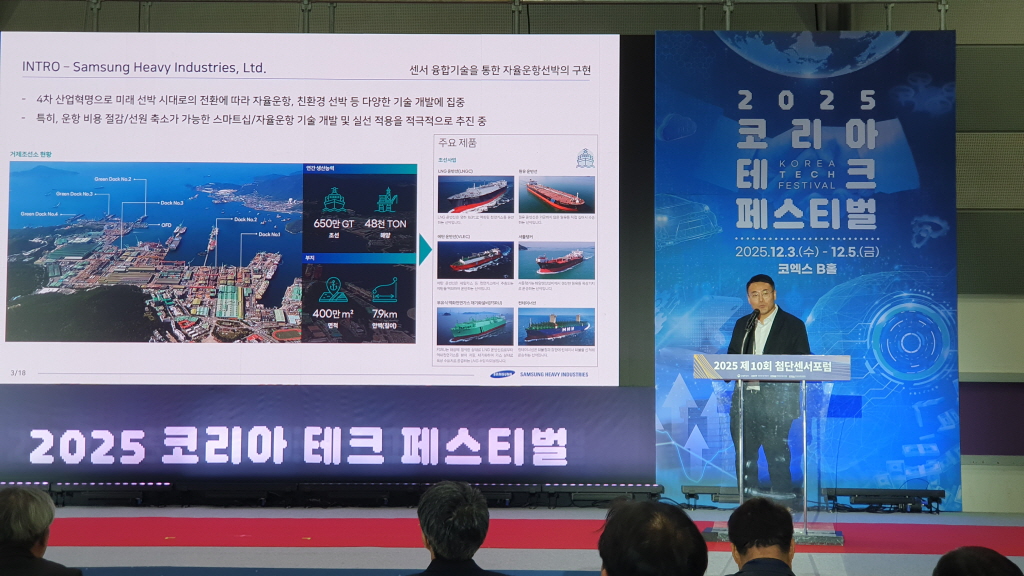
▲Kim Jae-woo, a division manager at Samsung Heavy Industries, is presenting on 'Cooperation Plans for Core Sensor Technology for Autonomous Ships' at the '2025 10th Advanced Sensor Forum.'
Utilizing key sensors such as cameras and radar requires consideration of cost-effectiveness and efficiency.
“Sensors and autonomous navigation systems onboard ships are essential to assist in safe navigation.”
Kim Jae-woo, a division manager at Samsung Heavy Industries, presented on the 'Cooperation Plan for Core Sensor Technology for Autonomous Ships' as a keynote speaker at the '2025 10th Advanced Sensor Forum' held at COEX on the 4th.
Kim Jae-woo, the head of the department, said, “Recently, we have been spurring the development of autonomous ship technology, which is attracting attention as a future industry beyond simple ship manufacturing,” and “Various sensors and communication systems are essential for the safe operation of ships.”
Kim Jae-woo, the head of the department, said, “Currently, the ship’s electrical system is largely divided into five categories: △Automation system △Main engine control △Cargo management △Fire and gas response △Navigation and communication system. Among these, the navigation and communication system is called the ‘bridge’ of the ship, and it is a space where numerous sensors are concentrated. One container ship has about 25,000 sensors.“It is equipped with a
Autonomous ships are developing step by step.
Level 1 is where people make decisions directly, but the system assists them.
Step 2 involves remote operation with people on board.
Level 3 is a remotely controlled unmanned vessel, while Level 4 is fully autonomous, with human intervention only in emergency situations.
Currently, development is progressing to the third stage in Europe.
The role of a navigator is to perceive information, assess the situation, avoid collisions, and return to the course through a repeated process.
Autonomous driving systems also mimic this process.
It uses cameras and radar to perceive the surroundings and control speed and direction.
Citing a real-world example, Team Leader Kim Jae-woo said, “In fact, during a 1,500-mile voyage from Mokpo to the Philippines, the autonomous navigation system performed 21 turns,” adding, “This is similar to the number of times a navigator has changed course in an emergency situation.”
On the other hand, it was revealed that carelessness in looking out remains a major risk factor.
This year, oil tanker collisions and groundings have occurred in British waters. These incidents further highlight the need for onboard sensors and autonomous navigation systems.
The obstacles that ships face are varied.
Representative examples include other vessels, small fishing boats, reefs, glaciers, buoys, whales, warships, bridges, and fishing nets. To detect these objects, four main sensors are used: cameras, radar, electronic charts, and AIS (Automatic Identification System).
Cameras are replacing traditional telescopes and are evolving into deep learning-based object recognition. Currently, it can detect up to about 10km with a 180-degree field of view.
The radar rotates every 2.5 seconds and can detect day and night through X-band radar.
Electronic charts provide information on water depth, fishing ports, and fish farms to prevent the risk of grounding.
AIS, GPS, and VHF are responsible for ship location and communication, but with the recent emergence of GPS interference issues, complementary technologies are being demanded.
High-resolution cameras improve object recognition performance, but they also increase deep learning processing costs.
Since radar performance also varies depending on the environment, autonomous driving systems must automatically adjust this.
Ultimately, technological advancements should not simply focus on improving performance; they should also consider economic feasibility and efficiency.
Kim Jae-woo, the head of the division, said, “Autonomous ships are not only a new food source for the shipbuilding industry, but also a core technology that will simultaneously lead maritime safety and logistics innovation.” He added, “Sensor fusion and artificial intelligence-based judgment systems are replacing the experience of navigators and evolving toward reducing accidents and increasing efficiency.”

Comments
Related news
In what direction will future sensors be developed?
Sensors form the foundation of technologies expected to lead the Fourth Industrial Revolution, such as big data, artificial intelligence (AI), Internet of Things (IoT), and autonomous vehicles. This is because sensors selectively collect information from specific targets. Interest in advanced sensors—intelligent sensors that integrate not only sensing but also information processing and communication functions into a single unit—is growing. According to the POSRI report, the sensor market is expected to see increased demand across all sectors, primarily driven by smart cars and smartphones. While conventional mobile phones used only two types of sensors—image and audio sensors—smartphones now use more than 20 sensors per device. Accordingly, it is projected that the era of 1 trillion sensors will arrive around 2025. The advanced sensor market share is also expected to increase from 19% in 2010 to 49% in 2020. Kwang-Jun Sohn, PD at the Korea Institute of Industrial Technology Evaluation and Planning, explained, "Whereas semiconductors and MEMS sensors were primarily used in the information and communication or automotive industries in the past, with the advent of the era of intelligent advanced sensors, the markets in which they are applied—such as robotics, automobiles, medical, environmental, and energy industries—will expand significantly," and described the development direction of sensors by key sector of the Fourth Industrial Revolution.
2017.11.13by 김지혜 기자
[Planning] Power & Sensors ② - Reliable Industrial Solutions for the Most Harsh Environments
Infineon is actively engaged in developing next-generation silicon and wide-bandgap power portfolios as well as cutting-edge sensor products, based on 40 years of expertise and deep system understanding. Recently, the company has published a white paper covering its entire power and sensor product lineup to help developers find solutions best suited to their requirements. This publication presents an overview of applications and implementation cases of power and sensor semiconductors based on Infineon's 'Power and Sensing Selection Guide 2021'.
2021.09.14by 명세환 기자
.jpg)
ST, CEVA, and Wacom Join Forces to Expand the Value of Digital Pens
ST Microelectronics (Korea branch representative Park Jun-sik), CEVA, and Wacom are launching full-scale development of advanced sensor-enabled digital pens by leveraging their respective specialized capabilities through collaboration.
2022.04.06by 강정규 기자
.jpg)
Infineon Expands Applications of Advanced Sensor Technology with 'Lighting Shoes'
Infineon Technologies (hereinafter referred to as Infineon) has developed athletic shoes with Adidas that detect ambient music and beats based on advanced sensor technology and respond with a variety of programmable lighting effects.
2023.10.16by 성유창 기자
.jpg)
“‘Car Sensor’ Semiconductor Companies Face Many Difficulties in Localizing Production, Even Up to Real-Car Testing”
The Korea Semiconductor Research Cooperative and the Advanced Sensor Forum held a "Converged Sensor Field Consortium Business Council" where the latest sensor-related information was exchanged to enhance technology development and commercialization achievements of domestic sensor companies.
2023.11.22by 배종인 기자











