


"Sensor fusion technology with performance, economy, and durability is a key competitive edge in autonomous driving."
 Published2025.12.09 13:34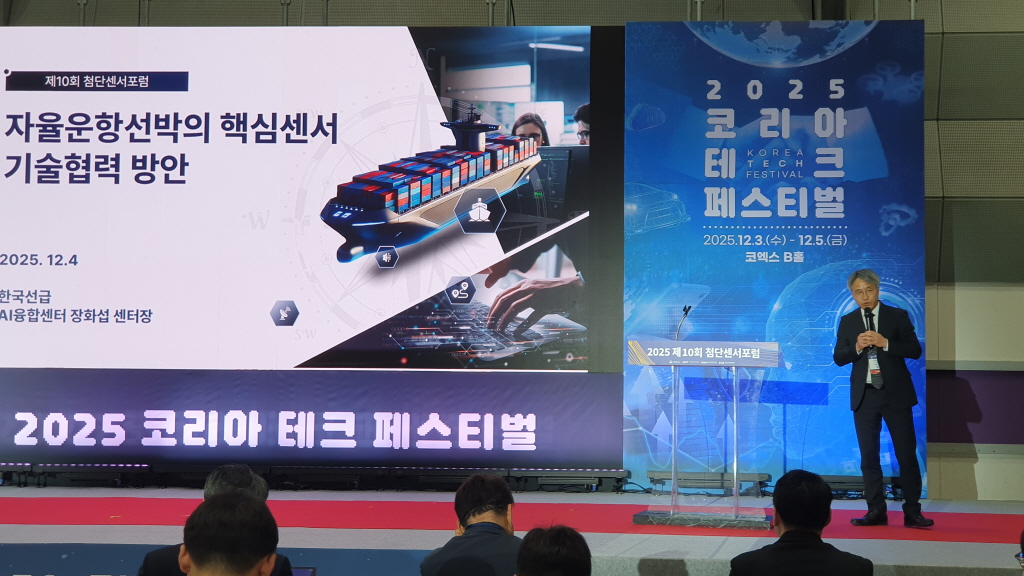
▲Jang Hwa-seop, head of the Korea Register of Shipping, is giving a presentation on the topic of technical cooperation plans for core centers for autonomous ships.
Autonomous ships generate 102TB of data per day, requiring data minimization.
"Sensor fusion technology, combining performance, economy, and durability, will become a key competitive edge in the era of autonomous ships."
At the '2025 10th Advanced Sensor Forum' held on December 4, Jang Hwa-seop, Director of the Korea Register of Shipping Center, gave a presentation on the topic of technical cooperation plans for core centers of autonomous ships.
Center Director Jang Hwa-seop emphasized the importance of sensor technology applied to ships, saying, “Ships are not just a means of transportation, but are like a nation.”
Director Jang first explained the special nature of the ship environment.
Unlike cars, ships must sail the sea for 15 to 50 days or more once they board, so the durability and stability of the sensors are of utmost importance, he said.
He said, “If a car’s rear detection sensor breaks down, you can just take it to a car repair shop, but a ship can’t be repaired in the vast ocean,” and cited long-term reliability of the sensor as a key issue.
He also pointed out that ship fuels are diversifying into LNG, ammonia, methanol, and hydrogen in accordance with the International Maritime Organization (IMO)'s carbon neutrality regulations.
These propulsion devices mustA sensor with explosion-proof certification is required.
“Sensors that have explosion-proof certification are five to seven times more expensive, but they cannot be installed on ships unless they pass insurance and international certification,” explained Director Jang.
The presentation also revealed a list of sensors that will actually be applied to ships.
The hull is equipped with fiber-optic-based FBG sensors, pressure sensors, and vibration sensors, while radar, lidar, CCTV, wind direction and anemometer, and depth sensors are essential for navigation.
Flow meters, current and voltage sensors, sound level meters, and vibration sensors are installed in the engine room.
In particular, the demand is so high that more than 40 vibration sensors are installed on just one engine.
Temperature and humidity sensors, ultrasonic sensors, and gas sensors are applied to cargo containers to ensure the safety of refrigerated cargo.
Director Jang also mentioned data processing issues.
Autonomous ships produce 102 terabytes of data per day.
On the other hand, in a satellite communication environment, only 10 to 20 gigabytes can be transmitted per day.
Accordingly, he emphasized the need for a method that minimizes data from the sensor itself and embeds an AI chip to transmit only the optimal results.
He also introduced the case of Google's self-driving car, Waymo, in the US.
Waymo vehicles are equipped with about 10 lidar sensors and 20 CCTV cameras to ensure stability.
Director Jang said, “While our country is trying to optimize by reducing the number of sensors, we need an approach that prioritizes commercialization by equipping various sensors.”
Finally, he said, “The business model of a single sensor is important, but convergence is also important. “There is a huge industrial demand for monitoring and solutions through this platform,” he said.

Comments
Related news

[Serial Project] Physical AI: Redefining the Future of Industry ①, "The Success of Physical AI Depends on the Design of Interactions Between Humans and Intelligent Machines."
While conventional AI has focused on inference and generation within digital data, Physical AI acts and responds directly in the real world through sensors, edge computing, robots, and control systems. The implementation of Physical AI can significantly advance industrial innovation and automation since AI directly acts and solves problems in the real world, interacting directly with the physical environment. Accordingly, global companies including NVIDIA, Tesla, and Google are making massive investments in Physical AI, and the related market is expected to grow explosively. To implement such Physical AI, perception technologies including sensors, edge computing and embedded systems for local computing to process real-time data, as well as robotics and control technologies are essential. In response, e4ds news has prepared a series of articles to examine core technologies and implementation strategies ranging from the concept of Physical AI to market outlook, related technologies, and practical cases.
2025.10.20by 배종인 기자
AI Has Started Learning on the Field? The Role of Industrial AI Being Transformed by ROHM
AI's center of gravity is shifting from the cloud to the edge. Japanese semiconductor company ROHM is leading this transformation by developing an "On-Device Learning MCU" that performs both learning and inference directly on the device itself without cloud dependency. It addresses the network latency, security risks, and installation cost issues that plagued traditional cloud-based AI, ushering in an era of autonomous AI where machines learn and make decisions independently. ROHM's MCU directly analyzes data generated from factory motors and sensors, learns normal operational states, and then detects anomalies to implement predictive maintenance. Unlike conventional pre-trained edge AI, it is distinguished by its ability to relearn and adapt to changes in the field. The core technologies are the lightweight neural network-based algorithm 'Solist-AI™' and the dedicated AI accelerator 'AxlCORE-ODL', enabling high-speed, low-power learning within the MCU. This combination reduces CPU load and theoretically achieves AI computations up to 1,000 times faster. This technology is being applied across various industrial environments including detecting subtle vibration anomalies in motors, predicting photoelectric sensor degradation, and identifying cracks based on acoustic emission. The differentiation points are that cloud pre-training is unnecessary, field relearning is possible, and it operates completely independently without network connectivity. ROHM's on-device AI goes beyond simply being a semiconductor—it accelerates the "intelligentization" of industrial equipment and establishes the foundation for manufacturing to transition to a Performance-as-a-Service model. An era where AI permeates into circuits? ROHM's tiny chip stands at the starting point of that revolution.
2025.11.05by 명세환 기자
[Serial Project] Physical AI: Redefining the Future of Industry ③, "Physical AI Sensors: A Key to Physical AI Competitiveness"
While conventional AI has focused on reasoning and generation within digital data, Physical AI directly acts and responds in the real world through sensors, edge computing, robots, and control systems. The implementation of Physical AI can greatly advance industrial innovation and automation since AI directly acts and solves problems in the real world, interacting directly with the physical environment. Accordingly, global companies including Nvidia, Tesla, and Google are making substantial investments in Physical AI, and the related market is expected to grow explosively. To implement such Physical AI, perception technologies including sensors, edge computing and embedded systems for local computation to process real-time data, as well as robotics and control technologies are essential. In response, e4ds news has prepared a series of planning articles to examine the core technologies and implementation strategies of Physical AI, ranging from its concepts to market prospects, related technologies, and practical cases. This edition covers sensors, which are the sensory organs of Physical AI.
2025.11.11by 명세환 기자
"In-cabin radar presents a new vehicle safety paradigm."
Texas Instruments (TI) held 'TI Embedded Labs 2025' on the 20th at The Westin Seoul Parnas. On that day, Park Sun-il, Senior Manager, who presented on the topic of 'Combining Radar and Sensor Fusion in Safety-Critical In-Cabin Applications,' stated that in-cabin radar technology mounted inside vehicles is expanding its scope beyond simply assisting drivers to detecting and protecting passengers inside the vehicle, thereby presenting a new safety paradigm.
2025.11.24by 명세환 기자
ST Accelerates Industrial Edge AI
Global semiconductor company STMicroelectronics (hereinafter ST) has launched a new 3-in-1 motion sensor ISM6HG256X targeting the industrial IoT and edge AI markets. This product is a unique MEMS-based inertial measurement unit (IMU) capable of simultaneously detecting low acceleration (±16g) and high acceleration (±256g), providing reliable monitoring even in harsh environments and advanced situational awareness for safety equipment.
2025.11.25by 배종인 기자











