


In the AI era, Korea is investing KRW 1.7 trillion in semiconductor R&D and KRW 700 trillion in infrastructure... A blueprint for becoming a global powerhouse.
 Published2025.12.11 08:27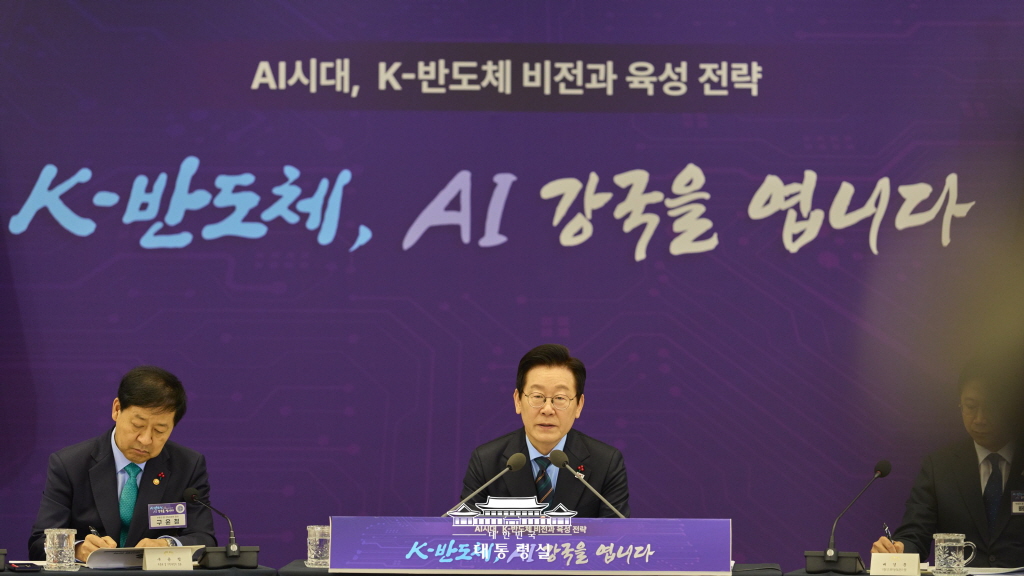
▲President Lee Jae-myung presides over a briefing session titled "K-Semiconductor Vision and Promotion Strategy in the AI Era." (Photo: Office of the President)
Establishment of "Sangsaeng Foundry" to provide dedicated supply and prototype support for fabless companies.
The government has unveiled a massive investment strategy to elevate Korea's semiconductor industry to a global top two position in line with the spread of AI. 1.7 trillion won will be invested in R&D alone, focusing on next-generation technologies, and more than 700 trillion won will be invested in production infrastructure.
On the 10th, the government held a briefing session titled “AI Era, K-Semiconductor Vision and Promotion Strategy Report” at the Presidential Office in Yongsan, with participation from relevant ministries, industry, and academia, and announced specific investment plans.
The government will invest a total of KRW 1.7042 trillion in R&D by 2030 to secure core semiconductor technologies.
215.9 billion won will be invested in next-generation memory by 2032, and 1.2676 trillion won will be invested in AI-specific semiconductors (NPU·PIM) by 2030.
260.1 billion won will be invested in compound semiconductors by 2031, and 360.6 billion won will be invested in advanced packaging by 2031.
The plan is to maintain the HBM super gap and lead future markets such as on-device AI semiconductors and advanced packaging.
More than 700 trillion won will be invested in the Yongin Semiconductor Cluster by 2047.
We will build 10 new fabs to create the world's largest production hub, and the government will take responsibility for core infrastructure such as power and water.
Additionally, the establishment of a 4.5 trillion won "Sangsaeng Foundry" will be considered to support the production of prototypes and supply of exclusive materials for domestic fabless companies. We will also strengthen the demand base by promoting a system for preferential purchasing of domestically produced semiconductors.
Defense semiconductors are currently launching a full-cycle technology development project to break away from their 99% dependence on imports.
The small and medium-sized business sector will focus on supporting key companies through the "Global No. 1 Project," and by 2027, the "Trinity Fab" will be completed to expand into a joint research base for small and medium-sized businesses.
Talent development is also in full swing.
Establishing Korea's first semiconductor graduate school, the university will train 300 master's and doctoral students annually and produce 1,400 design professionals over five years through the Arm School.
The semiconductor specialized graduate school and academy will also be gradually expanded by 2030.
To expand the semiconductor industry, currently concentrated in the metropolitan area, nationwide, a southern innovation belt connecting Gwangju, Busan, and Gumi will be established.
Gwangju will be developed into a cutting-edge packaging hub, Busan into a power semiconductor specialized complex, and Gumi into a materials and components center.
Each region will have a verification center and a testing and evaluation center, and local talent development will be strengthened through cooperation between industry, academia, and research institutes.
Experts participating in the discussion emphasized, “Although the demand for memory is rapidly increasing due to the development of AI, we must strengthen the competitiveness of system semiconductors and small parts and equipment to respond to the pursuit of competitors such as China.”
Manufacturing companies such as Samsung Electronics and SK Hynix announced that they would push ahead with cluster investment without a hitch, saying, “The launch of the National Growth Fund and the improvement of the system will be a great help in activating investment.”
Minister of Trade, Industry and Energy Kim Jeong-gwan said, “Since the fate of the industry depends on securing leadership in semiconductors, it is time to pursue extraordinary policies,” adding, “We must maintain the world’s leading position and address the shortage of system semiconductors.”He emphasized, “We will increase the national capacity tenfold and concentrate all national capabilities.”
Comments
Related news
.jpg)
[China Briefing] Global Semiconductor Investment Reaches Record High...2021 Projected at $150 Billion
e4ds News—China-region ICT News Roundup, Thursday, September 30, 2021 [China Briefing]
2021.10.01by 이춘영 외신
The new government's semiconductor investment and talent development efforts
China's semiconductor rise, U.S. President Biden holding a semiconductor wafer, and TSMC with the world's largest foundry market share—these three have a common point. That is, they all fall within the category of comprehensive government support for semiconductor industry development.
2022.04.28by 명세환 기자
South Korea's fab equipment sales are projected to reach $25.5 billion in 2022.
Amid unprecedented semiconductor investment flows, South Korea's semiconductor fab equipment sales are projected to reach $25.5 billion in 2022, representing a 7% increase year-over-year.
2022.06.15by 배종인 기자
2023 Mechanical Industry 'Contraction'
The machinery industry in 2023 is predicted to show a slightly contracted market situation compared to the previous year due to worsening domestic and external conditions, including decreased semiconductor investments and economic slowdown.
2023.02.27by 배종인 기자
Will the semiconductor investment tax cut really work? The industry is watching closely for passage.
National capacity is being concentrated on fostering the semiconductor industry. With the government's vision being disclosed alongside private investment in system semiconductor development plans, the industry is closely monitoring the passage of amendments to semiconductor facility investment tax credits, referred to as the "K-Chips Act."
2023.03.17by 명세환 기자











