


AMD Targets Industrial Fields with Ultra-Low-Power Edge Performance
 Published2025.12.12 08:48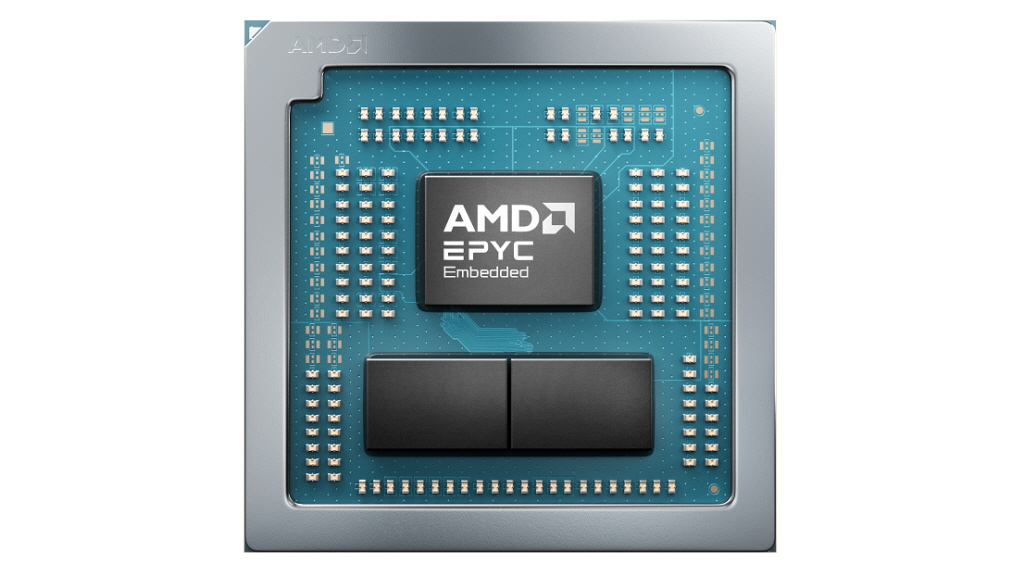
In the era of AI and cloud, the demands on industrial infrastructure are becoming increasingly demanding. High-density compute performance, power efficiency, and long-term stability are simultaneously required across diverse fields, including network switches and routers, data processing unit (DPU) control, cold cloud storage, aerospace, and robotics. AMD is targeting the next-generation embedded infrastructure market with ultra-low-power edge.
AMD announced on the 10th that it has launched the EPYC Embedded 2005 series processor.
The new product is a 40mm x 40mm BGA package, boasting a size that is 2.4 times smaller than the comparable Intel Xeon 6500P-B.
This allows designers to achieve higher I/O density and shorter electrical paths, simultaneously improving signal integrity and heat management.
It is equipped with up to 16 x86 cores and 64MB L3 cache, and can precisely adjust the TDP range from 45W to 75W to respond to various power and thermal environments.
In particular, compared to the Xeon 6503P-B, it achieves a 35% increase in base CPU frequency and a 28% increase in boost frequency with half the power, achieving both performance density and cost efficiency.
EPYC Embedded 2005 comes with up to 10 years of field operation warranty and 15 years of software maintenance. It provides long-term investment stability.
Additionally, RAS (Reliability, Availability, and Serviceability) features detect and correct errors in advance to minimize downtime.
It also includes BMC support, PCIe hotplug, and multi-SPI ROM capabilities for networking and storage environments.
On the security front, AMD Infinity Guard is key. AMD Secure Processor, Platform Secure Boot, and Memory Guard enhance data integrity and system reliability, providing peace of mind even in mission-critical environments.
The new product provides 28 PCIe Gen5 lanes to support high-speed NIC, FPGA, and network ASIC integration.
It also provides higher bandwidth with DDR5 memory and provides a smooth transition path for DDR4 as it nears its end of life.
Developers can leverage a rich open source ecosystem, including Yocto, kernel drivers, and EDK II, to simplify integration and accelerate time to market.

Comments
Related news
AMD Launches 'Radeon AI PRO R9700' GPU for AI Workstations… $1,299, Sales Begin October 27
AMD officially launches the high-performance workstation GPU 'AMD Radeon™ AI PRO R9700' optimized for AI workloads, enabling AI developers and creators to maximize GPU performance while maintaining their existing workflows.
2025.10.27by 명세환 기자
.jpg)
AMD Accelerates Open AI Stack to Strengthen US AI Leadership
AMD is supplying its high-performance computing technology to next-generation supercomputers 'Lux' and 'Discovery' in collaboration with the U.S. Department of Energy (DOE) and Oak Ridge National Laboratory (ORNL).
2025.10.29by 배종인 기자
AMD and StradVision Present Future Vision of Autonomous Driving at CES 2026
AMD and autonomous driving perception software specialist STRADVISION will showcase MultiVision Perception software based on the AMD Versal™ AI Edge Gen 2 VEK385 platform at CES 2026.
2025.11.13by 명세환 기자
Supermicro Announces Air-Cooled AI Server with AMD MI355X GPUs
Supermicro has announced a 10U air-cooled server equipped with AMD's latest Instinct MI355X GPU. The product delivers 288GB of HBM3e memory per GPU and 8TB/s bandwidth, achieving up to 4x improvement in AI compute performance and up to 35x improvement in inference performance compared to the previous generation. With a scalable architecture compatible with both air-cooled and liquid-cooled infrastructure, it is optimized for large-scale AI/HPC workloads in cloud and enterprise environments.
2025.11.24by 명세환 기자
.jpg)
AMD, Cisco, and Humain Establish World-Class AI Infrastructure Joint Venture
AMD, Cisco, and Huemain are establishing a joint venture to build world-class AI infrastructure. They plan to combine the Instinct MI450 GPU with state-of-the-art data centers and core infrastructure solutions to provide scalable AI solutions to global customers.
2025.11.24by 명세환 기자











