



ETRI overcomes the "memory barrier" for large-scale AI learning.
 Published2026.01.08 13:25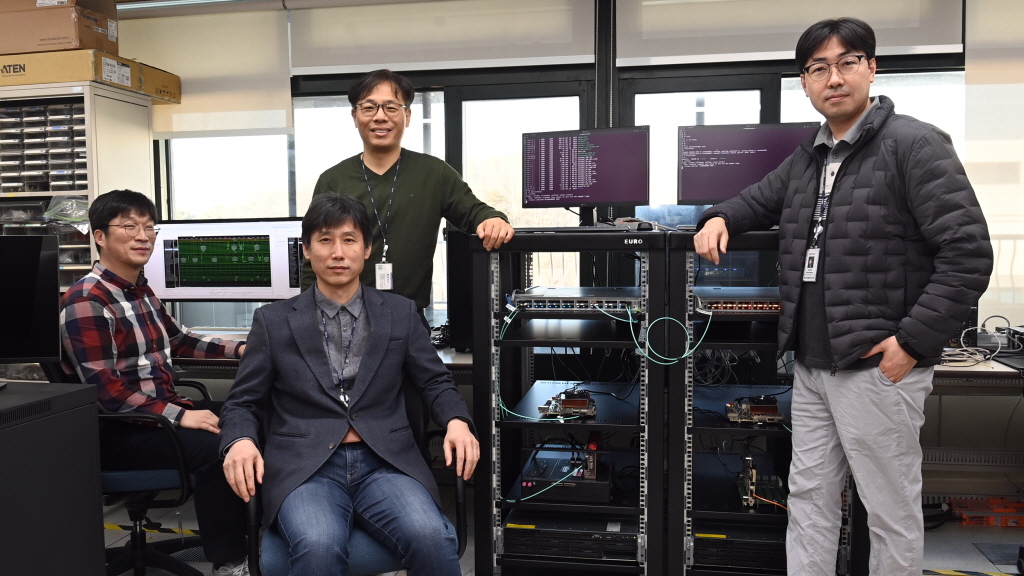
▲ETRI researchers who developed OmniExtend technology (from left: Dr. Seungjun Cha, Director Kangho Kim, Dr. Seok Seongwoo, and Director Gwangwon Ko)
The Electronics and Telecommunications Research Institute (ETRI) has developed a technology that fundamentally solves the GPU memory shortage problem, which has been considered the biggest challenge in the process of large-scale artificial intelligence (AI) learning.
ETRI announced on the 8th that it has developed a new memory technology, 'OmniXtend', that solves the memory limitations and data bottlenecks of GPUs, which are considered the biggest problems in large-scale AI learning.
OmniExtend, developed by ETRI, is a technology that utilizes standard Ethernet to configure the memory of multiple devices into a shared memory pool.
This allows for flexible expansion of the memory required for AI learning as needed, and allows for the creation of large-scale memory environments without replacing existing equipment.
ETRI announced that in an experiment applying OmniExtend, the LLM inference environment that had performance degradation due to memory shortage recovered performance by up to two times.
This means that processing performance similar to that of existing systems with sufficient memory can be achieved.
In addition, the existing PCIe-based expansion structure had limitations in the connection distance and expandability between devices, but OmniExtend is an Ethernet switch.It provides a highly scalable structure that can combine physically separated devices into a single memory pool.
This is why it is evaluated as an infrastructure suitable for ultra-large-scale AI data centers.
The ETRI research team developed key element technologies such as △FPGA-based memory expansion node and △Ethernet-based memory transfer engine and verified the stable operation of the system.
In a real demonstration, multiple devices successfully accessed each other's memory in real time over a network.
Additionally, OmniXtend received international attention when it was unveiled consecutively at the RISC-V Summit Europe and North America events held in Paris, France and Santa Clara, USA last year.
ETRI leads the interconnect working group of the CHIPS Alliance under the Linux Foundation and is also contributing to the standardization of open source-based memory expansion.
ETRI plans to promote technology transfer to data center hardware and software companies in the future and begin commercialization in earnest.
In particular, the goal is to create tangible industrial results in the next-generation AI infrastructure market by applying it to various equipment such as AI learning and inference servers, memory expansion devices, and network switches.
In addition, we plan to expand the technology to large-capacity memory networks for high-reliability embedded systems such as vehicles and ships, and pursue follow-up research to enhance the memory sharing structure between heterogeneous accelerators such as NPUs, GPUs, and CPUs.
ETRI's Kim Kang-ho, head of the High-Performance Computing Research Center, said, "We will expand research on NPU-centered memory interconnect technology and strengthen international cooperation so that it can be applied to the next-generation systems of global AI and semiconductor companies."
This study was conducted by the Ministry of Science and ICT and the Institute of Information and Communications Technology Planning and Evaluation (IITP). This work was supported by the project titled ‘Research on Memory-Centric Next-Generation Computing System Architecture.’

Comments
Related news
ETRI Successfully Demonstrates World's First 100m Underground Wireless Communication
ETRI has successfully achieved voice communication at a depth of 100 meters underground using magnetic fields for the first time in the world. The technology is expected to be applied in various fields including mine accident rescue operations, underground utility management, and military operations in the future.
2025.11.13by 명세환 기자
Urgent national strategy to overcome dependence on foreign AI and software core technologies.
Global tech giants are fully mobilizing to develop 'AI robot brains' in competition for future industrial dominance, and the Electronics and Telecommunications Research Institute (ETRI) held an AI Robot Strategic Project technology and policy forum at El Tower in Yangjaе, Seoul on the 21st, responding to the major transformation where the center of value in the robotics industry is rapidly shifting from precise hardware (body) to AI-based software (brain).
2025.11.21by 배종인 기자
ETRI Unveils Nine Cutting-Edge Technologies at the 2025 AIoT International Exhibition
ETRI will unveil 9 core AIoT technologies at the '2025 AIoT International Exhibition'. The technologies are comprised of 6 in the industrial and lifestyle sectors (carbon and energy, agriculture and livestock, healthcare, and transportation) and 3 in the future infrastructure sector (IoT networks, edge AIoT platform, and embedded behavioral intelligence).
2025.11.26by 명세환 기자
ETRI is on the verge of becoming the 100th research institute startup.
The Electronics and Telecommunications Research Institute (ETRI) is poised on the brink of surpassing 100 spin-off companies from its researchers, establishing itself as a central hub of the technology startup ecosystem. On the 17th, ETRI held the '2025 ETRI Researcher Spin-off Company Family Day' at the ICC Hotel in Daejeon, reaffirming its status as the government-funded research institution that has produced the most spin-off companies.
2025.11.28by 배종인 기자
.jpg)
ETRI unveils AI safety research results, discusses international cooperation trends and domestic applications
The Electronics and Telecommunications Research Institute (ETRI) AI Safety Research Institute (AISI) presented research outcomes from the past year at the AI Safety Consortium's final meeting held in Pangyo, discussed major trends in the international AI safety network and domestic implementation strategies, and explored future directions for expanding the AI safety ecosystem.
2025.12.17by 명세환 기자











