



T Map Mobility Accelerates AI Mobility Innovation Through Data Democratization
 Published2026.01.09 10:54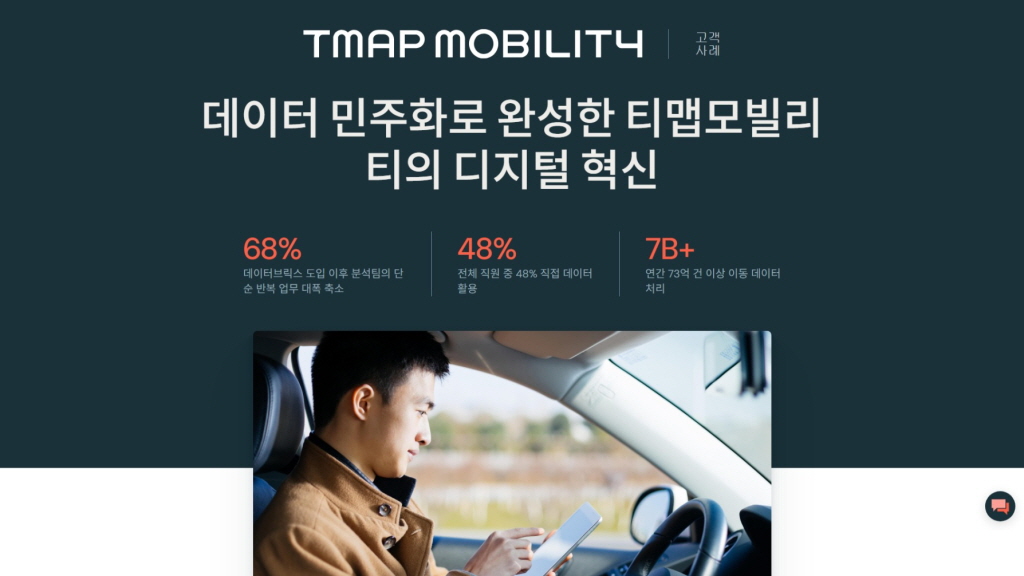
T Map Mobility, Korea's leading mobility platform company, is expected to strengthen its service competitiveness by accelerating AI mobility innovation through data democratization.
According to the latest case study reference from Databricks, T Map Mobility is in full swing with its digital transformation by building an integrated data environment based on Databricks.
T Map Mobility, a company that processes over 7.3 billion pieces of mobile data annually, is pursuing "data democratization," which simultaneously strengthens data accessibility and governance, as its core strategy.
T Map started out as the world's first mobile navigation service 20 years ago and has grown into a platform used by over 95% of domestic vehicles.
On the other hand, the existing data environment had limitations in efficiently managing large-scale data.
Because it was difficult for general staff to directly explore the data, the analytics team was repeatedly bombarded with requests for simple extraction, which led to excessive workload for analysts and delays in service expansion.
To solve this problem, T Map Mobility introduced the Databricks platform.
In particular, by utilizing 'Genie Space', a natural language-based data exploration tool, we have created an environment where even non-expert personnel can directly search and analyze data..
Through this, various departments, including planning and marketing, were able to independently utilize data to derive insights, and a culture of data utilization spread significantly throughout the organization.
There have also been significant changes in terms of data governance.
T Map introduced Databricks' 'Unity Catalog' to establish a detailed permission management and data ownership system.
Columns containing personal information are automatically masked, and access history tracking is also enabled, enhancing data security and transparency.
Another major change is that each department can now flexibly set the permissions they need without the intervention of the data engineering team.
These innovations are leading to real results.
As of September 2025, simple data extraction requests received by the analytics team have decreased by 68% compared to the previous period.
Data accessibility has been dramatically improved, with approximately 48% of all employees now able to explore and utilize data directly.
Analysts are freed from repetitive tasks and can focus on advanced analysis and modeling, which in turn enhances service competitiveness.
T Map Mobility plans to continue expanding its data hub centered around Databricks.
We plan to improve data migration efficiency through AWS Glue Federation and External Table integration, and integrate all in-house data into Databricks to drive more sophisticated data governance and AI-based analysis.
A T Map data platform manager emphasized, "Databricks, with its scalability and flexibility, is the core infrastructure supporting T Map's AI mobility service."

Comments
Related news

Databricks Appoints Kang Hyung-jun as CEO and Branch Manager of Databricks Korea
Databricks has newly appointed Kang Hyung-jun as CEO and Branch Manager of Databricks Korea and Um Kyung-soon as Vice President of Technology at Databricks Korea.
2024.07.15by 배종인 기자
Databricks Completes $15 Billion Funding
Global data and AI company Databricks has completed a funding round totaling $15 billion.
2025.01.23by 명세환 기자
Databricks accelerates AI agent development by integrating Cloud models
Databricks, a leading company in the data and AI industry, has established a strategic partnership with Anthropic, which leads in AI safety and research, and is accelerating AI agent development by integrating Claude, Anthropic's powerful AI model.
2025.03.27by 배종인 기자

Databricks, Korean Market Grows More Than 100% Annually
Databricks, a global leader in data and AI technology, has achieved over 100% annual growth rate in the Korean market due to increased demand for data intelligence. This result stems from enterprises' growing utilization of data intelligence, with Databricks securing major companies including Korean Air, BC Card, Lina Life, and AIA Life as new customers.
2025.04.30by 배종인 기자
Databricks Launches Major 'Unity Catalog' Update with Full Support for Iceberg and Delta Lake
Databricks, a leader in data and AI, has announced an enhanced version of its 'Unity Catalog' feature. With this update, the catalog now natively supports the Apache Iceberg REST Catalog API, enabling Iceberg tables to be read and written not only in Databricks but also in external engines such as Trino, Snowflake, and Amazon EMR.
2025.06.23by 배종인 기자











