


The combination of simulation and AI is a key driver of accelerating innovation in industrial settings.
 Published2026.01.23 08:30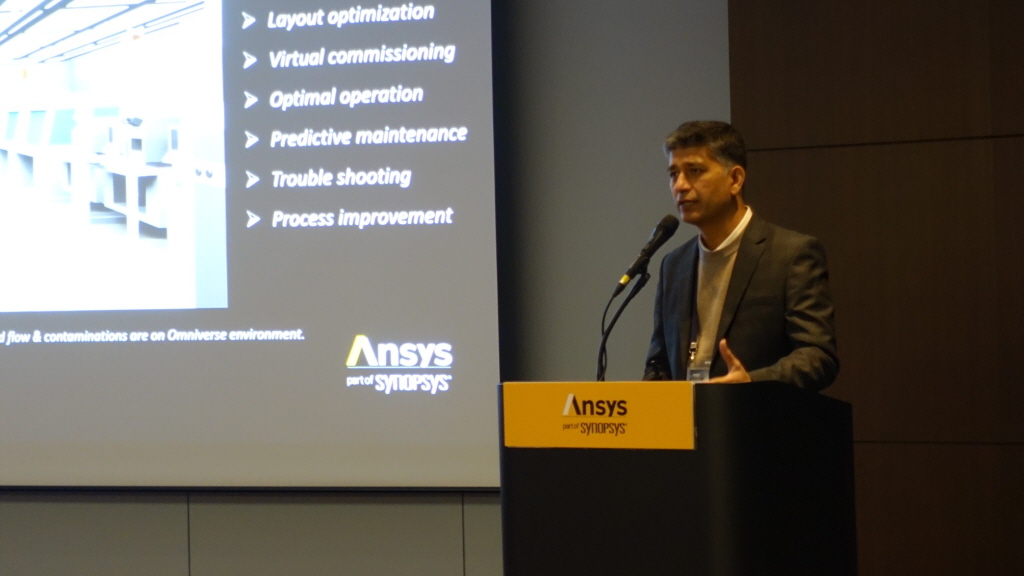
The combination of simulation and AI is a key driver of accelerating innovation in industrial settings.
Global engineering simulation company ANSYS Korea held an 'Industry-tailored Simulation AI Solution Seminar' at COEX in Seoul on the 22nd and shared strategies for utilizing simulation-based AI.
This event, held under the theme of "Engineering Transformed by AI from Design to Operation," attracted a great deal of interest, with approximately 190 engineers and practitioners from various industries, including manufacturing, automobiles, and electronics, in attendance.
The seminar began with opening remarks by Padmesh Mandloy, Vice President of Customer Support at Ansys Asia.
He emphasized that AI technology is expanding the role of engineering simulation and accelerating the pace of innovation across industries.
A total of six presentation sessions were held, broadly introducing AI-based simulation application strategies required in industrial settings.
In his first presentation, Kang Tae-shin, Managing Director of ANSYS Korea, highlighted the challenges facing the manufacturing industry in the era of digital transformation and emphasized the need for an end-to-end simulation platform that encompasses the entire process from design to manufacturing.
He explained that a simulation-based approach can simultaneously enhance product development speed and quality competitiveness.
Lee Min-wook ANSYS Korea Pro introduced a design optimization and robustness evaluation workflow utilizing optiSLang's MOP and FMOP technologies.
It also presented the practical applicability of improving design efficiency by utilizing the latest simulation-based AI techniques.
Next, Pro Taejin Kim presented a case study on data mining automation and meta model construction automation using PyAnsys.
He specifically explained the role that simulation can play in the generation and preprocessing of AI learning data, and proposed a strategy for utilizing it in industrial environments that require large-scale data acquisition.
In a session held after the break, Onstream CEO Youngtaek Lim presented a plan to build a physics-based AI model.
He emphasized the importance of generating virtual learning data through simulation and integrating real data, and proposed simulation-based AI as an alternative to address the practical difficulties of securing data encountered in manufacturing sites.
Yang Kyung-mo, a professional at ANSYS Korea, introduced a strategy for implementing near-real-time digital twins using reduced-order models (ROMs) and hybrid analytics.
He predicted that digital twin technology, which supports predictive design and rapid decision-making, will become a key competitive edge in the future engineering field.
In the final presentation, Lee Jeong-won, manager at ANSYS Korea, shared a case study of building a 4D flow MRI-based hemodynamic prediction model using SimAI. This case, which combined medical imaging data with simulation analysis, was recognized as demonstrating the potential of AI and simulation convergence in the medical field.
“ANSYS Korea will strengthen its technical support to help customers realize innovation across the entire cycle from design to operation,” said Padmesh Mandloy, Vice President.

Comments
Related news
Ansys, Synopsys, Samsung Electronics Foundry Productivity Improvement
Ansys has launched a new reference flow for radio frequency integrated circuit (RFIC) design developed in collaboration with Sihelix for Samsung Electronics' Foundry Business Division to support the 14LPU process technology.
2023.10.16by 배종인 기자
Ansys Supplies 'Thermal and Power Integrity Solution' to Samsung Foundry
Ansys Korea, a global leader in engineering simulation software (CEO Moon Seok-hwan), is closely collaborating on power and thermal management for advanced parallel (2.5D) and three-dimensional integrated circuit (3D-IC) systems, contributing to improved performance and reliability of Samsung Foundry products.
2023.10.23by 배종인 기자
Ansys' Raptor X to Use Samsung's 8nm Design
Ansys Korea (CEO Moon Seok-hwan) announced that Samsung Electronics' Foundry Division has certified 'RaptorX', Ansys's on-chip electromagnetic (EM) design solution for ultra-high-speed product analysis, manufactured using the 8nm (nanometer) LN08LPP Low Power Plus silicon process.
2023.12.07by 배종인 기자
Ansys Korea and Samsung SDS join hands in defense and defense cloud
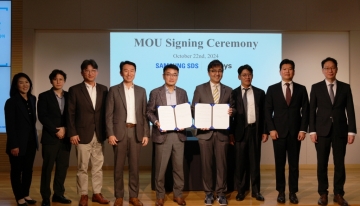
Ansys Korea (CEO Park Joo-il), a global leader in engineering simulation, and Samsung SDS (CEO Hwang Sung-woo) have joined hands in the defense and national security cloud business, with Ansys Korea providing and offering technical support for Ansys CAE solutions on the Samsung SDS cloud platform.
2024.10.23by 배종인 기자
.jpg)
Ansys, Intel 18A Process Power and Electromagnetic Integrity Certification
Global simulation company Ansys has obtained certification for thermal and multi-physics verification tools required for semiconductor design utilizing Intel 18A (1.8nm) process technology.
2025.05.09by 배종인 기자











