



Robotic arms don't tremble when suddenly lifting heavy loads.
 Published2026.01.26 08:40
▲Professor Kang Sang-hoon (left) and Researcher Son Jeong-woo (first author)
A next-generation robotic arm control technology that moves without shaking even when suddenly lifting heavy loads or receiving external shocks in industrial settings has been developed by domestic researchers. Interest in the industry is growing because this technology can be applied simply by updating software without changing the hardware of existing robotic arms.
A research team led by Professor Sang-Hoon Kang of the Department of Mechanical Engineering at UNIST announced on the 26th that they have developed a new 'adaptive PID control algorithm' that helps robotic arms operate stably even in situations of rapid load changes or unexpected external contact.
This technology significantly improves the performance of PID controllers, which are installed in more than 90% of industrial robots, and can be applied to various fields such as smart factories, rehabilitation robots, and humanoid robots.
The PID controller acts as a kind of 'motor nerve' that calculates the movements of the robot arm in real time and transmits them to the motor.
Although it has become the standard control method for industrial robot arms due to its simple structure and high reliability, it has the limitation of being overly dependent on initial settings.
There were frequent problems with vibration or deviation from the target position when the weight of the object suddenly changed or it came into contact with an external object.
The new adaptive PID algorithm developed by the research team is designed to give the robot the ability to analyze error information on its own and adjust control values in real time.
In particular, it solved the problem that existing adaptive control technology overreacts to minute noise (quantization error) of the sensor, making the system unstable.
The research team introduced a structure that offsets noise generated from digital sensors, thereby securing stable control performance without unnecessary force increase.
The biggest advantage of this technology is that it can be applied without additional sensors or complex physical information input.
There is no need to input detailed information such as the robot's mass and friction in advance, and there is no need to install expensive weight detection sensors.>
“If the robot is already equipped with a PID controller, it can be applied immediately with just a software update,” the research team explained.
The research team conducted various experiments using a two-joint robot arm.
The algorithm's performance was verified by creating a complex environment by making the robot arm lift a load equivalent to its own weight or connecting a spring with strong elasticity.
As a result, the robot arm with the new algorithm adjusted its control values according to environmental changes and accurately followed the target trajectory without shaking.
On the other hand, the existing PID method showed unstable behavior, such as large position errors or vibrations.
Professor Kang Sang-hoon emphasized, “This technology is a method that can dramatically improve the performance of PID controllers, which account for the majority of industrial robots,” and “It will be utilized in various fields, such as smart factories where the work environment changes frequently, as well as rehabilitation robots and humanoid robots that must detect even the slightest changes in human strength.”
The results of this research were published on January 13 in the IEEE/ASME Transactions on Mechatronics (TMECH), which is ranked among the top 4.1% journals in the field of mechanical and robotics engineering.
This research was supported by the National Research Foundation of Korea's Future Promising Convergence Technology Pioneer Project and the National Rehabilitation Institute's Rehabilitation Robot Intermediate Research Service.

Comments
Related news
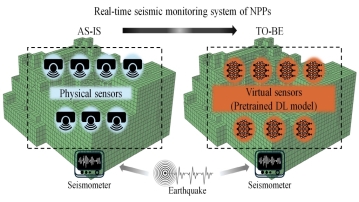
UNIST and Pyo Research Institute Use AI to Predict Nuclear Power Plant Earthquakes
UNIST (Ulsan National Institute of Science and Technology) and KRISS (Korea Research Institute of Standards and Science) have jointly developed an AI-based virtual sensor technology that implements a model capable of predicting seismic damage at 139 points within a nuclear power plant using only a single sensor. Real-time monitoring is now possible without establishing a conventional sensor network, which is expected to significantly improve inspection efficiency and safety.
2025.10.01by 명세환 기자
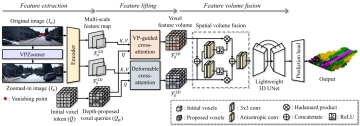
UNIST enhances autonomous driving with camera-based vanishing point technology.
A research team at UNIST's Graduate School of Artificial Intelligence has developed an AI model called 'VPOcc' that applies the Renaissance painters' concept of 'vanishing points' to artificial intelligence, compensating for perspective distortion in camera images. This research was conducted with support from the Ministry of Science and ICT and the National Research Foundation of Korea, and the results have been accepted for presentation at IROS 2025, an international conference in the field of intelligent robotics.
2025.10.15by 명세환 기자

UNIST: AI Improves Wireless Image Transmission Efficiency by 45 Times
A research team led by Professor Yun Sung-hwan from the Graduate School of Artificial Intelligence at Ulsan National Institute of Science and Technology (UNIST) has developed AI technology that dramatically improves the efficiency of wireless image transmission. The 'Task-Adaptive Semantic Communication' technology developed by the research team differs from the conventional method of compressing and transmitting entire images, instead selectively transmitting only the semantic information essential for task execution.
2025.11.06by 배종인 기자
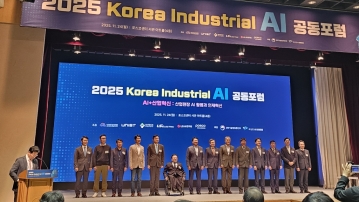
UNIST Accelerates Industrial AI Transition
UNIST (President Park Jong-rae) held the '2025 Korea Industrial AI Joint Forum' on the 24th at the POSCO Center in Seoul together with six industry-academia-research institutions, sharing AI utilization outcomes in manufacturing fields and corporate talent innovation cases.
2025.11.25by 배종인 기자

AI that feels like it's learned everything after learning only 1/25th of what it needs to learn.
A research team led by Professor Shim Jae-young at UNIST's Graduate School of Artificial Intelligence has developed dataset distillation technology that can maximize the learning efficiency of 3D artificial intelligence (AI) models, which are critical to advanced industries such as autonomous vehicles and robotics.
2025.12.01by 배종인 기자











