


Special Act on Semiconductors Passes National Assembly… Institutional Foundation Laid for K-Semiconductor Leap Forward
 Published2026.01.30 10:57
Government and local government support for the construction of industrial infrastructure such as electricity and water, and simplification of various licensing and permit procedures
An institutional foundation has been established for a new leap forward in Korea's semiconductor industry.
The 'Special Act on Strengthening and Supporting the Competitiveness of the Semiconductor Industry,' aimed at systematically strengthening the competitiveness of the semiconductor industry, a national strategic industry, passed the plenary session of the National Assembly on the 29th.
Amid intensifying global competition for technological supremacy, both the industry and the government regard this as a significant turning point, given that a legal foundation has been established to comprehensively support the entire semiconductor industry.
The core of this Special Act on Semiconductors is to comprehensively support the entire supply chain, ranging from memory and system semiconductors to design, manufacturing, packaging, materials, components, and equipment.
Semiconductor support policies, which were previously scattered across individual projects and budgets, have been consolidated into a single system to enable continuous implementation under a mid-to-long-term strategy.
Under the bill, a 'Special Committee on Strengthening the Competitiveness of the Semiconductor Industry' under the President will be established, and a 'Basic Plan for Strengthening the Competitiveness of the Semiconductor Industry' will be formulated on a five-year basis.
Also, semiconductors with a 10-year term Stable financial support becomes possible through the special account.
This is expected to enhance policy consistency and execution capabilities, and enable a more rapid response to the rapidly changing global market environment.
The designation of a semiconductor cluster considering balanced regional development is also a key point.
The government and local governments plan to reduce the burden on corporate investment by supporting the construction costs of industrial infrastructure within the cluster, such as electricity, water, wastewater, and roads, and by simplifying various licensing and permit procedures.
There are also predictions that this will serve as an opportunity to expand the semiconductor industry ecosystem, which has been concentrated in the metropolitan area, to the entire country.
In addition, the law includes grounds for various support measures to underpin corporate activities, such as technology development and the establishment of demonstration centers, fostering the ecosystem for materials, parts, equipment, foundries, and system semiconductors, training specialized personnel and attracting overseas talent, and special provisions regarding regulations and licensing.
In particular, it is expected to play a role in promoting investment and research and development by domestic companies in the competition for next-generation technologies centered on AI semiconductors.
Minister of Trade, Industry and Energy Kim Jeong-kwan stated, “Semiconductors are our country’s largest export industry and a strategic asset that determines national and economic security in the AI era,” adding, “With the enactment of the special act, we will maintain and strengthen the super-gap of K-semiconductors and secure leadership in global competition.”
The industrial sector also welcomes the passage of the bill.
In a welcoming statement, the Korea Semiconductor Industry Association (KSIA) stated, “The Special Act on Semiconductors is a starting point for elevating semiconductor competitiveness to the next level in the AI era,” adding, “We look forward to its swift implementation in the industry leading to tangible results.” The association also conveyed its intention to cooperate closely with the government and actively participate in the implementation process of the law.
Lee Sang-ho, Head of the Economic and Industrial Division at the Korea Economic Association, also assessed that “this special act serves as an institutional foundation to propel the growth engine of the domestic semiconductor industry to the next level,” adding that “government financial and infrastructure support will become a key driving force in promoting large-scale corporate investment amidst the global competition for technological supremacy.” Furthermore, he called for policy consistency and continuous institutional backing.
The Special Act on Semiconductors is scheduled to be promulgated after being passed by the government and approved by the Cabinet, and will be implemented as early as the third quarter of this year.

Comments
Related news

Special Measures Act to Strengthen Competitiveness of Materials, Parts, and Equipment to Take Effect on the 1st of Next Month
The Special Measures Act for Strengthening Competitiveness in the Materials, Parts, and Equipment Industry will be comprehensively reorganized for the first time in approximately 20 years since its last amendment and will take effect on April 1st. The Ministry of Industry plans to convert the special law, which was scheduled to sunset in 2021, into a permanent law and will promote the establishment of inter-company cooperation models and rent reduction for resident companies to strengthen industry-oriented competitiveness.
2020.03.24by 최인영 기자
The Korea Semiconductor Association (KSA) requests the enactment of a special law to foster the semiconductor industry.
The Korea Semiconductor Industry Association has requested the enactment of a "Special Act for Semiconductor Industry Development" to provide effective support to the semiconductor industry, and stated that support is needed including tax credits of up to 50% of semiconductor manufacturing facility investment costs, as well as support for facility construction, research and development, financial assistance, and talent development.
2021.04.13by 배종인 기자
Confidentiality and job transfer restrictions for advanced technology personnel
Legal grounds for confidentiality agreements and non-compete restrictions on advanced technology personnel have been established, and special legislation has been enacted to foster and protect national advanced strategic industries, including expedited licensing and support for specialized cluster development costs.
2022.01.13by 강정규 기자
Yongin Semiconductor Industrial Complex to Invest 181 Trillion Won in Exports, Including Exemption from Pre-Federal Taxation
The government is allocating 181 trillion won to trade and export support, including initiatives to exempt public institutions from preliminary feasibility studies for the Yongin semiconductor industrial complex in the second half of the year to foster domestic exports.
2023.09.04by 배종인 기자
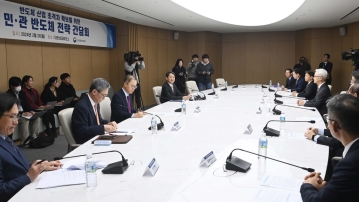
Breakthrough in the Semiconductor War as Government and Companies Unite
The Ministry of Industry, Trade and Resources (Minister Ahn Deok-geun) discussed countermeasures with semiconductor industry leaders to proactively respond to intensifying changes in external conditions affecting the semiconductor sector. At this meeting, the government discussed rapid implementation of the power supply plan for the Yongin Industrial Complex and measures to expand additional investment incentives.
2024.02.27by 배종인 기자











