



Intelligent data infrastructure is a platform that connects data to AI performance in real time.
 Published2026.02.03 11:10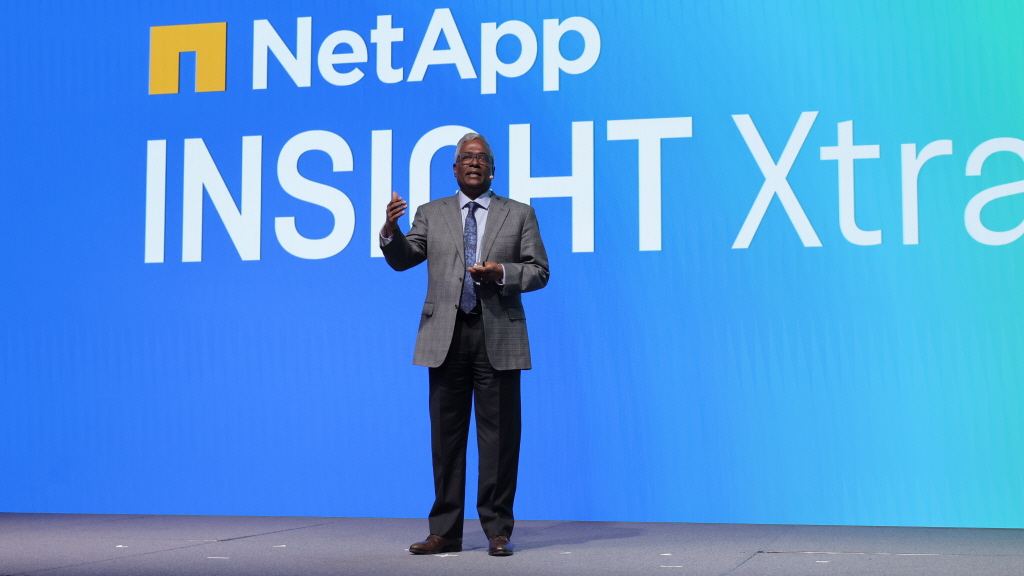
▲ George Kurian, NetApp CEO
'NetApp AFX' Expands to 128 Nodes and 1 EB Based on 3rd Generation Distributed Architecture
How a company integrates, protects, and intelligently utilizes its vast data determines its AI competitiveness.
NetApp held the 'NetApp INSIGHT Xtra' event at the Westin Seoul Parnas on the 3rd and shared data strategies for success in the AI era.
George Kurian, CEO of NetApp, who delivered the keynote speech on this day, stated, “The success or failure of AI is determined by data infrastructure, not models,” and announced a technology roadmap centered on the ‘NetApp Data Platform’ based on a distributed architecture.
CEO Kurian pointed out that existing centralized data lake and warehouse models are not suitable for AI environments where unstructured data and high-frequency data changes are common.
He stated, “The data required for AI learning and inference consists mostly of unstructured data such as files, objects, and multimedia, and methods of replicating and concentrating this data have clear limitations in terms of scalability and cost.” said.
The core of NetApp Data Platform is 'Active Metadata Fabric'.
This is a structure that collects and synchronizes metadata in real time at the locations where data is generated and stored, and integrates it into a global namespace.
It is designed to enable data search, classification, access control, and lineage tracking without data movement.
This metadata engine is integrated into ONTAP and automatically updates metadata when data changes.
In particular, it dynamically generates metadata for schema-less unstructured data to automate the configuration and vectorization of datasets for AI training.
NetApp explained that this can significantly reduce data preparation time in Retrieval-Augmented Generation (RAG) and agentic AI environments.
In the storage tier, they unveiled the next-generation all-flash system 'NetApp AFX'.
AFX is based on a third-generation disaggregated architecture and can be configured for up to 128 nodes and scaled up to 1 exabyte in a single cluster.
It is characterized by providing parallel file system-level performance while maintaining enterprise-grade data management features such as snapshots, replication, security, and governance.
NetApp emphasized that while existing parallel file systems sacrificed data management capabilities to secure performance, AFX simultaneously provides the massive parallel processing performance required for ONTAP-based data services and AI workloads.
This explains that AI training, inference, and data preprocessing workloads can be operated on a single storage platform.
NetApp also introduced the 'AI Data Engine' for automating AI data pipelines.
This engine includes data change detection, deduplication, vector data generation, access control, and sensitive information masking functions.
In particular, it can track which data was used to train which models, supporting regulatory compliance and the implementation of 'Responsible AI'.
The metadata engine is already in General Availability (GA), while data transformation and guardrail features are available to select customers in a private preview.
NetApp supports FlexCache and SnapMirror across AWS, Microsoft Azure, and Google Cloud, and has implemented a global data namespace spanning on-premises and the cloud.
All replicated volumes are read- and write-enabled, providing the same data accessibility regardless of the data location.
In terms of security, autonomous ransomware response services and data leakage detection capabilities have been enhanced.
It is designed to simultaneously detect data tampering and external leakage attempts at the storage level, and to enable rapid recovery to data with verified integrity through an isolated recovery environment (clean room).
CEO Kurian stated, “Intelligent data infrastructure is not merely a repository, but a platform that activates data in real-time and connects it to AI outcomes,” adding, “NetApp will provide the foundation to run AI wherever data is present.”

Comments
Related news
.jpg)
The key to AI success lies in securing high-quality data, parallelizing infrastructure like GPUs, and optimizing it.
At the AI Semiconductor Future Technology Conference held at Lotte Hotel Sogong on December 10, Jeon Gyeong-jeong, Division Head of LG AI Research Institute, presented on the topic "Keys to AX Success: EXAONE AI Stock Strategy Cases," stating, "For successful AI implementation, automation of data generation and processing, efficient infrastructure expansion, and development of customized models for each industry are essential."
2025.12.10by 배종인 기자
Dell Technologies: "Governance and the Knowledge Layer are Key to the AI Era"
Dell Technologies announced its 2026 artificial intelligence industry outlook on the 12th through the 'Predictions APJC Media Briefing,' stating that growth in the AI economy will be built on five pillars: governance, data, agents, resilience, and sovereign infrastructure—not merely technological advancement. The company particularly forecasts that the Asia-Pacific region is accelerating AI adoption through close collaboration between government and industry, and is expected to play a significant role in global AI competition.
2025.12.12by 배종인 기자
Supermicro Launches NVIDIA HGX B300-Based Liquid Cooling Solution
Global IT solutions company Super Micro Computer, Inc. (hereinafter Super Micro) has unveiled a new liquid-cooled server solution featuring NVIDIA's latest HGX B300 platform, beginning in earnest to provide highly integrated and efficient infrastructure for hyperscale data centers and AI factories.
2025.12.15by 배종인 기자

Professor Kim Seong-dong of Seoul National University of Science and Technology: "'Optical Packaging' is a rapidly emerging key technology that addresses AI data transfer limitations."
Professor Kim Sung-dong from Seoul National University of Science and Technology presented on "Trends in Advanced Packaging Technology" at the "2025 2nd Advanced Optical Packaging Technology Seminar" held at Seoul Tech's Eo-ui Hall on the 17th, noting that the center of gravity in the semiconductor industry is shifting to "advanced packaging."
2025.12.19by 배종인 기자
AMD Unveils "Huge AI Strategy" at CES 2026, Covering AI, Data Centers, and Embedded Systems
AMD CEO Dr. Lisa Su unveiled a new lineup of products across the client, graphics, embedded, and commercial segments during the opening keynote address at CES 2026 on the 5th, officially launching the 'Full-Scale AI Expansion' strategy.
2026.01.06by 명세환 기자











