



Professor Cho Seong-jae④: "The success or failure of electronic design hinges on managing 'noise'."
 Published2026.02.03 11:47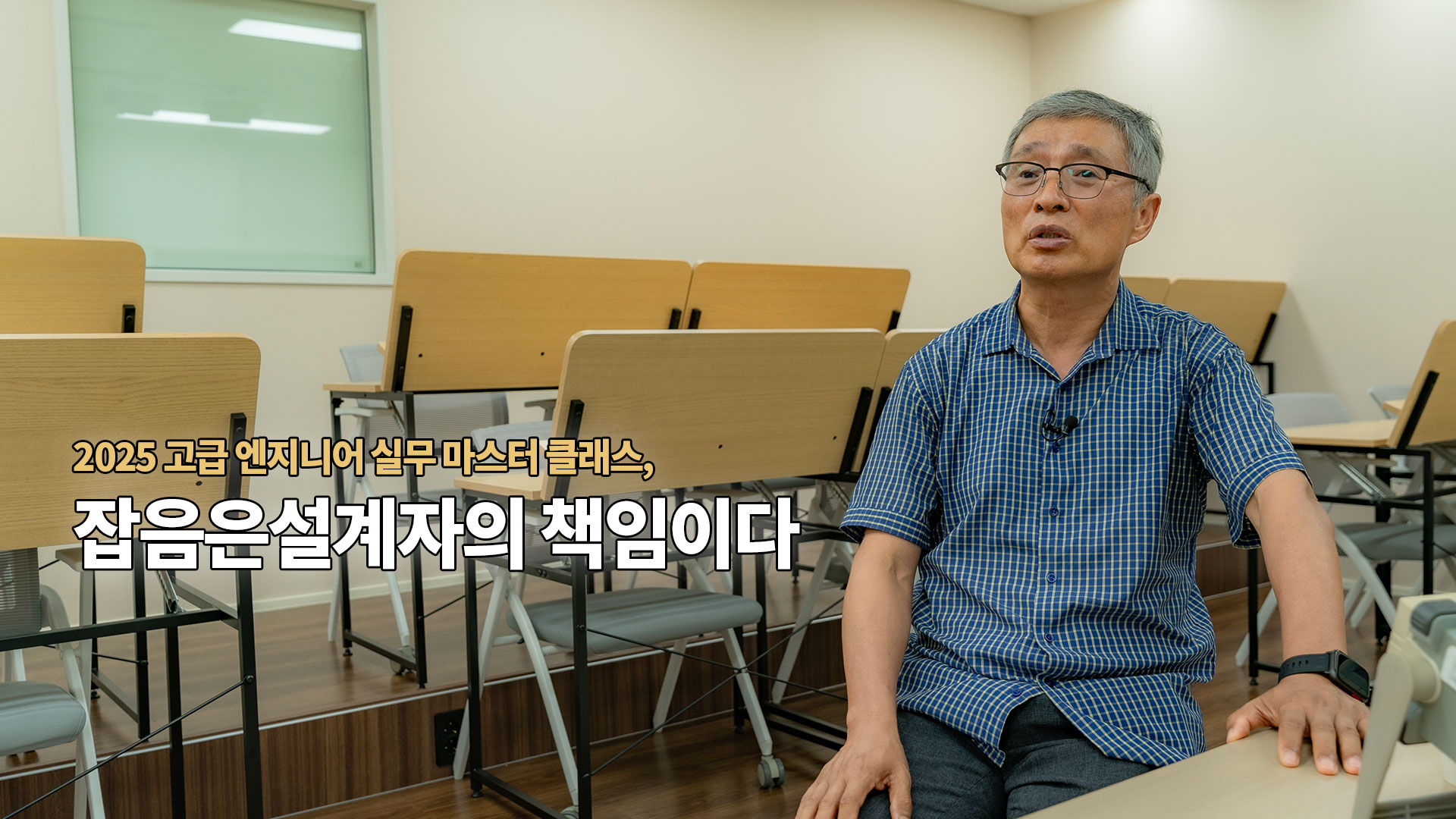
Emphasize the importance of a design philosophy that permeates the entire system.
High-performance components, sophisticated algorithms, and fast processing speeds are important, but noise is the key factor in determining the performance of electronic systems.
In a recent interview with e4ds news, Professor Cho Seong-jae of Shinhan University emphasized that “noise is the most easily overlooked, yet most critical element in electronic design.”
According to Professor Jo Seong-jae, noise generated in electronic circuits can be broadly divided into three types.
Power noise generated from the power source, noise entering the circuit from the external environment, and internal noise generated from the circuit itself.
Although recent advances in semiconductor technology have significantly reduced the noise of the components themselves, power and external noise still remain the responsibility of the designer.
In particular, power noise can be controlled to some extent through filtering, but noise coming from outside is not easy to deal with because its nature varies depending on the situation.
Professor Cho Seong-jae emphasized the need for educational programs that demonstrate, through experiments, how noise changes when resistance or impedance is changed, saying, “You need to see with your own eyes how much noise is introduced under what conditions to understand.”
Noise problems are also common in digital circuits.It's not my mother.
The difference between TTL IC and CMOS IC is a representative example. TTL maintains a stable state even when the input is open, but CMOS is sensitive to external noise when the input is open due to its high impedance characteristic.
This can result in unstable output and, in severe cases, unnecessary current consumption, heat generation, and component damage.
So, in CMOS circuits, pull-up or pull-down resistors must be considered even for unused pins.
The problem doesn't end here.
The choice between pull-up and pull-down is directly related to low-power design.
In battery-powered systems like mobile devices, even a difference of a few milliamps in current can affect product competitiveness.
Professor Cho Seong-jae said, “It is meaningless to select a low-power IC and then thoughtlessly configure the surrounding circuitry,” and pointed out the importance of a design philosophy that permeates the entire system.
Noise and power consumption are inherently a trade-off.
Lowering the impedance reduces noise inflow but increases current consumption, while increasing the impedance saves power but increases susceptibility to noise.
Therefore, designers must clearly determine whether the product's goal is low noise or low power, and then select component values and structures accordingly.
If you need to satisfy both, the answer lies in 'pattern design'.
Professor Cho Seong-jae said, “PCB pattern design is key to reducing noise while maintaining high impedance,” and explained that a comprehensive approach is needed that takes into account wiring length, layout, and even grounding structure.
Professor Cho concluded by saying, “Digital circuits are ultimately an extension of analog,” and emphasized that not only hardware engineers but also software engineers must understand noise and EMC/EMI issues.all.

Comments
Related news
"Need to pay attention to pattern design according to signal flow"
Professor Cho Sung-jae won the '2019 Engineer of the Year Award' in the high-efficiency power supply design category through the '2019 Engineer of the Year Evaluation' conducted by e4ds News in December. e4ds News asked him about his acceptance remarks and inquired about the current state and future of the high-efficiency power supply design field.
2020.01.06by 명세환 기자
[Interview] Professor Jo Seong-jae of Shinhan University - “EMC/EMI, the eternal homework of circuit design, training of experts is essential”
Professor Jo Sung-jae of Shinhan University, who recently conducted an interview with this publication, stated that EMI is a common issue among circuit designers, and emphasized the importance of education provided by specialized institutions, noting that solving EMI requires accumulating experience by encountering and resolving diverse problems over an extended period.
2021.09.14by 배종인 기자
[Interview] Professor Cho Seong-jae ①: "Practical circuit design issues ultimately boil down to fundamentals."
Recently, e4ds Electrical and Electronics Lifelong Education Institute held an offline course titled "2025 Advanced Engineer Practical Masterclass." This course is designed for practicing developers who have completed intermediate-level courses and engineers with practical circuit design experience, covering advanced topics in electronic circuit design and real-world problems in precision measurement environments. In this regard, this publication conducted an interview with Professor Cho Sung-jae from the Department of Electrical and Electronics Engineering at Shinhan University, who is teaching this course, to discuss the course direction and engineer education. This interview will be serialized over six installments.
2025.11.20by 배종인 기자
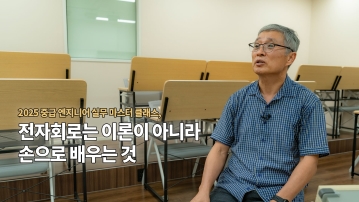
[Interview] Professor Cho Seong-jae ②, “Electronic Circuits Are Learned by Hand, Not Theory”
Recently, e4ds Electrical and Electronics Lifelong Education Institute held an offline course titled "2025 Advanced Engineer Practical Master Class." This course targets current developers who have completed intermediate-level coursework and engineers with practical circuit design experience, covering advanced topics in electronic circuit design and real-world problem-solving in precision measurement environments. Through an interview with Professor Jo Sung-jae of the Department of Electrical and Electronics Engineering at Shinhan University, who is instructing this course, we inquired about the direction of the course and engineer education. This interview will be serialized over six installments.
2025.12.11by 배종인 기자
.jpg)
[Interview] Professor Cho Seong-jae ③, “Mid-level engineers must also keep learning”
Professor Cho Sung-jae emphasizes that the most overlooked risk in circuit design is the 'moment of OFF switching.' He states that the back EMF and transient phenomena occurring when a transistor turns off are major causes of component failure, but since textbooks do not cover this, practitioners must verify and understand it themselves. His intermediate and advanced courses cover everything from general circuit problem-solving to specialized techniques such as I-V converters in the nA and pA ranges, and also address measurement instrument reliability issues. Professor Cho Sung-jae emphasizes that stable circuit design capability ultimately stems from an engineer's level of understanding and passion. We spoke with Professor Cho Sung-jae about the mindset and attitude that intermediate-level engineers should have when designing circuits.
2025.12.23by 배종인 기자











