



The key to AI success lies in prioritizing data strategy over infrastructure.
 Published2026.02.03 13:13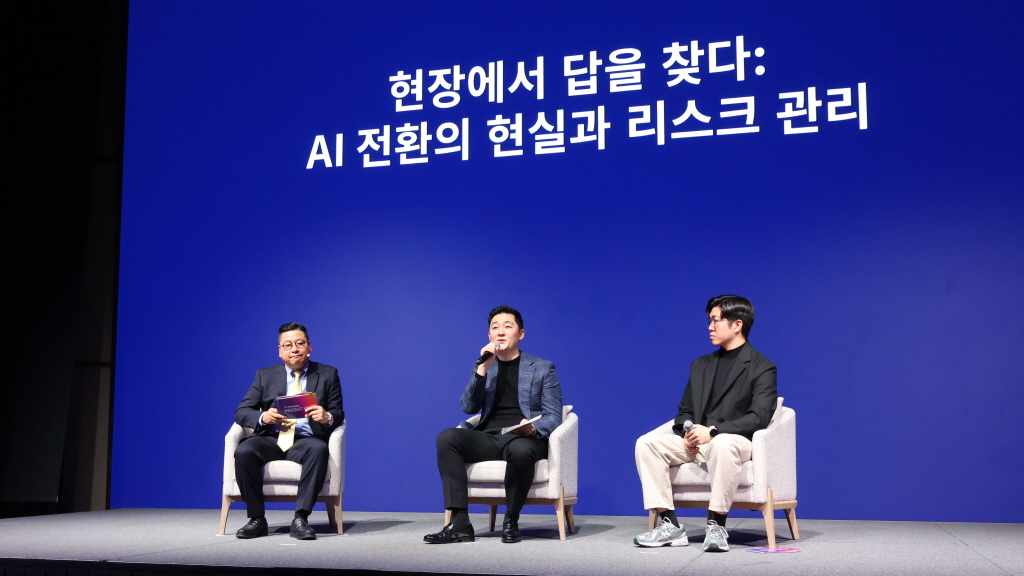
▲(From left) NetApp Managing Director Eunseop Kim, DS&G Managing Director Youngmin Seo, and Upstage AI Director Jahyun Kim are participating in a panel discussion.
Starting small with AI transition, designing for operational excellence and a clear accountability structure.
The success or failure of the AI transition hinges not on technology, but on understanding reality.
At the 'NetApp INSIGHT Xtra' event held at the Westin Seoul Parnas on the 3rd, a panel discussion was held to discuss the concerns and solutions of the domestic AI industry under the theme of 'Finding Answers in the Field: The Reality and Risk Management of AI Transformation.'
The panel discussion was moderated by NetApp Managing Director Eunseop Kim, and panelists Youngmin Seo, DS&G Managing Director, and Jahyun Kim, Upstage AI Director, pointed out the misunderstandings and limitations that companies face in the process of adopting AI.
The panelists unanimously emphasized that “the AI transition cannot be solved simply by introducing the latest models or GPUs.”
Director Kim Ja-hyun said, "Many companies mistakenly believe that a single, well-crafted LLM can solve all their internal problems." She added, "The model is merely the human brain. It must also be equipped with the systems, data, and processes that actually perform the work."He said.
He emphasized the importance of agent AI that connects actual work flows and data, saying that it is difficult to achieve the 99% or higher accuracy that companies expect with just a RAG-based platform.
Executive Director Seo Young-min cited "data reality" as the starting point for the AI transformation.
He pointed out that, “Customers worry about purchasing GPUs first, but in most cases, the data is scattered and in various formats,” and that, “If data quality and governance are not prepared, the project will inevitably be delayed no matter how quickly GPUs are introduced.”
The key to AI success lies in establishing a data strategy before infrastructure.
A realistic assessment of the risks of document automation and OCR projects followed.

▲(From left) NetApp Managing Director Eunseop Kim, DS&G Managing Director Youngmin Seo, and Upstage AI Director Jahyun Kim are participating in a panel discussion.
Director Kim Ja-hyun explained, “The existing OCR method had a significant cost burden due to document-specific model learning and limited scalability,” and “The next-generation document AI that combines vision and language models can process various documents without separate learning, and enables inference beyond simple extraction.”
This was presented as an alternative that could simultaneously solve the problems of cost, accuracy, and scalability.
Regarding the case where the pilot (PoC) was successful but the operational stage was shaky, Executive Director Seo Young-min said, “ This is because the topology of the pilot and operating environment are different,” he diagnosed.
Failure to account for the differences between single-GPU-based testing and multi-node operating environments can result in performance degradation and failures.
He emphasized, “From the outset, we need infrastructure design that is operationally sound and clear operating procedures.”
'Focus and selection' were suggested as strategies to accelerate the AI transition while reducing risk.
Director Kim Ja-hyun said, “If you try to solve all problems at once, the probability of failure is high,” and added, “The most realistic way is to select one core problem that can be solved, achieve results in a short period of time, and expand based on that.”
The panelists identified GPU-centric thinking, a separation of proof-of-concept and operations, and lack of ownership as common patterns in failed AI transformations.
Conversely, success stories differ in that they start small and have a design that considers operations and a clear accountability structure.

Comments
Related news
.jpg)
The key to AI success lies in securing high-quality data, parallelizing infrastructure like GPUs, and optimizing it.
At the AI Semiconductor Future Technology Conference held at Lotte Hotel Sogong on December 10, Jeon Gyeong-jeong, Division Head of LG AI Research Institute, presented on the topic "Keys to AX Success: EXAONE AI Stock Strategy Cases," stating, "For successful AI implementation, automation of data generation and processing, efficient infrastructure expansion, and development of customized models for each industry are essential."
2025.12.10by 배종인 기자
Dell Technologies: "Governance and the Knowledge Layer are Key to the AI Era"
Dell Technologies announced its 2026 artificial intelligence industry outlook on the 12th through the 'Predictions APJC Media Briefing,' stating that growth in the AI economy will be built on five pillars: governance, data, agents, resilience, and sovereign infrastructure—not merely technological advancement. The company particularly forecasts that the Asia-Pacific region is accelerating AI adoption through close collaboration between government and industry, and is expected to play a significant role in global AI competition.
2025.12.12by 배종인 기자

Supermicro Launches NVIDIA HGX B300-Based Liquid Cooling Solution
Global IT solutions company Super Micro Computer, Inc. (hereinafter Super Micro) has unveiled a new liquid-cooled server solution featuring NVIDIA's latest HGX B300 platform, beginning in earnest to provide highly integrated and efficient infrastructure for hyperscale data centers and AI factories.
2025.12.15by 배종인 기자

AMD Unveils "Huge AI Strategy" at CES 2026, Covering AI, Data Centers, and Embedded Systems
AMD CEO Dr. Lisa Su unveiled a new lineup of products across the client, graphics, embedded, and commercial segments during the opening keynote address at CES 2026 on the 5th, officially launching the 'Full-Scale AI Expansion' strategy.
2026.01.06by 명세환 기자
ETRI overcomes the "memory barrier" for large-scale AI learning.
The Electronics and Telecommunications Research Institute (ETRI) has developed a new memory technology called "OmniXtend" that addresses GPU memory limitations and data bottleneck issues, which have been identified as the most critical challenges in large-scale AI training. This breakthrough fundamentally resolves the GPU memory shortage problem that has been a major obstacle in large-scale artificial intelligence training processes.
2026.01.08by 배종인 기자











