


Shin Heon-seop, CEO of Safetics, “Realizing a Safe Collaboration Environment Between Robots and Humans Without Fences or Stoppages”
 Published2026.02.09 09:37
Nexcobot Distribution Agreement, Full-scale Expansion of Physical AI-based Robot Safety Intelligence
[Editor's Note] With the introduction of physical AI, we are now living in a world where humans and robots coexist. As robots become deeply integrated into industry and daily life, 'safety' is no longer an additional feature but is becoming the starting point of design. Amidst this, Safetics, a leading company in robot safety, is setting new standards for robot safety with its AI-based collision simulation and autonomous control technologies. Accordingly, this magazine arranged a meeting with Shin Heon-seop, CEO of Safetics, who is preparing for the upcoming humanoid era, to hear about the philosophy of robot safety, technology trends, and practical applications.
.jpg)
■ Please introduce yourself and Safetics.
I am Shin Heon-seop, CEO of Safetics.
Safetics is developing robot safety intelligence to enable humans and robots to coexist safely.
Through the world's first AI crash analysis simulation, it enables safety verification that fully meets international standards without the need for costly physical crash tests.
We provide a solution that maximizes both worker safety and process productivity by enabling robots to independently determine risks and adjust their speed.
■ You have consistently emphasized that “robot safety must be ensured during the design phase, not after installation.” What is the background behind this philosophy, and what do you consider to be the biggest safety issue currently facing the industry?
If safety issues are discovered after the robot is installed, the entire process layout must be modified to implement safety measures.
It has been emphasized that 'ensuring safety during the design phase' is essential to prevent the massive waste of time and money that occurs at this stage.
With the emergence of humanoids based on Physical AI, robots that previously only repeated standardized movements have begun to perform non-standardized movements in accordance with the environment. As humanoids become more closely integrated with real human life, it has become important to analyze such unstructured movements to ensure safety.
I am curious about the biggest difference between SafetyDesigner and existing safety verification methods.
SafetyDesigner evaluates safety through an AI collision safety verification model that precisely calculates the forces and pressures generated when a robot comes into contact with a person or object.
Conventional physical experiments were limited to measurements only at specific locations or angles due to equipment installation limitations, but Safetics utilizes simulation to perform collision tests on all 360 degrees and the entire complex robot motion without directional constraints.
Thanks to this, all risk scenarios that may occur in the actual field can be thoroughly verified, ensuring safety with a higher level of reliability than any other method.
I am curious to know the biggest difference between Safetics' technology and the 'collision detection function' built into existing collaborative robots.
Since the collision detection method of collaborative robots stops 'after' an accident occurs, it is possible to prevent accidents caused by static collisions such as pinching and crushing, but there are limitations to fast and strong dynamic collisions.
Forces several times stronger than the safety limits set on the robot can be transmitted directly to the worker.
Furthermore, the collision detection function only measures force and fails to account for the 'pressure' generated when hitting a sharp surface, so there is still a risk that it could lead to more serious injuries in reality.
SafetyDesigner calculates both the 'force' and 'pressure' generated during a collision on a unit-time basis, and the collisionBecause the robot moves at a safe speed (a speed that meets standards), it is designed for intrinsic safety so that people are not injured even if a collision occurs.
■ I would like to know about the key features of how robot safety intelligence is implemented by combining Safetics' web-based safety design solution, SafetyDesigner, and its robot-embedded autonomous control solution, SafetyGiver.
If SafetyDesigner is the brain that analyzes risks, SafetyGiver is the nervous system that autonomously controls robots.
By combining these two, we realize a safe collaborative environment between robots and humans without fences or stops.
SafetyDesigner analyzes collision risks in a simulation environment to derive the maximum safe speed, and using this data, the robot perceives the environment in real time through SafetyGiver, which incorporates robot autonomous control technology, and safely controls its movements in accordance with the maximum safe speed.
Ultimately, the core of our solution is to maximize space efficiency and productivity simultaneously while ensuring workplace safety through 'robot safety intelligence,' which moves intelligently enough to prevent human injury even in the event of a collision, rather than stopping only after an accident occurs.
■ Please share any actual client cases where the greatest benefits were achieved from applying SafetyDesigner or SafetyGiver.
I will present the case of Hanwha Ocean as a representative example of how SafetyDesigner was utilized to solve safety issues and improve the work environment and productivity.
At the time, the client company was pushing for the introduction of collaborative robots in its precision welding process, and safety was paramount due to the nature of the process, which required humans to work alongside them at close range.
On the other hand, with existing safety measures such as fences or sensors, humans and robots It was a situation where it was impossible to have real 'collaboration' at close range.
To solve this problem, we performed a robot collision safety analysis using SafetyDesigner and applied PFL mode to establish an environment where robots can safely collaborate with humans without stopping, even without fences or sensors.
As a result, it simultaneously achieved reduced worker fatigue and increased productivity through improved working environments, establishing itself as a successful case of collaborative robot adoption within a large corporation. Based on this trust, we have maintained a solid technical cooperation partnership to this day, jointly carrying out Hanwha Ocean's major robot safety projects.
It was also a project to install cooking robots in a school cafeteria, and since it was a public project, safety was a major concern. Furthermore, due to the nature of the kitchen, workers had to be present to cook, so it was impossible to erect a fence.
To solve this problem, we performed a robot collision safety analysis using SafetyDesigner and applied PFL mode to establish an environment where robots can safely collaborate with humans without stopping, even without fences or stopping mechanisms.
By resolving safety issues through SafetyDesigner, we successfully installed the nation's first large-scale school meal cooking robot system without safety concerns, thereby increasing cooking efficiency.
■ Please introduce any next-generation technologies or new businesses that Safetics is preparing for the future.
Last December, Safetics established a foothold for entering the global market by signing a distribution agreement with NexCOBOT, a global specialist in industrial controllers.
Starting from this point, we plan to actively expand 'Physical AI-based robot safety intelligence,' a core next-generation technology, into the global market.
In addition, efforts are being made to disseminate technologies for humanoid safety in preparation for the upcoming era of humanoids.
■ Finally, please share a few words with the readers of e4ds news.
The paradigm of robot safety is now shifting from the past method of isolating with fences to an 'era of intelligence' where robots make decisions on their own.
In 2026, Safetyics will globally leverage Korean technologyThis will be the inaugural year for setting a new standard for bot safety.
Safetics aims for a world where all robots on Earth collaborate with humans without boundaries.
Safetics will take the lead in paving the way as a global standard so that true coexistence between humans and robots can take root in the place where the barrier of fences disappears.

Comments
Related news
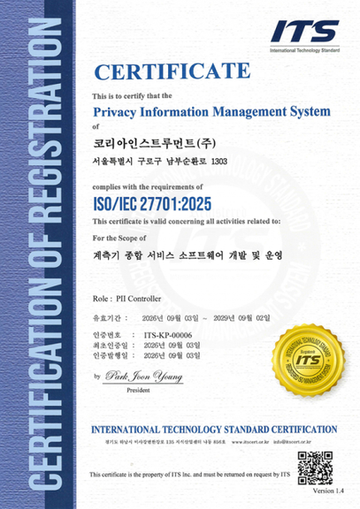
Korea Instrument, KOLAS Accredited Calibration Agency First to Simultaneously Acquire ISO/IEC 27,001·27,701
Korea Instrument has become the first among KOLAS accredited calibration agencies to simultaneously acquire ISO/IEC 27,001 and ISO/IEC 27,701 certifications. Through its proprietary platforms CWIZ Enterprise and CWIZ Partners, the company has embedded information security and personal data protection requirements across all business processes including customer information, equipment data, and calibration reports, with plans to continuously advance its management system through regular audits and security inspections.
2026.10.12by 배종인 기자

TeamViewer One, IT Incident Automation Workflow and Resolution Center Enhanced
TeamViewer has added IT incident automation capabilities and an advanced Resolution Center to its integrated digital workplace management platform 'TeamViewer ONE'. Recurrent service disruptions, configuration errors, and capacity shortages are automatically handled according to preset policies, and device status verification through script deployment can be managed in a unified interface, significantly reducing repetitive tasks for IT teams.
2026.10.12by 배종인 기자
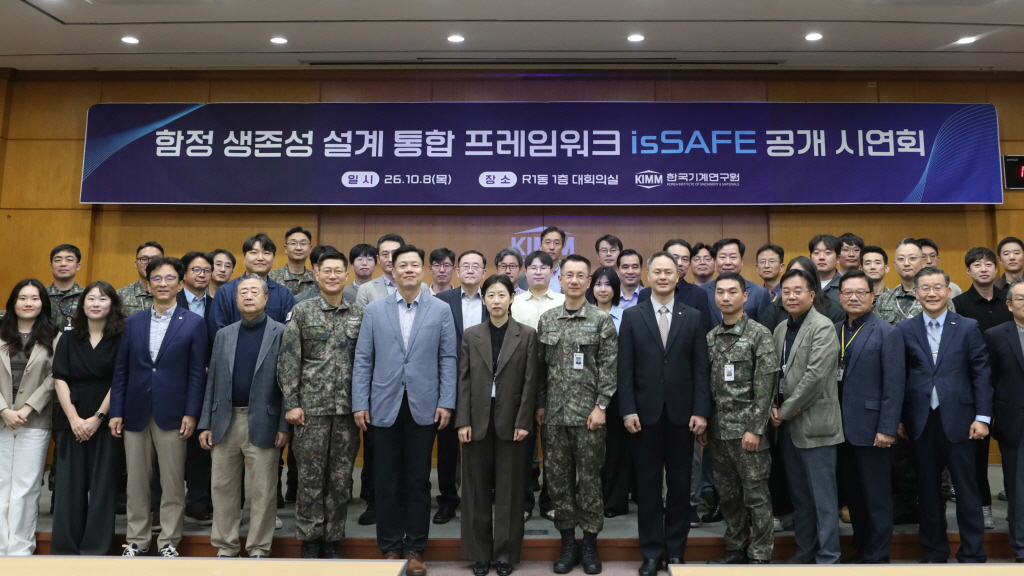
KAERI Develops Domestically-Produced SW 'isSAFE' for Integrated Warship Survivability Analysis
The Korea Institute of Machinery and Materials has developed domestically-produced software 'isSAFE' that comprehensively analyzes warship survivability. This design framework integrates the entire process—from warship modeling to hit scenario generation, vulnerability analysis, and results analysis—into a single platform, establishing an independent technology foundation in the defense technology sector that had previously relied on foreign software.
2026.10.08by 배종인 기자
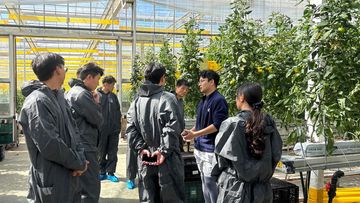
ioCrops Shares AI Smart Farm Operations Case Study
About 20 cultivators from the Agricultural Cooperative's Smart Agriculture Support Centers visited ioCrops' smart farm in Jincheon, North Chungcheong Province. They directly confirmed how data collected through substrate weight sensors, drainage weight sensors, and soil moisture sensors is applied to tomato cultivation, as well as the greenhouse pest control process using the AI-based autonomous spraying robot 'HERMAI'. By sharing on-site operational case studies combining data and automation technology, the adoption of smart farms in agricultural fields is being promoted.
2026.10.07by 배종인 기자
Rockwell, "90% Digital Transformation Essential in Life Sciences Manufacturing"
According to the digital transformation report for the life sciences manufacturing sector released by Rockwell Automation, 90% of responding companies recognized digital transformation as a business-critical element. Primary investment technologies include AI and machine learning (46%), process automation (44%), and cybersecurity (39%), with 64% of companies planning to expand AI utilization within the next year. However, only 32% of companies actually utilize more than half of the collected data, indicating an urgent need to strengthen data utilization capabilities.
2026.10.07by 배종인 기자











