


Development of an ECG patch that adheres to the skin without gel or chemical adhesives.
 Published2026.02.09 10:18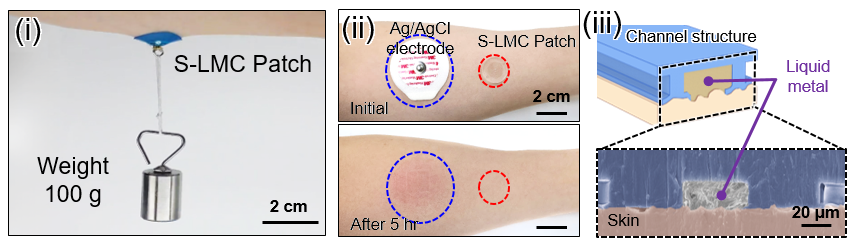
A UNIST research team has doubled signal accuracy during exercise using liquid metal and microstructure design.
Electrocardiogram (ECG) testing typically involves patches using gel and chemical adhesives. However, these patches have been criticized for their coldness, skin irritation, and signal distortion caused by movement. A gel- and adhesive-free ECG patch has been proposed, addressing these issues through structural design.
A research team led by Professor Jeong Hoon of the Department of Mechanical Engineering at UNIST announced on the 9th that they have developed a high-performance electrocardiogram patch utilizing microstructures of liquid metal and rubbery silicone. The results of the research were published in the international journal Advanced Science on January 5th.
The patch consists of a 20-micrometer-wide liquid metal tube, rolled up like a snail shell. The lower portion of the tube, where it touches the skin, is open, allowing heartbeat signals to be transmitted directly to the electrodes, enabling signal capture without the need for gel. Liquid metal leakage was addressed by inwardly curling horizontal protrusions at the bottom of the tube.
Adhesive strength comes from microscopic protrusions measuring 28㎛ in diameter and 20㎛ in height distributed across the patch's surface. These protrusions, shaped like a cap edge, adhere closely to the skin's microscopic curves, expanding the contact area and maintaining stable adhesion without adhesive. This structure ensures an adhesive strength that can withstand a weight of 100g.
Performance evaluation results showed electrode resistance was more than five times lower than that of commercial patches, and ECG signal accuracy was maintained approximately twice as high even during strenuous activities such as walking or running. Unlike conventional patches, which degrade signal quality as the gel dries, this patch ensured stable measurements even under repeated use. It can be reused more than 500 times.
The research team is transferring the technology to its joint venture, Nvix Lab, Inc., and is pursuing commercialization. The company was selected for the Ministry of SMEs and Startups' TIPS project and has already secured initial investment. The research was supported by the Ministry of Science and ICT, the Ministry of Trade, Industry and Energy, and the National Research Foundation of Korea.

Comments
Related news

Intel Unveils Next-Generation 'Core Ultra Series 3' and vPro Platform for Enterprise PCs
Intel has officially unveiled the "Intel Core Ultra Series 3" for next-generation enterprise PCs and the latest vPro platform, addressing a wide range of demands from enterprise notebooks to high-performance workstations.
2026.03.26by 배종인 기자
ROHM Launches ESD Protection Diode Compatible with High-Speed Interfaces of 10Gbps or Higher
Semiconductor specialist ROHM has developed the 'RESDxVx series' of ESD (electrostatic discharge) protection diodes capable of responding to next-generation high-speed data communication environments exceeding 10Gbps, simultaneously enhancing both signal quality maintenance required in high-speed interfaces and IC protection performance.
2026.03.26by 배종인 기자
ST Launches 75V Drive IC Targeting 48V Industrial Motor Driving
ST Microelectronics has unveiled the 'STSPIN9P' series of 75V motor drive ICs tailored for 48V-class industrial drive system design. The new product family is characterized by half-bridge and full-bridge configurations that enable design scalability according to motor type and output conditions. Power supply circuits, protection functions, and current sensing circuits are integrated on-chip to simplify system configuration, and the devices are designed to support applications up to 500W maximum. The company plans to provide reference designs and demo boards to support development and evaluation in industrial automation, robotics, pumps, fans, lighting, and textile machinery.
2026.03.26by 배종인 기자

Nordic supports security updates for the entire lifecycle of IoT devices at a single fixed cost
Nordic Semiconductor, a global leader in low-power wireless connectivity solutions, has unveiled a single fixed-cost licensing model that delivers FOTA (Firmware Over-the-Air) and device management capabilities throughout the device lifecycle via nRF Cloud, and introduced a new firmware update solution to prepare for the enforcement of the European Union's Cyber Resilience Act (CRA).
2026.03.26by 배종인 기자

Practical Training in Low-Noise, Low-Power Circuit Design All in One Place… Training Fee Support
The "2026 Advanced Engineer Practical Masterclass" to strengthen competencies in high-sensitivity analog circuit and sensor-based system design will be held on April 16 at the e4ds Conference Center in Gasan-dong, Seoul. This program will be conducted as an offline paid hands-on training session, not online, and is targeted at engineers seeking on-site intensive learning. Texas Instruments will provide educational support for this training, allowing participation at 150,000 won, a 100,000 won discount from the original price of 250,000 won.
2026.03.26by 배종인 기자











