


LG Electronics applies marine glass to the Suncheon Bay tidal flats, demonstrating its commitment to restoring the blue carbon ecosystem.
 Published2026.02.11 14:21
.jpg)
Suncheon City and Seoul National University's Blue Carbon Project Team Collaborate to Verify the Growth and Carbon Absorption Effects of Halophytes
LG Electronics, in collaboration with Suncheon City and Seoul National University's Blue Carbon Project Group, will utilize the new functional material "Marine Glass" to restore the Suncheon Bay tidal flat ecosystem and expand its blue carbon sink. The goal is to apply the material, which promotes the growth of marine life, to the field to verify its effectiveness and explore the potential of establishing a long-term ecosystem management model.
LG Electronics announced on the 11th that it signed a Memorandum of Understanding (MOU) with Suncheon City and Seoul National University's Blue Carbon Business Unit at Suncheon City Hall in South Jeolla Province to "create a blue carbon ecosystem and jointly implement carbon neutrality." The signing ceremony was attended by Kim Young-seok, Head of HS Functional Materials Business at LG Electronics, and Suncheon Mayor Noh Gwan-gyu.
Under this agreement, LG Electronics will conduct a demonstration project to apply marine glass to approximately 1,500 square meters of the Suncheon Bay tidal flats, a UNESCO World Heritage site, to verify the growth and carbon absorption efficiency of salt-loving plants. The participating organizations will jointly pursue carbon neutrality through the creation and preservation of a blue carbon ecosystem.
Marine glass is a functional glass material that changes into mineral ions when it comes into contact with water, and is characterized by supplying minerals necessary for seaweed and halophytes at a constant amount and speed. LG Electronics explained that it has secured technology to precisely control the release of mineral components according to the intended use. It also suggested that the product could be manufactured in beads or chip form for use in areas with fast-flowing water.
LG Electronics previously conducted similar demonstrations in Busan and the salt marshes of the Nakdong River estuary late last year. With the Suncheon Bay application as a catalyst, the company plans to continue its research and development of new materials. It also plans to expand its portfolio with products such as "Purotech," a glass powder-based antibacterial material, and "Mineral Wash," a functional laundry material, and foster its B2B business. Kim Young-seok, head of the business division, stated that the company will contribute to environmental conservation and carbon emissions reductions while strengthening its competitiveness in the sustainable new materials business.

Comments
Related news

Intel Unveils Next-Generation 'Core Ultra Series 3' and vPro Platform for Enterprise PCs
Intel has officially unveiled the "Intel Core Ultra Series 3" for next-generation enterprise PCs and the latest vPro platform, addressing a wide range of demands from enterprise notebooks to high-performance workstations.
2026.03.26by 배종인 기자

ROHM Launches ESD Protection Diode Compatible with High-Speed Interfaces of 10Gbps or Higher
Semiconductor specialist ROHM has developed the 'RESDxVx series' of ESD (electrostatic discharge) protection diodes capable of responding to next-generation high-speed data communication environments exceeding 10Gbps, simultaneously enhancing both signal quality maintenance required in high-speed interfaces and IC protection performance.
2026.03.26by 배종인 기자
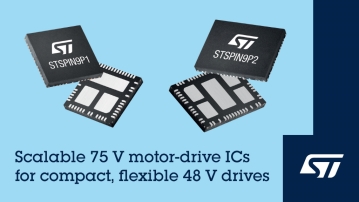
ST Launches 75V Drive IC Targeting 48V Industrial Motor Driving
ST Microelectronics has unveiled the 'STSPIN9P' series of 75V motor drive ICs tailored for 48V-class industrial drive system design. The new product family is characterized by half-bridge and full-bridge configurations that enable design scalability according to motor type and output conditions. Power supply circuits, protection functions, and current sensing circuits are integrated on-chip to simplify system configuration, and the devices are designed to support applications up to 500W maximum. The company plans to provide reference designs and demo boards to support development and evaluation in industrial automation, robotics, pumps, fans, lighting, and textile machinery.
2026.03.26by 배종인 기자
Nordic supports security updates for the entire lifecycle of IoT devices at a single fixed cost
Nordic Semiconductor, a global leader in low-power wireless connectivity solutions, has unveiled a single fixed-cost licensing model that delivers FOTA (Firmware Over-the-Air) and device management capabilities throughout the device lifecycle via nRF Cloud, and introduced a new firmware update solution to prepare for the enforcement of the European Union's Cyber Resilience Act (CRA).
2026.03.26by 배종인 기자
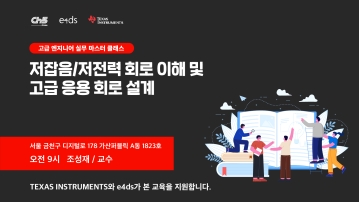
Practical Training in Low-Noise, Low-Power Circuit Design All in One Place… Training Fee Support
The "2026 Advanced Engineer Practical Masterclass" to strengthen competencies in high-sensitivity analog circuit and sensor-based system design will be held on April 16 at the e4ds Conference Center in Gasan-dong, Seoul. This program will be conducted as an offline paid hands-on training session, not online, and is targeted at engineers seeking on-site intensive learning. Texas Instruments will provide educational support for this training, allowing participation at 150,000 won, a 100,000 won discount from the original price of 250,000 won.
2026.03.26by 배종인 기자











