


UNIST Develops 'Artificial Leaf' That Produces Hydrogen Using Only Indoor Lighting
 Published2026.02.19 12:17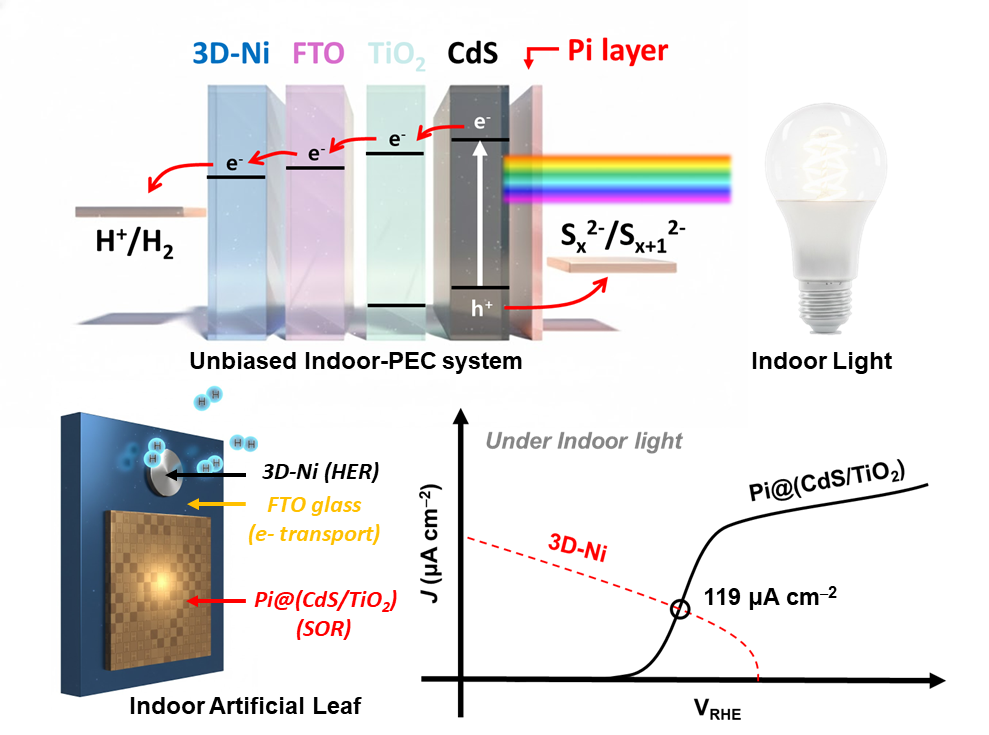
Combining CdS/TiO₂ Photoelectrode with 3D Nickel Catalyst… Applied Catalysis B Released Online
Domestic researchers have developed "artificial leaf" technology that produces hydrogen from water using only indoor LED light. This method generates hydrogen by inducing a photoelectrochemical reaction even in weak lighting environments.
A research team led by Professor Ji-Hyeon Jang of the Department of Energy and Chemical Engineering at UNIST announced on the 19th that they have developed an artificial leaf combining a photoelectrode that operates under indoor lighting conditions with a hydrogen production catalyst. The research results were published online on the 16th of last month in the international journal 'Applied Catalysis B: Environmental and Energy' and are awaiting formal publication.
Conventional photoelectrochemical-based hydrogen production technologies have primarily utilized sunlight. However, indoor lighting has limitations in that it is difficult to secure charge generation and separation efficiency due to low light intensity. To address this issue, the research team designed a structure in which a titanium dioxide (TiO₂) layer is bonded to a sulfide (CdS) photoelectrode. This structure helps utilize limited charges for the hydrogen generation reaction by reducing the recombination of generated positive and negative charges.
In addition, phosphate (Pi) was coated on the surface of the sulfide to suppress photocorrosion caused by strong light and improve the charge transfer speed. The generated charge is transferred to the three-dimensional nickel (3D-Ni) catalyst layer on the back side and reacts with water to produce hydrogen.
Experimental results showed that a photocurrent of 119–120 microamperes (µA/cm²) was measured using only indoor lighting without external voltage. This is similar to the 121 µA/cm² reported when using a platinum (Pt) catalyst. Furthermore, it maintained 94% of its initial performance even after 12 hours of operation. Photocurrent is used as an indicator to gauge the potential for hydrogen production.
The research team explained that they fabricated a module consisting of four 85 cm² artificial leaves connected in series and recorded a total photocurrent of 5 milliamperes (mA) under indoor lighting. It was also confirmed that the 3D nickel catalyst is relatively inexpensive and can be produced through a printing process, demonstrating the potential for large-area expansion.
This research was conducted with support from the 'Chemical Engineering and Bio-Convergence Process Research Center for Microplastic Response' ERC project, the Mid-Career Researcher Project, and the InnoCore Project.

Comments
Related news

Intel Unveils Next-Generation 'Core Ultra Series 3' and vPro Platform for Enterprise PCs
Intel has officially unveiled the "Intel Core Ultra Series 3" for next-generation enterprise PCs and the latest vPro platform, addressing a wide range of demands from enterprise notebooks to high-performance workstations.
2026.03.26by 배종인 기자

ROHM Launches ESD Protection Diode Compatible with High-Speed Interfaces of 10Gbps or Higher
Semiconductor specialist ROHM has developed the 'RESDxVx series' of ESD (electrostatic discharge) protection diodes capable of responding to next-generation high-speed data communication environments exceeding 10Gbps, simultaneously enhancing both signal quality maintenance required in high-speed interfaces and IC protection performance.
2026.03.26by 배종인 기자
ST Launches 75V Drive IC Targeting 48V Industrial Motor Driving
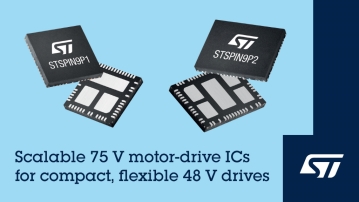
ST Microelectronics has unveiled the 'STSPIN9P' series of 75V motor drive ICs tailored for 48V-class industrial drive system design. The new product family is characterized by half-bridge and full-bridge configurations that enable design scalability according to motor type and output conditions. Power supply circuits, protection functions, and current sensing circuits are integrated on-chip to simplify system configuration, and the devices are designed to support applications up to 500W maximum. The company plans to provide reference designs and demo boards to support development and evaluation in industrial automation, robotics, pumps, fans, lighting, and textile machinery.
2026.03.26by 배종인 기자

Nordic supports security updates for the entire lifecycle of IoT devices at a single fixed cost
Nordic Semiconductor, a global leader in low-power wireless connectivity solutions, has unveiled a single fixed-cost licensing model that delivers FOTA (Firmware Over-the-Air) and device management capabilities throughout the device lifecycle via nRF Cloud, and introduced a new firmware update solution to prepare for the enforcement of the European Union's Cyber Resilience Act (CRA).
2026.03.26by 배종인 기자

Practical Training in Low-Noise, Low-Power Circuit Design All in One Place… Training Fee Support
The "2026 Advanced Engineer Practical Masterclass" to strengthen competencies in high-sensitivity analog circuit and sensor-based system design will be held on April 16 at the e4ds Conference Center in Gasan-dong, Seoul. This program will be conducted as an offline paid hands-on training session, not online, and is targeted at engineers seeking on-site intensive learning. Texas Instruments will provide educational support for this training, allowing participation at 150,000 won, a 100,000 won discount from the original price of 250,000 won.
2026.03.26by 배종인 기자











