


KERI Breaks Performance Limits of Eco-friendly Insulation Materials… Innovation Expected in High-Voltage Power Equipment
 Published2026.02.23 09:45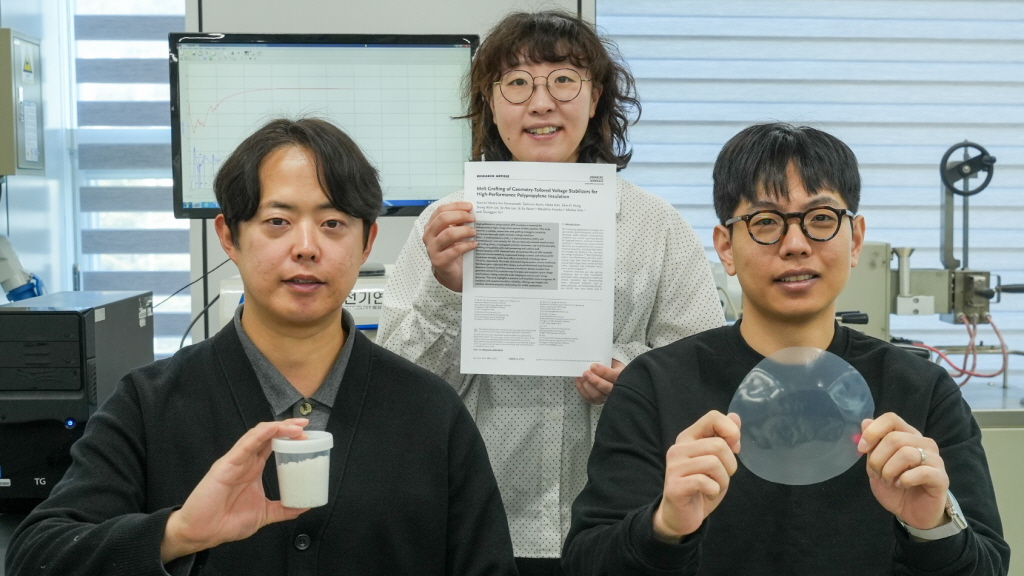
Drs. Yoo Seung-geon, Kim Min-hee, and Kwon Ik-soo of KERI have developed a process technology that overcomes the performance limitations of 'polypropylene,' an insulating material for power equipment.
The Korea Electrotechnology Research Institute (KERI) has created a new turning point for the high-voltage power industry by developing a technology that dramatically improves the performance of eco-friendly insulation materials for power equipment.
Dr. Seung-Gun Yoo's team at the KERI Insulating Materials Research Center has unveiled a technology that overcomes the structural limitations of existing insulating material polypropylene and achieves stable performance even in high-voltage environments.
Polypropylene has been widely used in various power devices, such as power cables, due to its ease of recycling and excellent insulation properties.
On the other hand, further enhancing the insulation properties of materials that already possess high performance has been considered a difficult challenge in the industry.
With the rapid increase in voltage of power equipment recently demanding much higher insulation performance than before, this research achievement is attracting attention from the industrial sector.
A research team at KERI developed a technology to effectively combine a voltage stabilizer with polypropylene based on a dry process that does not use toxic solvents.
In particular, by utilizing the melting method widely used in industrial settings, the stabilizer is uniformly distributed throughout the material.The key is that it induced them to include it.
The research team selected the optimal molecule capable of chemically bonding with polypropylene through simulation and mixed it like dough in a molten state to secure stable insulation properties that prevent charge shifting to one side even at high voltages.
Dr. Yoo Seung-geon explained, “There have been previous attempts to mix polypropylene with voltage stabilizers, but commercialization was difficult due to complex organic solvent-based processes. It is highly significant that we have developed a high-performance insulation material that companies can immediately utilize through an eco-friendly, one-step process familiar to the industry.”
This research was enhanced through collaboration between internal departments at KERI as well as international joint research with Kyushu Institute of Technology in Japan.
High-voltage performance evaluation was conducted by Dr. Ik-Su Kwon's team and Professor Masahiro Kozako's team at the KERI Power Cable Research Center, and physical phenomenon analysis was performed by Dr. Min-Hee Kim at the KERI Eco-friendly Power Equipment Research Center.
The research team anticipates that this technology will significantly improve the performance and reliability of high-power devices across the board, including HVDC power cables, electric vehicles, energy storage systems (ESS), and data centers. Furthermore, they plan to utilize AI-based molecular design technology to identify additional voltage stabilizer candidates and further enhance insulation performance.
This achievement has been recognized for its academic excellence by being published in 'Advanced Functional Materials,' a top-tier international journal in the field of materials engineering. Notably, this marks the first time a Korean study on high-voltage insulating materials has been published in the journal, further enhancing the technical and academic value of the research.

Comments
Related news
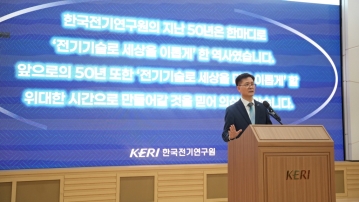
Kim Nam-gyun, president of the Korea Electrotechnology Research Institute, declares a "power rush" in the era of electrification.
Kim Nam-gyun, President of the Korea Electrotechnology Research Institute (KERI), presented AI-based research innovation, response to mega-scale national projects, and strengthened open collaboration as core strategies through his New Year's address, declaring that "2025 will be a year in which KERI prepares for an even stronger leap forward as the national representative of electrical technology."
2026.01.05by 배종인 기자
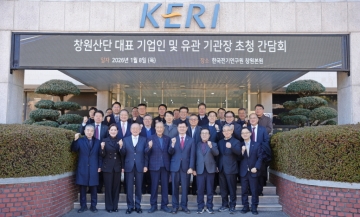
The Korea Electrotechnology Research Institute (KERI) invites representatives from companies and institutions to strengthen regional innovation cooperation.
The Korea Electrotechnology Research Institute (KERI) held a discussion session on the 8th at its Changwon headquarters with approximately 30 regional leaders, sharing the institute's major achievements and future collaboration directions.
2026.01.09by 배종인 기자
Korea Electrotechnology Research Institute (KERI) introduces AI accessibility solution, becoming the first government-funded research institute to do so.
The Korea Electrotechnology Research Institute (KERI), a government-funded research institute under the National Research Council of Science and Technology, which is under the Ministry of Science and ICT, has undertaken a digital communication innovation by comprehensively redesigning its official homepage to commemorate its 50th anniversary.
2026.01.12by 배종인 기자
The Korea Electrotechnology Research Institute (KERI) sets a model for safety management among research institutions.
The Korea Electrotechnology Research Institute (KERI) has consecutively achieved top-tier ratings across three categories in the safety management field in 2025—including △Excellent Safety Management Laboratory △Outstanding Institution for Intensive Safety Inspection △Outstanding Institution for Disaster Response Safe Korea Training—thereby demonstrating the safety standards across its overall research environment.
2026.01.19by 배종인 기자
Dr. Kim Sang-cheol of KERI appointed director of the Korea-EU Semiconductor R&D Cooperation Center.
Dr. Kim Sang-chul, Principal Researcher at the Power Semiconductor Research Division of the Korea Electrotechnology Research Institute (KERI), has been appointed as director of the 'Korea-EU Semiconductor R&D Cooperation Center' under the Korea Fabless Industry Association, taking on the role of a bridgehead for domestic system semiconductor companies' expansion into Europe.
2026.01.26by 명세환 기자











