



Conditions for Maintaining Quantum Catalysts in Noisy Environments
 Published2026.03.05 15:53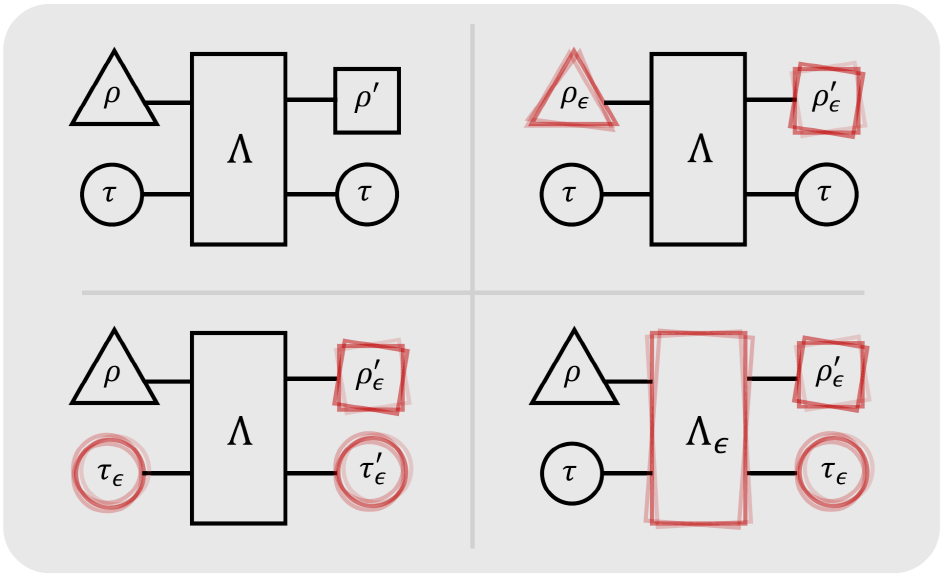
Only the catalytic channel prevents error accumulation… summarized in a PRL paper.
The states handled by quantum computers are vulnerable to external "noise." An international research team has mathematically defined the conditions under which a "quantum catalyst," an auxiliary resource repeatedly used as a catalyst in quantum computation, can maintain its effectiveness even when faced with realistic errors.
UNIST announced on March 4 that a study led by Professor Seok-Hyung Lee of the Department of Physics found that even a very small error in the process of preparing the input state could gradually transform the catalyst in many previously proposed quantum catalyst scenarios, shaking the premise of “reuse.”
The solution the researchers focused on was a "catalytic channel." This approach structurally prevents the catalyst from changing as it wears out during computation by designing computations so that the catalyst always returns to its original state (restoration) regardless of the input. The research paper demonstrated that only this framework can guarantee a generally noise-resistant catalytic process.
However, it was also pointed out that even if a catalytic channel is used, not all quantum resources generate 'additional gains'. The research team discussed the impossibility theorem, which states that it is difficult to obtain fundamental benefits even with catalytic channels in representative resource theories such as entanglement and coherence, while also discussing that the effect of catalytic channels can be established even in the presence of noise under certain thermodynamic conditions.
The results of this study are confirmed in a paper published in Physical Review Letters (Volume 136, Paper No. 050202) and in an open access version available on arXiv. The PRL journal page includes the paper title, author, and publication information.

Comments
Related news
UNIST enhances autonomous driving with camera-based vanishing point technology.
A research team at UNIST's Graduate School of Artificial Intelligence has developed an AI model called 'VPOcc' that applies the Renaissance painters' concept of 'vanishing points' to artificial intelligence, compensating for perspective distortion in camera images. This research was conducted with support from the Ministry of Science and ICT and the National Research Foundation of Korea, and the results have been accepted for presentation at IROS 2025, an international conference in the field of intelligent robotics.
2025.10.15by 명세환 기자

UNIST: AI Improves Wireless Image Transmission Efficiency by 45 Times
A research team led by Professor Yun Sung-hwan from the Graduate School of Artificial Intelligence at Ulsan National Institute of Science and Technology (UNIST) has developed AI technology that dramatically improves the efficiency of wireless image transmission. The 'Task-Adaptive Semantic Communication' technology developed by the research team differs from the conventional method of compressing and transmitting entire images, instead selectively transmitting only the semantic information essential for task execution.
2025.11.06by 배종인 기자
UNIST Accelerates Industrial AI Transition
UNIST (President Park Jong-rae) held the '2025 Korea Industrial AI Joint Forum' on the 24th at the POSCO Center in Seoul together with six industry-academia-research institutions, sharing AI utilization outcomes in manufacturing fields and corporate talent innovation cases.
2025.11.25by 배종인 기자

AI that feels like it's learned everything after learning only 1/25th of what it needs to learn.
A research team led by Professor Shim Jae-young at UNIST's Graduate School of Artificial Intelligence has developed dataset distillation technology that can maximize the learning efficiency of 3D artificial intelligence (AI) models, which are critical to advanced industries such as autonomous vehicles and robotics.
2025.12.01by 배종인 기자
.jpg)
AI that moves 3D characters with a single photo
A research team led by Professor Ju Kyung-don from the UNIST Graduate School of Artificial Intelligence has developed 'DeformSplat (Rigidity-aware 3D Gaussian Deformation)', an AI model that deforms the poses of 3D characters generated based on 3D Gaussian Splatting without shape distortion. This technology can implement natural 3D motion without multi-angle photography data or complex motion capture equipment that were previously required in the conventional 3D content production process, and is expected to significantly reduce production costs and lower barriers to entry across the metaverse, game, and animation industries.
2025.12.26by 명세환 기자











