


NVIDIA Defines AI as a "Five-Layer Cake" and Releases a Blueprint for Next-Generation AI Infrastructure Transformation
 Published2026.03.11 16:26
.jpg)
▲NVIDIA defined AI as a "five-tier cake" and presented a blueprint for the next-generation AI infrastructure transformation.
NVIDIA has defined artificial intelligence (AI) as a core infrastructure that supports society as a whole, not just a simple technology, and has proposed a new structure for the AI ecosystem.
On the 11th, NVIDIA likened the AI stack, which spans energy, chips, infrastructure, models, and applications, to a "five-tier cake," and announced that the global AI infrastructure transformation is in full swing.
According to Nvidia, AI is evolving from a collection of individual applications or single models to a vital infrastructure, like power and networks.
The explanation is that, due to the nature of AI, which generates intelligence in real time, the entire computing structure that supports it is being fundamentally redesigned.
At the very bottom of the AI stack is energy.
Real-time inference and generation processes consume enormous amounts of power, and the capacity to supply energy will soon determine the limits of how much intelligence AI can produce.
Above that sits an AI-specific chip that supports massively parallel computing and high-bandwidth memory.
Advances in chip technology are considered a key factor in determining the speed and cost structure of AI expansion.
Tens of thousands of processors are placed on a single chip. An infrastructure that operates as a system is built.
This facility, called the "AI Factory," is more like a factory that produces intelligence than a space for storing data.
A large-scale infrastructure combining land, power, cooling, networks, and system software is essential.
On the upper floor, there is an AI model that has learned various industrial knowledge.
Beyond language models, it expands into specialized fields such as life sciences, chemistry, physics, finance, and robotics, and is becoming the foundation for driving real-world industrial innovation.
At the top are applications that create economic value, such as new drug development, autonomous driving, industrial automation, and legal and medical support.
Nvidia diagnosed that the construction of this AI infrastructure is still in its early stages.
While hundreds of billions of dollars have been invested to date, additional investment in the trillions of dollars is expected in the future.
Accordingly, construction of semiconductor factories, AI data centers, and computing facilities is expanding globally.
In this process, the demand for skilled workers is also rapidly increasing.
AI factories require specialized personnel in electrical, cooling, networking, and facilities, leading to the creation of new, high-paying jobs.
Nvidia explained that the spread of AI is structured to create new demand by increasing productivity rather than replacing existing jobs.
Nvidia predicted that AI is now emerging as a strategic asset beyond companies and into countries, and that future competition for AI infrastructure will reshape the global economy and industrial structure.
The analysis is that the AI transition is just beginning, and its speed and scope will determine the shape of future society.

Comments
Related news
Microchip Unveils Custom Firmware for the MEC1723, Specifically Designed for NVIDIA DGX Spark
Global leader in microcontroller and mixed-signal semiconductor technology Microchip Technology officially launched custom firmware for the MEC1723 embedded controller (EC) designed for NVIDIA's personal AI supercomputer DGX Spark, enhancing security, power management, and system management capabilities to align with the AI supercomputing era.
2026.01.16by 명세환 기자

3DEXPERIENCE WORLD 2026, a forum for discussing AI-based design and manufacturing innovation, opens.
Dassault Systèmes will hold the '3DEXPERIENCE World 2026' in Houston, USA from February 1st to 4th. This annual global event is targeted at the SolidWorks and 3DEXPERIENCE platform user community, providing insight into the direction of design and manufacturing innovation centered on AI and the 3D universe. Speakers from various fields, including Jensen Huang, CEO of NVIDIA, as well as Pavlos Holman and Jay Bogler, will participate to discuss the intersection of technology and creativity. Dassault Systèmes will present an integrated vision encompassing augmentative, predictive, and generative AI, while emphasizing the role of AI across product development and manufacturing.
2026.02.04by 명세환 기자
Dassault Systèmes and NVIDIA Build Joint Industrial AI Architecture… Aiming for Widespread Adoption of Virtual Twin-Based Technologies
Dassault Systèmes and NVIDIA announced a long-term partnership to build an industrial AI joint architecture applicable across industries. The two companies plan to combine Dassault Systèmes' virtual twin technology with NVIDIA's AI infrastructure and acceleration technologies to implement scientifically validated industrial world models and enhance reliability across the entire design, simulation, and operation processes. The collaboration is expected to expand based on real-world application cases across various industrial sectors including life sciences, advanced materials, manufacturing, and engineering.
2026.02.04by 명세환 기자

Cloudera Unveils NVIDIA-Powered On-Premises AI Inference Capabilities
Cloudera announced that it is providing 'Cloudera AI Inference' powered by NVIDIA technology in on-premises environments. Enterprises can deploy and scale large language models (LLMs) and models for anomaly detection, computer vision, and speech AI in their data centers. The 'Cloudera Data Warehouse' based on Trino also expands data center support to centralize security, governance, and visibility while enhancing data accessibility. Data visualization includes feature updates such as AI annotation, query logging and tracing, and simplified administrative configuration.
2026.02.10by 명세환 기자
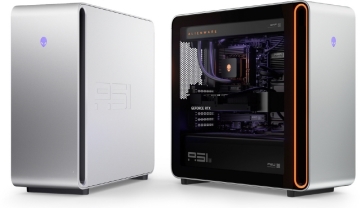
Dell Technologies Launches the Alienware Area-51 with AMD Ryzen 7 9850X3D
Dell Technologies has launched the 2026 'Alienware Area-51' gaming desktop equipped with the AMD Ryzen 7 9850X3D. It supports up to NVIDIA GeForce RTX 5090 and PCIe Gen5, targeting high-end gaming and AI-based work environments through a CPU power design exceeding 200W and up to 600W-class graphics power headroom. Thermal management has been enhanced with a positive pressure airflow structure and 360mm liquid cooling system, and the product also provides storage and graphics card expandability along with latest connectivity features including Wi-Fi 7. The product has been available for purchase on Dell's official website since early February.
2026.02.12by 명세환 기자











