


NVIDIA Accelerates Telecommunications Infrastructure Transformation with AI-RAN
 Published2026.03.12 11:15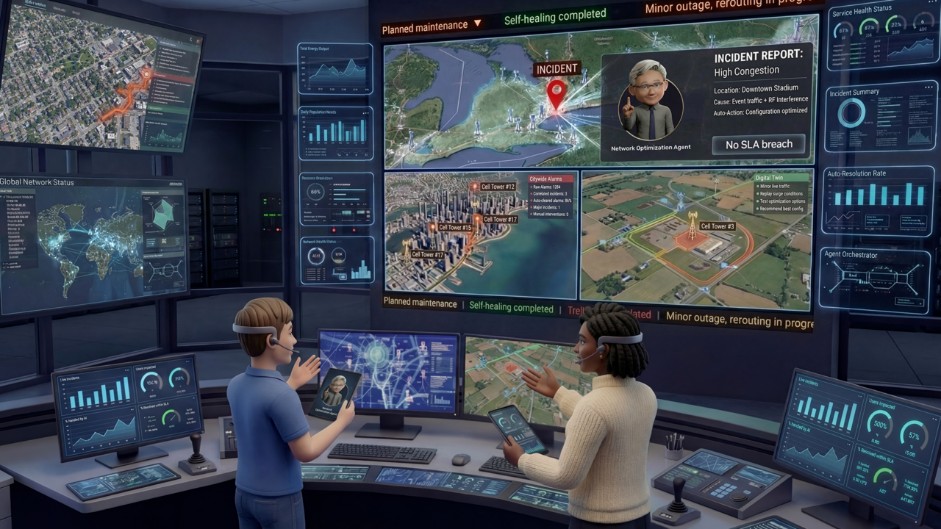
Strategy for implementing global cooperation and autonomous networks
NVIDIA unveiled its AI-RAN-based next-generation communications infrastructure strategy at the Mobile World Congress (MWC) in Barcelona, Spain, on March 12th. The event, attended by 105,000 attendees from 207 countries, featured NVIDIA and global telecommunications companies presenting AI-native 6G collaboration, autonomous network implementation technology, and the direction of AI-RAN commercialization.
Technically, NVIDIA has open-sourced a large-scale, 30 billion-parameter Nemotron-based communications model trained on communications data, enabling operators to build their own AI agents. Furthermore, through a blueprint proposing a multi-AI agent architecture, NVIDIA has laid the foundation for autonomous management of all operations, including network status analysis, traffic adjustments, and configuration changes.
The live demonstration demonstrated how AI-RAN expands beyond the lab into real-world environments. T-Mobile demonstrated technology that simultaneously performs RAN processing and AI workloads on NVIDIA platforms, and SoftBank achieved the industry's first 16-layer massive MIMO implementation. IOH and SynaXG also demonstrated the commercial viability of software-defined 5G and AI-RAN, presenting various application examples such as robot control and ultra-low-latency communications.
The NVIDIA AI Aerial platform provides accelerated computing and software tools for building AI-native wireless networks, and was used in 26 of the 33 AI-RAN Alliance demos at MWC this year, demonstrating the accelerating expansion of the ecosystem.
Nvidia CEO Jensen Huang emphasized the importance of global cooperation, saying, “Just as AI has redefined computing, communications will also be transformed into AI infrastructure.”
Industrially, this announcement demonstrates that the core infrastructure of the 6G era is evolving from a simple connectivity network to an intelligent, autonomous network. This represents a shift in telecommunications companies' role from simple service providers to AI-based infrastructure operators, and is expected to form the foundation for diverse industries, including robotics, autonomous machines, and generative AI.

Comments
Related news

Cloudera Unveils NVIDIA-Powered On-Premises AI Inference Capabilities
Cloudera announced that it is providing 'Cloudera AI Inference' powered by NVIDIA technology in on-premises environments. Enterprises can deploy and scale large language models (LLMs) and models for anomaly detection, computer vision, and speech AI in their data centers. The 'Cloudera Data Warehouse' based on Trino also expands data center support to centralize security, governance, and visibility while enhancing data accessibility. Data visualization includes feature updates such as AI annotation, query logging and tracing, and simplified administrative configuration.
2026.02.10by 명세환 기자
Dell Technologies Launches the Alienware Area-51 with AMD Ryzen 7 9850X3D
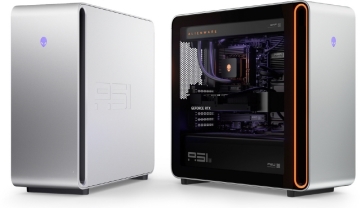
Dell Technologies has launched the 2026 'Alienware Area-51' gaming desktop equipped with the AMD Ryzen 7 9850X3D. It supports up to NVIDIA GeForce RTX 5090 and PCIe Gen5, targeting high-end gaming and AI-based work environments through a CPU power design exceeding 200W and up to 600W-class graphics power headroom. Thermal management has been enhanced with a positive pressure airflow structure and 360mm liquid cooling system, and the product also provides storage and graphics card expandability along with latest connectivity features including Wi-Fi 7. The product has been available for purchase on Dell's official website since early February.
2026.02.12by 명세환 기자
NVIDIA's Blackwell Platform Reduces AI Inference Costs by Up to 10x Per Token
NVIDIA is accelerating AI adoption across industries by reducing the cost per token for AI inference services by up to 10 times through its next-generation AI computing platform, NVIDIA Blackwell.
2026.02.20by 배종인 기자
.jpg)
NVIDIA Accelerates the Era of Agentic AI with Blackwell Ultra, Delivering 50x Performance and 35x Cost Savings
NVIDIA is transforming the AI infrastructure market by dramatically enhancing agentic AI inference performance and cost efficiency through its next-generation 'NVIDIA Blackwell Ultra' platform. On the 23rd, NVIDIA announced that the GB300 NVL72 system based on Blackwell Ultra improves throughput per megawatt by up to 50x compared to the existing Hopper platform, and reduces cost per one million tokens by up to 35x.
2026.02.23by 배종인 기자

NVIDIA Innovates AI Training and Inference with NVFP4… Securing Both Performance and Efficiency
Nvidia is accelerating a paradigm shift in AI computing by dramatically improving AI training and inference performance through NVFP4, its next-generation low-precision computation format. Nvidia announced on the 23rd that technology based on NVFP4 enables optimization of large-scale AI workloads by simultaneously improving throughput and energy efficiency while maintaining high accuracy.
2026.02.23by 배종인 기자











