



'E2E Autonomous Driving' Learning from Real-World Data Begins in Full Swing
 Published2026.03.17 11:12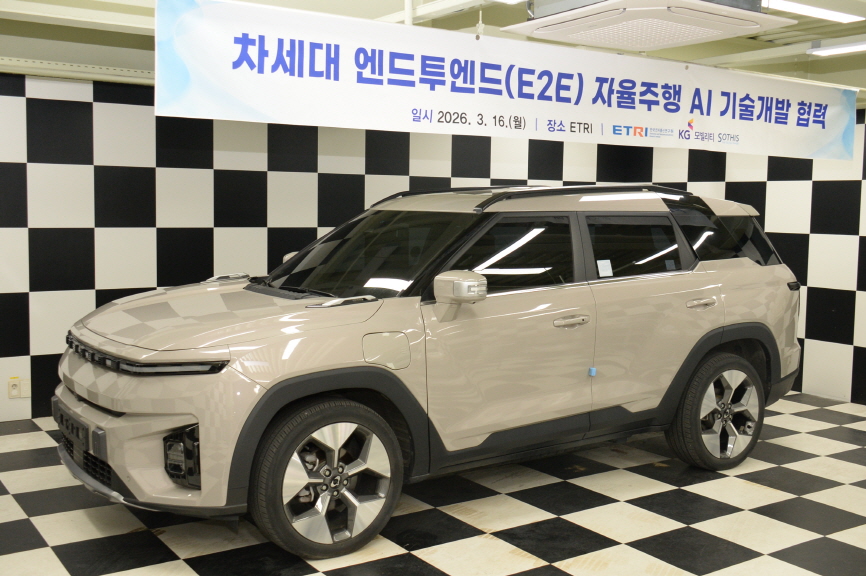
ETRI, KG Mobility, and Sodis Collaborate… Integrated Learning from Perception to Control with a Single AI
The Electronics and Telecommunications Research Institute (ETRI) announced on the 17th that it has entered into cooperation with KG Mobility and Sodis, a company specializing in autonomous driving, to develop next-generation end-to-end (E2E) autonomous driving artificial intelligence technology. A signing ceremony for a letter of intent was held at ETRI in Daejeon on the 16th, and the three organizations agreed to jointly pursue technology development, demonstration, and industrial application.
The core of this research lies in implementing 'driving intelligence' in which artificial intelligence comprehensively understands the road environment and independently determines the vehicle's steering, acceleration, and deceleration. It is designed to determine driving strategies in a human-like manner by utilizing large-scale driving data and vehicle movement information collected from actual roads for learning.
Conventional autonomous driving technology typically features a structure where perception, decision-making, and control functions are processed step-by-step by separate systems. In contrast, this research applies an end-to-end approach where a single integrated AI model interprets road conditions and simultaneously determines vehicle steering and speed control. Furthermore, methods are being explored to enhance decision-making accuracy even in complex road environments by incorporating a multimodal AI structure that understands both visual information and situational context.
The research team is also pursuing an approach that reduces reliance on expensive LiDAR sensors and combines camera-centric visual information with artificial intelligence decision-making capabilities. Through this, the goal is to develop an intelligent driving model capable of stable autonomous driving with a minimal sensor configuration.
The three institutions plan to proceed in stages with data acquisition in real-world road environments, AI model training, and demonstration of application in actual vehicles. The research team envisions expanding this technology into a general-purpose mobile intelligence technology applicable not only to automobiles but also to various mobile devices such as robots and drones.

Comments
Related news
High-performance SoCs, accelerating the era of autonomous driving, are rapidly emerging as a key player in the automotive industry.
According to a Technical Article from Texas Instruments titled "Why Scalable High-Performance SoCs Are the Future of Autonomous Vehicles," automotive manufacturers are accelerating their transition to software-defined vehicles (SDVs) by adopting centralized computing platforms instead of distributed electronic control unit (ECU) architectures, enabled by high-performance systems-on-chip (SoCs) that simultaneously offer scalability and performance.
2026.01.27by 명세환 기자
ETRI ushered in an era of autonomous driving transportation with speeds of up to 80 km/h.
The autonomous driving artificial intelligence (AI) and vehicle-to-infrastructure communication technology developed by the Electronics and Telecommunications Research Institute (ETRI) are being applied to actual public transportation, marking the full opening of the era of wide-area autonomous driving transportation connecting Daejeon and Sejong.
2026.01.30by 배종인 기자
Global Automotive Industry in 2026, 'Test of Transformation'
The Korea Automotive Technology Institute (KATECH) recently forecasted through a special industrial analysis report that significant changes in the global automotive industry will enter a critical testing phase starting in 2026. The report presented five key issues for the automotive industry in 2026: △autonomous driving and robotics △powertrain electrification △software-defined vehicles (SDV) and user experience (UX) △complete vehicle market dynamics △and global core component supply.
2026.02.06by 배종인 기자
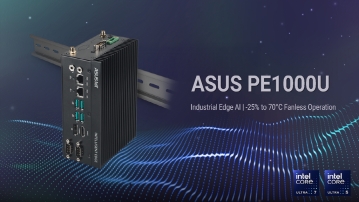
ASUS Launches PE1000U, an Ultra-Compact Edge AI Computer for AMR and Robotics
ASUS Korea has launched the PE1000U, an ultra-compact edge AI computer for AMR (autonomous mobile robots), robotics, and computer vision applications. Based on Intel Core Ultra Series 2 processors, it supports CPU·GPU·NPU hybrid acceleration and is designed to enable concurrent motion control, AI inference, and graphics processing. It features dimensions of 63×110×160mm and adopts DIN rail mounting, with an IP40 sealed chassis, vibration durability rated to MIL-STD-810H standards, and an operating temperature range of -25~70℃. It targets on-site sensor, camera, and vehicle-mounted environments through dual 2.5GbE Ethernet, USB, COM, dual CAN bus, isolated DIO, 4K dual display output, and Wi-Fi 6E and 5G support.
2026.02.11by 명세환 기자
Semiconductors are the key to the evolution of automobiles into 'moving computing platforms'
Autonomous driving technology is no longer a story of the distant future. An era is rapidly approaching in which vehicles recognize their surrounding environments and make judgments to assist or take over driving. At the center of this transformation lies the evolution of software and semiconductor technology. Recently, the automotive industry is shifting away from a hardware-centric structure toward a new design paradigm that places software at its core, fundamentally changing the quality of autonomous driving experience.
2026.03.03by 배종인 기자











