



Theori Participated Research Adopts NDSS… Presents New Path for Linux Kernel Attacks
 Published2026.03.18 09:16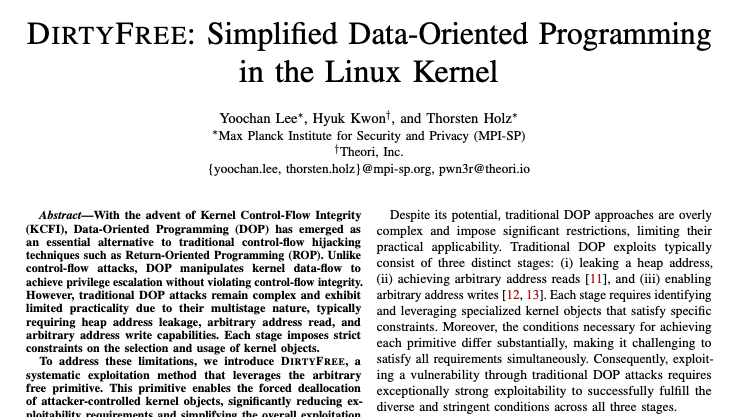
'DirtyFree' Unveiled Targeting Enhanced Kernel Defense Environments
Theory announced that the paper 'DirtyFree: Simplified Data-Oriented Programming in the Linux Kernel,' co-authored by one of its researchers, was released at NDSS. This research was a joint effort between researchers from the Max Planck Institute in Germany and Theory. NDSS is considered one of the major academic conferences in the field of information security.
With the recent introduction of protection techniques such as KCFI into the Linux kernel, traditional attacks that alter the execution flow of programs are becoming increasingly difficult. Consequently, data-oriented programming attacks that compromise system privileges by modifying data values or structures have been discussed as an alternative. However, the existing method had limitations in actual application because it required conditions such as memory address leakage or random address writing.
The 'DirtyFree' proposed by the research team is a method that forcibly frees memory and injects a fake object intended by the attacker into that location. It is designed to allow manipulation of internal kernel data structures without complex preconditions. During the research process, 14 new objects usable for attacks were identified in the kernel heap area.
This technique also demonstrated its scope of application in actual vulnerability verification. The research team proved the feasibility of attacks targeting 24 Linux kernel vulnerabilities, showing that DirtyFree is not a method limited to specific cases. This highlights the importance of kernel security checks in various industries that operate based on the Linux kernel, such as servers, the cloud, and embedded devices.
This study is significant in that it went beyond merely presenting attack techniques to address defensive measures as well. Theori explained that they implemented two defense mechanisms capable of blocking the attack and suppressed performance degradation to a low level. This research is interpreted as suggesting that kernel security must expand beyond simple vulnerability patches to encompass the entirety of memory management structures and object processing methods.

Comments
Related news
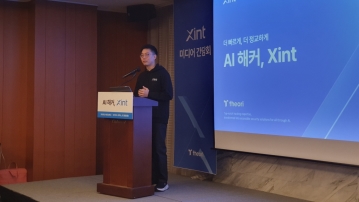
"Jint," an AI hacker who thinks like a hacker, blocks even unpredictable attacks."
Cybersecurity specialist Theori (CEO Park Se-jun) has officially launched its AI-based security service 'Xint' in Korea. The newly unveiled 'Xint' is an AI hacker developed by Theori by training AI on hacking techniques and problem-solving processes accumulated over the past 10 years. Xint enables AI to continuously perform inspections 24 hours a day, 365 days a year, and proposes attack scenarios and generates test code with human-level contextual understanding. Through this, enterprises can achieve sustainable security operations.
2025.10.28by 배종인 기자
.jpg)
Tiori and POSCO DX Establish AI Security System for the AX Era and Launch Business in Full Scale
Offensive cybersecurity specialist Theori (CEO Park Se-jun) and POSCO DX (CEO Shim Min-seok) are proactively building an AI security system to counter increasingly sophisticated and advanced security threats in the age of AI transformation (AX), and are launching full-scale commercialization efforts both internally and externally.
2025.12.01by 배종인 기자

Theory and Pohang University of Science and Technology (POSTECH) Launch Joint Research on AI and IT Security
Offensive cybersecurity company TioRi is launching joint research with Pohang University of Science and Technology (POSTECH) in the fields of artificial intelligence (AI) and information security. The two institutions plan to jointly explore safe system operation technologies in multimodal, physical, and agentic AI environments, and cultivate practical talent through graduate internships and curriculum development. The research collaboration will be centered on 'AlphaPrism,' an LLM security solution developed by TioRi, with the goal of advancing technology through industry-academia partnerships and expanding the security ecosystem.
2026.02.19by 명세환 기자
.png)
Databricks Unveils Open AI Security Monitoring 'Lakewatch'
Databricks entered the security market on March 24 by unveiling LakeWatch, an open-source agentic SIEM. The core functionality of this product is to integrate and analyze security, IT, and business data in a single environment to support AI-based threat detection and investigation. The company explained that it reduces the limitations of existing security operations centers, which have had to forgo some data due to high cost structures, and enables large-scale data analysis and automation based on open formats and ecosystems. LakeWatch is currently offered as a private preview, with Adobe and Dropbox mentioned as early customers. Databricks also announced an expanded partnership with Anthropic as well as the acquisition of Antimatter and SiftD.ai.
2026.03.26by 배종인 기자
Kaspersky Unveils Revamped 'NEXT' Combining SOC Integrated Management and AI Analytics
As enterprises increase demand for integrated management and automation in the construction and operation of Security Operations Centers (SOC), Kaspersky has disclosed updates to its B2B security product suite 'Kaspersky Next'. This update expands EPP, EDR, XDR, and SIEM integration through a single console based on OSMP, incorporates AI capabilities such as DLL hijacking detection and suspicious account takeover behavior identification, and includes integration with generative AI assistant tool KIRA. The company stated that in large-scale deployment environments, EDR Expert can reduce resource requirements by up to 30%, and XDR Expert by up to 60%.
2026.03.25by 배종인 기자











