


UNIST Develops Single Quantum Light Source with Reduced Energy Fluctuation Even When Controlled by Voltage
 Published2026.03.23 10:54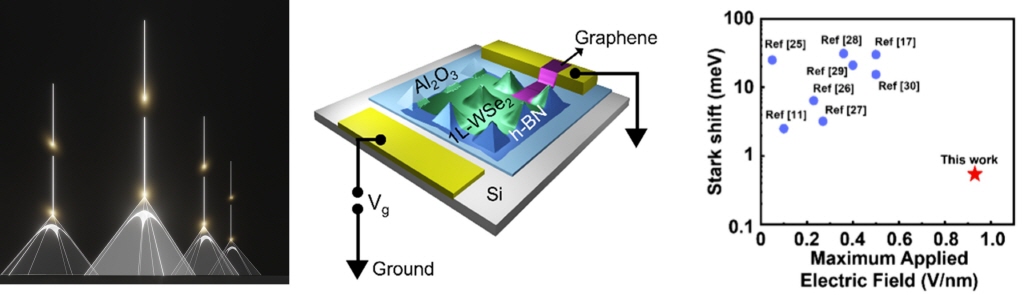
Application of a Stark effect suppression structure… Presents the possibility of realizing silicon chip-based quantum communication and quantum sensor devices
UNIST announced on the 23rd that a research team led by Professors Sun Namgung and Jehyeong Kim of the Department of Physics has developed a high-purity single-quantum light source based on a 2D semiconductor that suppresses the Stark effect. The research results were published online in the international academic journal 'Nano Letters' on March 11. Researchers Satyabrat Behera and Jongseong Moon participated as first authors in this study.
A single quantum light source is a light source that emits photons one by one for a very short duration. In quantum computing or quantum cryptography, this single photon is utilized as the smallest unit of information. However, when voltage is applied to turn a light source on and off, the Stark effect may occur, which changes the energy of the emitted photons. In this case, interference between photons becomes difficult, which can reduce the performance of quantum information processing.
To reduce this, the research team placed tungsten diselenide (WSe₂), a two-dimensional semiconductor material, on top of pointed silicon nanopyramids and designed it so that a fine air layer is formed between the silicon and the semiconductor. This air layer reduces the electric field transmitted to the semiconductor to about one-twentieth of the level of the periphery, thereby reducing changes in photon energy. In addition, a high-quality insulating layer was added to suppress background luminescence caused by surrounding defects.
The purity of the light source has also been improved. As a result of the study, the probability value indicating single-photon emission characteristics was measured at 0.06. Generally, if this value is 0.5 or lower, it is classified as a single-quantum light source, and the closer it is to 0, the higher the probability that only one photon is emitted at a time. The research team believes that the insulating layer contributed to the improvement in purity by reducing background luminescence.
This achievement is significant in that it demonstrates the potential for application in the development of chip-based quantum communication, photon quantum computing, and quantum optical sensors, based on compatibility with silicon semiconductor processes. It is evaluated as a technology that goes beyond merely improving the performance of individual light sources and can serve as a foundational technology for the development of quantum devices that require the integration of multiple light sources onto a single chip.

Comments
Related news

UNIST Implements First 100V Self-Powering Technology
UNIST researchers have developed a new electrochemical cell technology that produces high voltage without external stimuli by mimicking the biological structure of electric rays. This technology is attracting attention as a core foundational technology in next-generation energy harvesting fields such as wearable power devices and self-generating sensors.
2026.01.21by 배종인 기자

Robotic arms don't tremble when suddenly lifting heavy loads.
The research team led by Professor Kang Sang-hoon from the Department of Mechanical Engineering at UNIST announced on the 26th that they have newly developed an 'adaptive PID control algorithm' that enables robot arms to operate stably even under sudden load changes or unexpected external contact situations. This technology significantly enhances the performance of PID controllers installed in over 90% of industrial robots, and can be applied to various fields including smart factories, rehabilitation robots, and humanoid robots.
2026.01.26by 명세환 기자
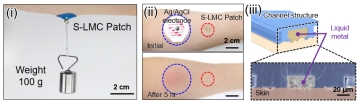
Development of an ECG patch that adheres to the skin without gel or chemical adhesives.
An electrocardiogram patch has been developed that solves the problems of cold sensation and skin irritation caused by gel and chemical adhesives in existing ECG patches through structural design alone. A research team at UNIST combined liquid metal with microstructured protrusions to create a patch that adheres closely to skin without gel and maintains high signal accuracy even during vigorous movement. The patch has lower electrode resistance than commercial products and enables repeated use, making it suitable for long-term monitoring. The research results have been published in the international journal Advanced Science.
2026.02.09by 배종인 기자
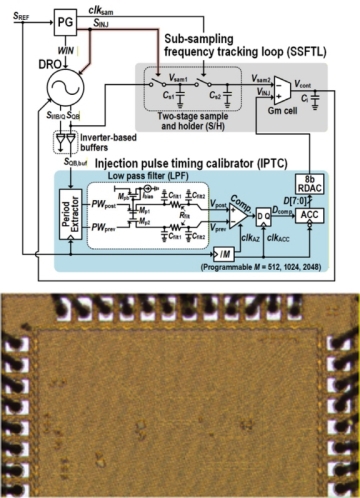
UNIST Develops Ultra-Compact, Low-Power Clock Generation Circuit with Minimized Reference Spurs
Professor Yoon Hee-in's research team at UNIST has developed an ILCM-based clock signal generation circuit with significantly reduced reference spurs. At 2.1GHz output, the circuit achieved reference spurs of −81.36dBc and jitter of 280.9fs, with an area of 0.0444mm² and power consumption of 12.28mW based on 28nm CMOS process. The research results were published in IEEE's 'Journal of Solid-State Circuits' on February 6th.
2026.02.12by 배종인 기자
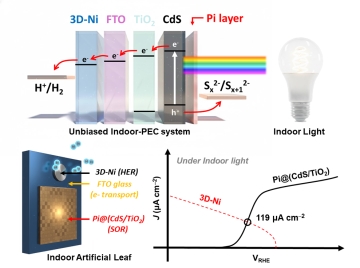
UNIST Develops 'Artificial Leaf' That Produces Hydrogen Using Only Indoor Lighting
Researchers at Ulsan National Institute of Science and Technology (UNIST) have developed an "artificial leaf" system that produces hydrogen under indoor LED lighting without external voltage. By combining a cadmium sulfide (CdS)-based photoelectrode with titanium dioxide (TiO₂) and incorporating a three-dimensional nickel (3D-Ni) catalyst, the team reduced charge recombination and suppressed photocorrosion even under weak illumination. The device recorded photocurrent of 119–120 μA/cm² and maintained 94% of its initial performance after 12 hours of operation. The research results were published online on the 16th of last month in the international academic journal Applied Catalysis B: Environmental and Energy.
2026.02.19by 배종인 기자











