


SKT and NTT Docomo Jointly Publish AI-RAN White Paper… Presenting Conditions for Next-Generation Wireless Network Implementation
 Published2026.03.31 10:42
.jpg)
From Base Station Virtualization to AI-RAN, Embracing Hardware & Software Separation, Resource Pooling, and AI Computing Directions
SK Telecom announced on the 31st that it has jointly published a white paper with NTT Docomo outlining key technical requirements and development directions for the evolution of virtualized base stations (vRAN) and the implementation of AI-RAN. Based on both companies' experience in building and operating mobile networks, the white paper consists of an analysis of the technical elements required from the perspective of mobile carriers and the expected benefits.
The first condition presented in the white paper is the separation of hardware and software. The explanation is that if base station control software is designed not to be dependent on specific equipment or virtualization platforms, functions can be rapidly deployed or improved independently of infrastructure replacement. Both companies viewed this as a foundation for more flexibly expanding network functions and as a prerequisite for the advancement of virtualized base stations.
The second key element is resource pooling. By integrating distributed computing resources into a single pool, it is possible to simultaneously expand base station capacity and improve power efficiency while maintaining service quality. This approach aims to enhance network operational efficiency and utilization by transitioning base stations, which were previously operated as fixed equipment units, into a more flexible resource allocation system.
The third point is the adoption of AI computing capabilities. The white paper pointed out that in an xPU-based virtualized base station architecture that includes various computing resources such as CPUs, GPUs, and NPUs, orchestration technology that allocates and manages both AI and communication resources is crucial. It explained that through this, the virtualized base station can evolve into an integrated platform—namely, an AI-RAN—that processes not only communication functions but also AI computations.
The two companies unveiled demonstration results for resource pooling and xPU-based orchestration technologies at MWC 2026, held earlier this month. Furthermore, since signing a research cooperation agreement for next-generation communication infrastructure technologies in November 2022, they have published joint white papers on power saving technologies and 6G requirements in 2023, and on considerations for the deployment and operation of virtualized base stations in 2024. The two companies plan to continue their cooperation in the fields of strengthening 5G competitiveness and improving efficiency, as well as 6G standardization and technology verification.

Comments
Related news
.jpg)
SKT Implements Special Communication Measures in Preparation for the Lunar New Year Holiday and Winter Olympics
SK Telecom will implement special communication measures to maintain the stability of telecommunications services during the Lunar New Year holiday and the Winter Olympics period. A special communication control room will be operated for six days from February 13 to 18 during the Lunar New Year holiday, and capacity inspections of base stations at approximately 1,200 major locations nationwide have been completed. Free video call services and intensive management of international roaming will be implemented during the holiday period, while wired and wireless network management in preparation for increased Winter Olympics content will also be conducted in parallel. Additionally, a 24-hour security monitoring system centered on the integrated security center will be operated, including responses to hacking, DDoS, and smishing attacks.
2026.02.09by 명세환 기자
.jpg)
SKT Unveils 'Full-Stack AI' at MWC 26... Fully Exhibiting Everything from Infrastructure to Models and Services
SK Telecom will showcase its "full-stack AI" capabilities covering AI infrastructure, models, and services at MWC26 held in Barcelona, Spain from March 2-5 (local time). The company will introduce AI data center operation platforms and network technologies including GPUaaS and AI-RAN, and will demonstrate physical AI-related technologies such as the ultra-large model 'A.X K1' that has advanced to the second phase of the government's "independent AI foundation model" project, as well as digital twin, robot training, and vision solutions. During the event, SK Telecom will explore collaboration opportunities with global telecom operators, AI data center operators, and startups, while also supporting exhibitions and investment attraction for domestic AI startups.
2026.02.23by 명세환 기자
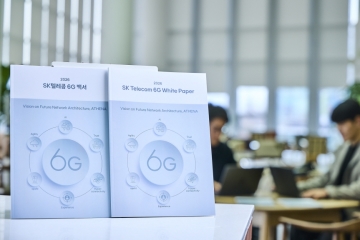
SKT publishes its third 6G white paper, "ATHENA," presenting a blueprint for an AI-based network.
SK Telecom announced on the 23rd that it has published its third 6G whitepaper titled 'ATHENA' and unveiled a mid-to-long-term network evolution strategy in preparation for the AI era beyond 2030. The whitepaper presents six major visions based on the fundamental values of networks—security, stability, and quality—including AI-native architecture, zero-trust security, converged infrastructure of 5G, 6G, and satellite communications, an open ecosystem, cloud-native based virtualization, and customer experience-centric structure. SKT has defined the 'ATHENA' architecture encompassing radio access network (RAN), core network, transmission network, and network data platform, and plans to showcase AI-RAN, on-device AI-based antenna optimization, and integrated communication and sensing technologies at MWC26. The company is also engaging in international standardization activities in parallel.
2026.02.23by 명세환 기자
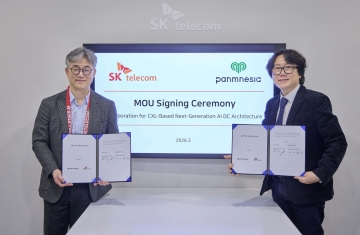
SKT and Panesia Jointly Develop Next-Generation AI Data Center Architecture Based on CXL
SK Telecom announced that it has signed a Memorandum of Understanding (MOU) with Panesia for joint development of a "next-generation AI datacenter (DC) architecture" based on CXL (Compute eXpress Link) at MWC26 held in Barcelona, Spain. The two companies will transition from an expansion method centered on GPU addition to a structure that flexibly connects and combines CPU, GPU, and memory, thereby improving resource utilization efficiency and reducing cost burden. They will expand the scope of resource connection, previously limited within servers, to the rack unit level, and will also review the application of CXL-based connectivity in place of general-purpose networks during GPU collaborative computing processes. After validating utilization rate, latency, and throughput using actual AI models, they plan to disclose deliverables by the end of 2026 and promote large-scale environmental demonstration and commercialization.
2026.03.04by 배종인 기자
.jpg)
SKT Partners with Supermicro and Schneider to Build Modular AI Data Centers at MWC26
SK Telecom has signed a three-party Memorandum of Understanding (MOU) with Supermicro and Schneider Electric at MWC26 held in Barcelona, Spain, to build an AI data center (AI DC). The three companies will jointly review an integrated solution using a "Pre-fabricated Modular" approach, in which servers and equipment such as power and cooling systems are integrally designed in module units, pre-manufactured, and then assembled on-site. SKT will participate in promoting the integrated model based on its operational experience, while Supermicro will take on the role of GPU server and cluster configuration capabilities, and Schneider will be responsible for MEP (Mechanical, Electrical, and Plumbing) design and operational solution services. Specific construction timelines and cost reduction figures have not been disclosed.
2026.03.04by 명세환 기자











