


Humanoid Robots Move Beyond Demonstration to Adoption Stage… KIMM: “The Next Five Years Will Be a Watershed”
 Published2026.04.08 16:04
In the 122nd issue of 'Machine Technology Policy,' published on the 8th, the Korea Institute of Machinery and Materials (KIMM) identified 2026 as the year when humanoid robots will move beyond the R&D-focused stage and begin limited demonstration and commercialization reviews in earnest. The report explained that in the industrial sector, the ability to demonstrate cost-effectiveness and efficiency when deployed in actual processes has recently become a more important criterion than the robot's operational performance itself.
Market expansion is proceeding in both price and supply. Citing forecasts from major investment firms, the report predicted that there is a high likelihood of simultaneous declines in manufacturing costs and increases in shipments over the next few years. It added that some companies are rapidly lowering sales prices to reduce market entry barriers, thereby increasing the conditions for humanoids to be considered as targets for facility investment rather than merely test equipment.
It was assessed that the competitive landscape by country is also distinct. The United States is striving to secure market dominance based on AI models, semiconductors, and computing infrastructure, while China is enhancing its production and price competitiveness by launching new products through numerous companies. On the other hand, it was pointed out that while Korea has strengths in semiconductors, batteries, and manufacturing automation infrastructure, its supply chain for general-purpose AI and humanoid specialized components is a relatively weak area.
However, it was noted that opportunities centered on domestic manufacturing sites still remain. Hyundai Motor Group has announced plans to establish a robotic production system, and Samsung Electronics is also expanding its investment in the robotics sector. Based on these trends, the Korea Institute of Machinery and Materials explained that a strategy is needed to achieve results first in sectors with clear demand for specific manufacturing processes, such as semiconductors and automobiles, rather than competing on general-purpose platforms.
The Korea Institute of Machinery and Materials (KIMM) proposed that the internalization of core components and global AI cooperation be pursued simultaneously as a response strategy. This suggests that while enhancing the competitiveness of key components such as actuators and control systems, AI capabilities must be supplemented through external collaboration. KIMM announced that it will operate a strategic research group from May 2025 to April 2030 to establish a standard platform, an autonomous growth brain, and data infrastructure, and is developing its proprietary humanoid robot, 'Kairos,' with the goal of an initial public unveiling in April 2027. Ultimately, KIMM explained that the competitiveness of the domestic humanoid robot industry depends not on the technology demonstration itself, but on how quickly demand for actual application in manufacturing sites can be secured.

Comments
Related news
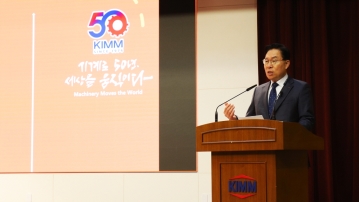
KIMM President Ryu Seok-hyun announces "KIMM-NEXT 50" to mark the 50th anniversary of the institute's founding.
Korea Institute of Machinery and Materials (KIMM, Director Ryu Suk-hyun), a leading research institution under the National Research Council of Science and Technology, held its New Year ceremony on the 2nd and announced its future research direction and core strategies, presenting the vision of "Moving the world with machinery for 50 years."
2026.01.05by 배종인 기자
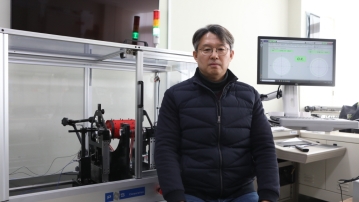
AI-based rotor imbalance measurement technology breaks through the 0.1㎛ limit.
The research team led by Dr. Kim Byung-ok, Principal Research Scientist at the AX Convergence Research Center of the Virtual Engineering Platform Research Division at the Korea Institute of Machinery & Materials (KIMM) under the National Research Council of Science & Technology, and P&S Co., Ltd. have jointly secured core technologies for high-precision automated balancing machines.
2026.02.05by 배종인 기자
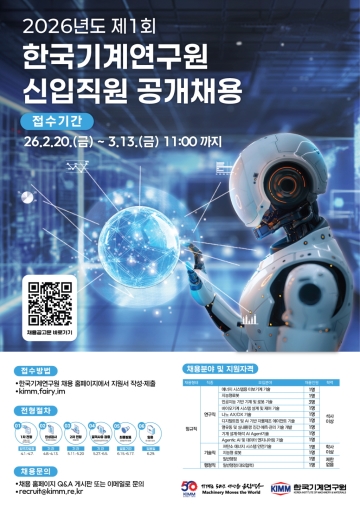
Korea Institute of Machinery and Materials is recruiting key talent to lead AX, AI, and carbon neutrality.
The Korea Institute of Machinery and Materials (KIMM) under the Ministry of Science and ICT, led by President Ryu Seok-hyun, will recruit 15 personnel across 13 fields in 3 job categories—research, technical, and administrative positions—through the "First Open Recruitment of New Employees for 2026."
2026.02.20by 배종인 기자
.jpg)
Robots that learn daily routines liberate people from repetitive labor
The Korea Institute of Machinery and Materials under the National Research Council of Science and Technology has developed a robot task AI that learns from human task demonstrations and performs various everyday operations. By enabling robots to flexibly handle simple yet labor-intensive tasks such as item organization and table arrangement, the application scope is expected to expand widely from homes and office spaces to retail and logistics sites.
2026.03.12by 배종인 기자
.jpg)
AI Humanoids Deployed on Automotive Production Lines… The Era of 'Physical AI' Begins in Domestic Manufacturing Sites
Korea Institute of Machinery and Materials (KIMM), Electronics and Telecommunications Research Institute (ETRI), and KG Mobility have concluded a tripartite memorandum of understanding for the development and demonstration of AI humanoid robots customized for manufacturing sites. According to the agreement, the humanoid robot being developed will be directly deployed in KG Mobility's vehicle production process.
2026.03.20by 배종인 기자











