


KIMS and Pusan National University Develop Real-Time Diagnosis Technology for Water Electrolysis Performance Degradation
 Published2026.04.09 14:06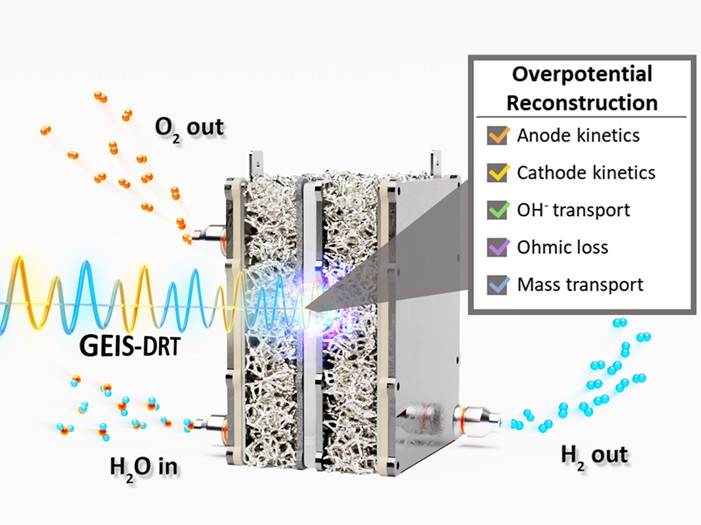
Isolation of the Causes of Anion Exchange Membrane Water Electrolysis Voltage Loss via Two-Electrode Based Analysis
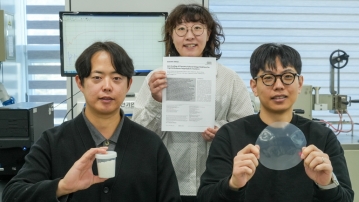
The Korea Institute of Materials Science announced that a research team led by Dr. Seungmok Choi of the Energy and Environmental Materials Research Division developed the relevant technology in collaboration with a research team led by Professor Yangdo Kim of Pusan National University. The research results were published online in the international academic journal ACS Energy Letters on March 27.
Water electrolysis is a technology that produces hydrogen by electrolyzing water. Among these, anion exchange membrane water electrolysis has been attracting attention as a next-generation hydrogen production method, but there was a problem where performance deteriorated as the voltage increased during long-term operation. The actual equipment consists of a two-electrode structure, so while changes in overall performance can be verified, there were limitations in distinguishing and analyzing specific causes.
Previously, electrode reactions were analyzed separately using three-electrode methods or half-cell experiments, but it was pointed out that this differed from the actual unit cell operating environment, making it difficult to adequately reflect issues at the commercialization stage. To address this, the research team combined electrochemical impedance spectroscopy data obtained from a unit cell in actual operation with a distributed relaxation time analysis technique and established an analysis system to isolate overvoltage.
By applying this technology, the causes of voltage loss can be analyzed by classifying them into electrode reaction resistance, hydroxide ion transfer resistance, membrane and contact resistance, and mass transfer resistance. The research team explained that they confirmed that performance degradation is the result of a complex interplay of ion transfer and mass transport limitations, in addition to simple electrode degradation. Furthermore, they verified the reproducibility of the analysis results through repeated experiments varying electrolyte concentrations and membrane conditions.
This technology is noteworthy for its ability to distinguish reaction characteristics by electrode in an actual two-electrode-based water electrolysis system without the need for a separate three-electrode device. The research team anticipates that this technology can be utilized in the development of electrode materials, the design of membrane and electrode structures, and the establishment of system operation strategies.

Comments
Related news
.jpg)
Korea Institute of Materials Science (KIMS) breaks new ground in unmanned aerial vehicle technology... Fuel cell drone achieves 12-hour continuous flight.
The Korea Institute of Materials Science (KIMS) has independently developed a 1.2kW-class fuel cell and succeeded in continuous flight of an unmanned aircraft utilizing this technology for over 12 hours. This achievement is evaluated as the longest domestic flight record among fuel cell-based unmanned aircraft and represents world-class technology by civilian standards.
2025.08.04by 명세환 기자
Korea Materials Research Institute Accelerates Global Collaboration in Materials Science
The Korea Institute of Materials Science (KIMS, Director Chol-Jin Choi) has established the KIMS-NIMS International Joint Research Center together with Japan's National Institute for Materials Science (NIMS, Director Kazuhiro Hono), and will conduct joint research projects at a world-class level.
2025.10.15by 명세환 기자
Korea Institute of Materials Science and Samsung Heavy Industries Join Forces to Secure Sovereignty in Materials
The Korea Institute of Materials Science (KIMS, Director Choi Chul-jin) and Samsung Heavy Industries (SHI) have joined forces to establish the 'KIMS-SHI Materials Innovation Research Center,' holding a dedication ceremony at the KIMS headquarters in Changwon, Gyeongnam on November 28th.
2025.12.01by 배종인 기자
The Korea Institute of Materials Science selected five projects, the largest number ever, for its 2025 National R&D Excellence List.
The Korea Institute of Materials Science (KIMS, Director Choi Cheol-jin) has raised expectations for technology transfer and commercialization as a record five projects have been selected for the 2025 National Research and Development Excellence Awards.
2025.12.24by 배종인 기자
KERI Breaks Performance Limits of Eco-friendly Insulation Materials… Innovation Expected in High-Voltage Power Equipment
A research team led by Dr. Yu Seung-gun at the Insulation Materials Research Center of the Korea Electrotechnology Research Institute (KERI) has demonstrated a technology that overcomes the structural limitations of polypropylene, a conventional insulation material, and implements stable performance even in high-voltage environments.
2026.02.23by 배종인 기자











