



IBS, UNIST, and POSTECH Improve Room-Temperature Luminescence Performance of 2D Semiconductor Quantum Light Sources
 Published2026.04.14 10:14
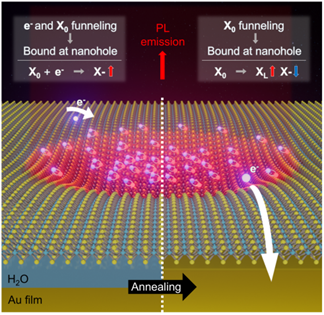 A joint research team from the Institute for Basic Science (IBS), UNIST, and POSTECH has enhanced the room-temperature luminescence performance of a 2D semiconductor-based quantum light source. This is the result of controlling the exciton diffusion problem, which has been cited as a hurdle for room-temperature operation, through nano-structure design.
The results of this study were published in the international journal Science Advances on March 13. The research team noted that while two-dimensional semiconductors have been attracting attention as next-generation optoelectronic materials, at room temperature, excitons spread easily and excess charge interferes with light emission, making it difficult to stably emit light at specific locations.
Excitons are quasiparticles formed by the combination of electrons and holes, playing a key role in generating light in semiconductors. In particular, localized excitons, which remain in a narrow region, have great potential as quantum light sources, but their formation has been difficult in room-temperature environments with high thermal energy. To overcome this limitation, the research team placed a nanohole structure with a diameter of 500 nanometers beneath a two-dimensional semiconductor and cleared the charge environment by removing the water layer between the semiconductor and the gold substrate through heat treatment.
In this process, excitons gathered in a narrow region at the center of the nanohole, and the conditions for them to be emitted as light without losing energy were also improved. According to the research team, the exciton confinement efficiency was found to be approximately 98%, and the luminescence efficiency increased by about 130 times compared to existing methods. The team explained that through this, they confirmed that a two-dimensional semiconductor-based light source can operate relatively brightly and stably even at room temperature.
This achievement is significant in that it expands the scope of research on quantum photonic devices operating at room temperature. However, rather than immediately entering the commercialization stage, this research is closer to presenting a structure capable of precisely controlling the processes of light generation and extinction at room temperature. The research team anticipates that by further fine-tuning the nanostructure and refining light irradiation conditions, this research could be extended to room-temperature single-photon sources in the future.

Comments
Related news

Cloudflare Implements Quantum-Resistant Encryption Across All Cloudflare One Routes
Cloudflare has announced that it has applied post-quantum cryptography across its SASE platform 'Cloudflare One.' Following the deployment in Secure Web Gateway and Zero Trust domains in 2025, the company has now expanded it to IPsec-based WAN segments. This move is interpreted as a response to quantum threats across enterprise networks, particularly as the U.S. National Institute of Standards and Technology (NIST) recommends transitioning from existing public key cryptography around 2030. The measure is evaluated as a step to strengthen long-term data protection against potential "harvest now, decrypt later" attacks.
2026.02.25by 배종인 기자
Nota Unveils Upstage's "Solar Open 100B" Quantization Model, Increasing Weight Memory from 191.2GB to 51.9GB
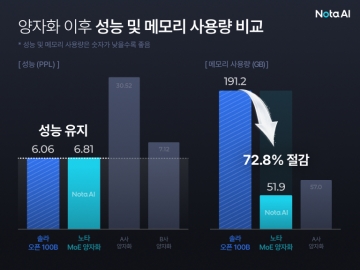
As quantization competition to reduce GPU memory burden—a key variable in AI model operating costs—spreads to large language models (LLMs), Nota has released a quantized model targeting Upstage's 'Solar-Open-100B' on Hugging Face. According to the model card, applying 'Nota MoE Quantization' reduced the weight memory footprint from 191.2GB to 51.9GB. In terms of performance metrics, the perplexity (PPL) on WikiText-2 is presented as 6.81 compared to the original model's 6.06. Nota explained this as a technique to reduce quantization distortion that can occur in MoE structures, and some reports also mentioned linkage with the Ministry of Science and ICT's 'Independent AI Foundation Model' project as well as patent applications.
2026.03.05by 배종인 기자
Conditions for Maintaining Quantum Catalysts in Noisy Environments
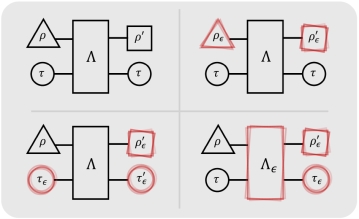
An international research team has mathematically formulated the conditions under which quantum catalysts—referred to as "reusable auxiliary resources" in quantum computation—maintain their catalytic effect, based on the premise that they can be easily degraded in realistic noisy environments. The researchers explained that minor errors accumulated during input state preparation can gradually alter the catalyst, making repeated use difficult, and that a "catalyst channel" structure designed to ensure the catalyst is always restored to its original state is a general method to avoid such problems. The results can be found in a paper published in Physical Review Letters and in an arXiv preprint.
2026.03.05by 명세환 기자
.jpg)
Infineon Strengthens Future Mobility Security with Quantum-Resistant Cryptography
As vehicle electrical system security becomes increasingly important, Infineon Technologies has unveiled the TEGRION™ SLI22, manufactured using a 28-nanometer process, and presented security technologies to prepare for advancing cyber threats and the quantum computing era. The SLI22, based on Infineon's Integrity Guard 32 architecture, has enhanced system integrity and data protection capabilities. Additionally, by applying the new ETSI MFF3 package, it significantly reduces installation footprint compared to existing packages, enabling flexible design even in vehicle electrical environments with severe space constraints.
2026.03.09by 배종인 기자

[Special Report] Robot Design Overcomes 'Physical SOC' Limitations: Dabo Executive Vice President Yong-gyu Cho Reveals Infineon's Robotics Systems Philosophy
Jo Yong-gyou, Executive Director at DABO, emphasized a design philosophy centered on system-level approaches rather than individual components through a robotics webinar co-hosted with Infineon Technologies. Executive Director Jo diagnosed that "humanoids must simultaneously control dozens of joint motors, making system-level approaches essential." The core solution, the P4C3 MCU, is mounted on each joint in an ultra-compact form factor to perform high-speed computation and precision control. CoolGaN™, a next-generation power semiconductor, reduces losses by up to 60% compared to conventional silicon MOSFETs. This enables a 40% reduction in motor driver size and eliminates the need for heat sinks, dramatically reducing the robot's weight and volume. Executive Director Jo defined Infineon's SOC (System on Chip) concept as "a design philosophy that organically integrates an optimal semiconductor ecosystem rather than a single chip," and emphasized that developers can shorten POC and time-to-market through validated reference designs. Additionally, he presented a strategy that combines integrated sensor solutions such as radar and ToF with quantum-resistant security technology to simultaneously secure both the robot's cognitive capabilities and safety.
2026.03.12by 명세환 기자











