


KIMS and UNIST Develop Electrochemical System for Simultaneous Production of Hydrogen and Formate Using Waste Glycerol
 Published2026.04.14 14:21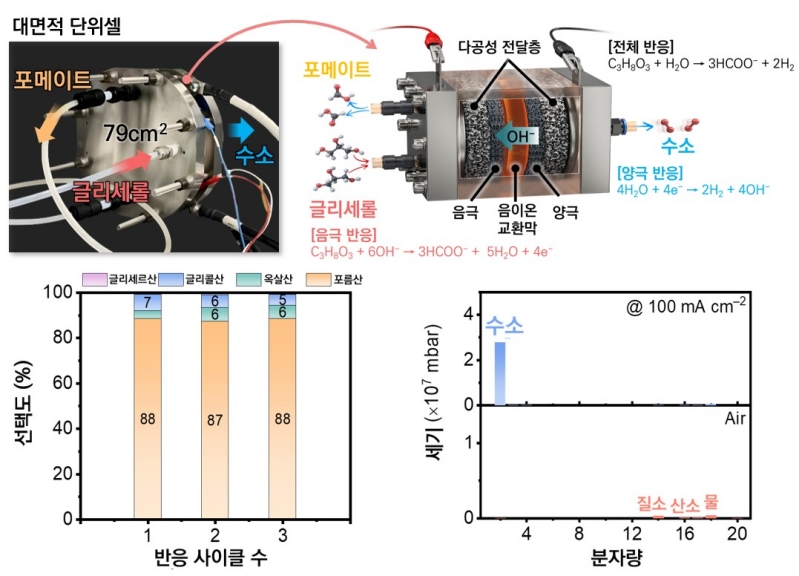
Applying glycerol oxidation reaction instead of oxygen evolution reaction, checking scalability with a 79㎠ cell
This research was jointly conducted by the research team led by Principal Researcher Yang Ju-chan of the Korea Institute of Materials Science and the research team led by Professors Jang Ji-wook, Lim Han-kwon, and Lee Ho-sik of UNIST. The research results were published in the international journal Joule on March 18.
Conventional water-based electrolysis had limitations, such as a high energy burden and slow reaction speed due to the oxygen evolution reaction at the anode. The research team altered the reaction pathway by introducing glycerol, a biodiesel byproduct, into this section. The structure produces hydrogen while simultaneously obtaining formate.
The research team announced that they achieved a current density of 110 mA/cm² at 1.31 V by applying a copper-cobalt oxide-based non-precious metal catalyst. They explained that the formate selectivity of the product was approximately 96%, and stable performance was confirmed even in a large-area electrolytic cell of 79 cm².
This result is significant in that it expands the water electrolysis process, which previously produced only hydrogen, into a process that produces both hydrogen and chemical raw materials. However, further verification is required for actual industrial application, including continuous process operation, the use of actual waste glycerol as a raw material, long-term durability, and separation and purification costs.

Comments
Related news
UNIST Develops 'Artificial Leaf' That Produces Hydrogen Using Only Indoor Lighting
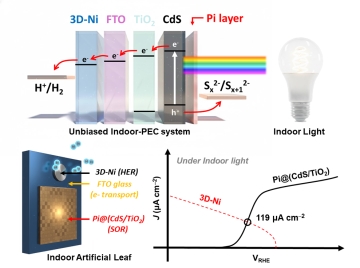
Researchers at Ulsan National Institute of Science and Technology (UNIST) have developed an "artificial leaf" system that produces hydrogen under indoor LED lighting without external voltage. By combining a cadmium sulfide (CdS)-based photoelectrode with titanium dioxide (TiO₂) and incorporating a three-dimensional nickel (3D-Ni) catalyst, the team reduced charge recombination and suppressed photocorrosion even under weak illumination. The device recorded photocurrent of 119–120 μA/cm² and maintained 94% of its initial performance after 12 hours of operation. The research results were published online on the 16th of last month in the international academic journal Applied Catalysis B: Environmental and Energy.
2026.02.19by 배종인 기자
KIMS Develops Non-Precious Metal OER Catalyst… Raising Possibility of Commercializing AEM Water Electrolysis
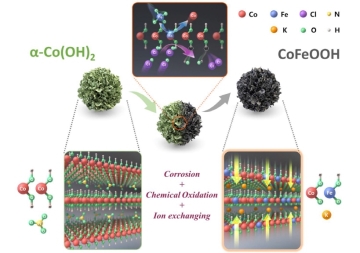
The Korea Institute of Materials Science has developed a non-precious metal oxygen evolution reaction (OER) catalyst applicable to anion exchange membrane water electrolysis (AEMWE). A cobalt-iron based oxyhydroxide (CoFeOOH) was designed with a layered structure, and the electronic structure and reaction pathway were precisely controlled by combining iron doping with surface chemical treatment. As a result, high current density was achieved even at low overpotential, and structural stability was secured during extended operation. The research team applied the catalyst to a unit cell and verified its performance and durability in an actual water electrolysis environment. This achievement, which reduces reliance on precious metals, is expected to contribute to the commercialization of low-cost, high-efficiency green hydrogen production technology.
2026.02.25by 배종인 기자
Lotte Air Liquide EnerHi Appoints Ahn Jung-soo as New CEO… Accelerating Strategy for Hydrogen Mobility Market
Lotte AirLiquide EnerHy appoints Ahn Kyung-su as new representative director and accelerates hydrogen business expansion.
2026.03.03by 배종인 기자

Water electrolysis efficiency is increased by iron substitution
The Korea Institute of Materials Science (KIMS) has moved a step closer to realizing the hydrogen economy by developing a high-performance alkaline water electrolysis catalyst through atomic structure control utilizing iron (Fe).
2026.03.17by 배종인 기자
KIMM, First Government-funded Research Institute to Release Machinery Research Data Externally
Korea Institute of Machinery and Materials (KIMM) has become the first among government-funded research institutes to publicly disclose mechanical research data and has begun operating a "Mechanical Data Platform." The platform is designed to systematically provide data types, generation conditions, producer information, and other details, enabling industries and researchers to locate necessary data and examine collaboration possibilities. In certain fields, raw data and guidebooks applicable to AI training are also provided together. KIMM plans to expand the scope of disclosure centered on eight priority areas including hydrogen society, AI robotics, and mobility, while establishing a mechanical data ecosystem that can be utilized in research and development as well as industrial applications.
2026.03.25by 명세환 기자











