


DeepX CEO Kim Nok-won aims for a victory with the trifecta of high performance, low power consumption, and low cost… Targeting the physical AI market using Hyundai Motor and Baidu as stepping stones.
 Published2026.04.14 16:42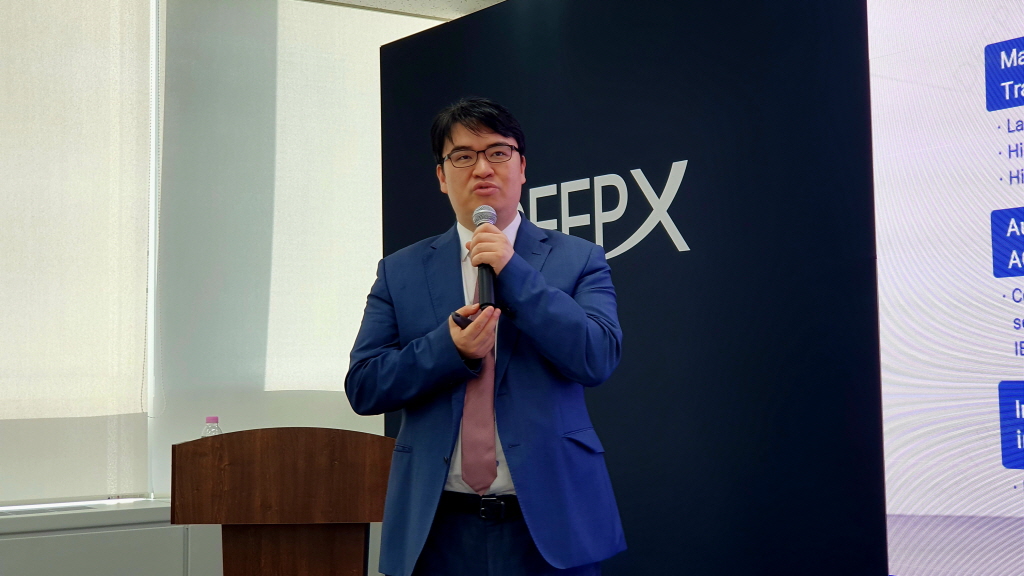
CEO Kim Nok-won is giving a presentation at a press conference held on the 14th.
4-Wat Power Consumption, Strengths in Heat Management and Battery Efficiency, On-Device AI as a Winning Strategy
“If you want to create AI, you should go to NVIDIA, but if you want to spread AI throughout the world and deploy it on actual devices, you need DeepX’s solutions.”
At a press conference held on the 14th, DeepX CEO Kim Nok-won summarized DeepX’s competitiveness as high performance, ultra-low power consumption, and low cost, stating, “We will compete in the on-device AI market, which runs on actual devices, rather than AI inside data centers.”
The key point of the announcement that day was that DeepX would not simply remain a 'domestic NPU developer,' but could enter a full-fledged growth trajectory alongside the expansion of the physical AI market, represented by humanoid robots, autonomous driving, factory automation, and smart cameras.
CEO Kim Nok-won predicted that NPUs are already being widely installed in smartphones and various devices, and that the related market will grow more than threefold within the next five years.
In particular, as demand for robots, robotaxis, dark factories, and home appliances and cameras with built-in AI capabilities skyrockets, it was emphasized that “the center of gravity of AI semiconductors will shift out of data centers.”
DeepX's The biggest weapon is its overwhelming power efficiency and price competitiveness.
CEO Kim explained that their chip offers performance equal to or higher than NVIDIA's Jetson Orin family of solutions, while being priced at around $40, which is significantly cheaper than competing products priced at around $800.
It is claimed that the power consumption is also at the 4-watt level, which is significantly lower than the 40-watt level of competing products, showing strengths in heat generation and battery efficiency.
He said, “What physical AI devices ultimately require is power efficiency, absolute heat generation, and price,” adding, “DeepX is recognized as the unrivaled No. 1 in these three areas and is being chosen.”
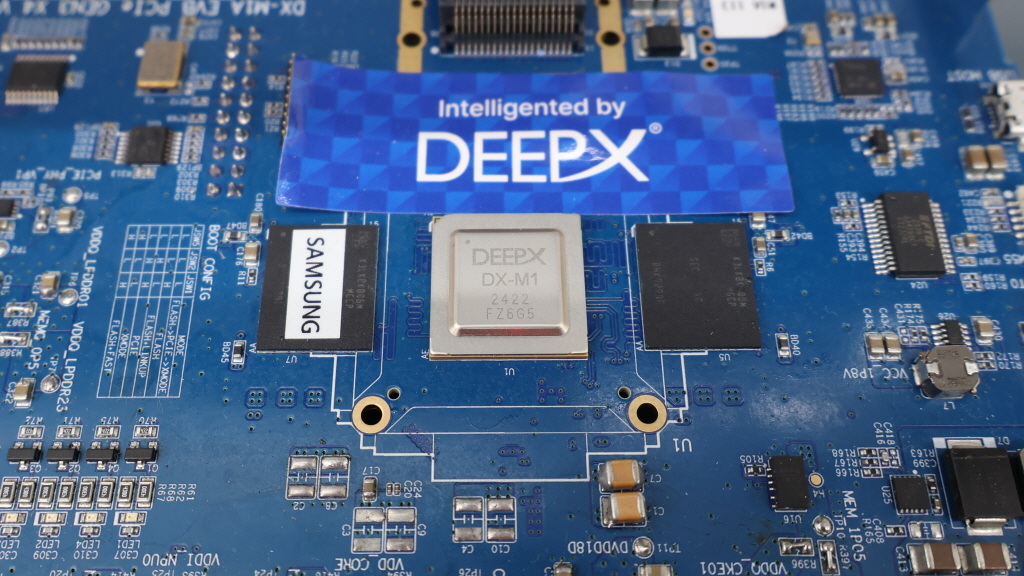
▲ Demo module with DeepX's DX-M1 chip packaged
Actual market reaction is also becoming visible.
DeepX announced that after entering mass production of its first product in August of last year, China's Baidu disclosed in December of the same year that it had adopted the DeepX chip.
Baidu is applying DeepX chips in OCR and industrial automation projects, and DeepX expects this to lead to expansion into the Chinese factory automation market.
Citing the fact that Baidu possesses an open-source AI platform and an industrial automation ecosystem, CEO Kim Nok-won stated, “If DeepX-based modules become the standard in China, it can leap forward as a global leader.”
Collaboration with Hyundai Motor Company also supports DeepX's growth potential.
DeepX has collaborated with Hyundai Motor Robotics Lab for about three years Hyundai Motor announced that DeepX chips will be applied to commercial robots that will be mass-produced in the second half of this year.
CEO Kim explained that existing GPU-based approaches revealed limitations in mass production due to heat, battery, and price issues, and communication-dependent methods could not avoid stability problems, stating that on-device AI semiconductors ultimately became the solution.
He said, “I want to become a standard hardware platform provider for physical AI systems,” and also presented a plan to create a structure that supplies hundreds of types of modules in the future.
The business performance is also fast for an early stage.
DeepX announced that it has secured 30 purchase orders (POs) from 8 countries and 8 industries within 7 months of mass production.
The company explained that while it typically takes 9 to 18 months for a customer to evaluate a chip and place a mass production order, they shortened the time by distributing samples and conducting verification in parallel before mass production.
This is interpreted as a signal that DeepX is moving beyond the stage of simple technology demonstration and entering the actual commercialization phase.
DeepX also emphasized its technological moat.
The company announced that it ranks among the top in NPU patent competition based on U.S. patent registrations, and that the total number of registered and pending patents has now exceeded 500.
CEO Kim Nok-won described this as “an asset that can keep us ahead in the race against latecomers.”
In addition, it revealed that it achieved a yield of 90% in Samsung's 5nm process, highlighting that it is not merely a design company but a firm with mass production capabilities and supply stability.
CEO Kim Nok-won stated, “Ultimately, the future DeepX is aiming for is ‘Physical AI,’ which runs AI directly inside robots, automobiles, industrial equipment, and smart devices in an era where large-scale data centers struggle to handle all AI demand.”“The market is expected to grow explosively, and DeepX will compete in this trend with ‘high-performance, yet inexpensive, low-power, and low-heat chips,’” they stated.

Comments
Related news
DeepX, AIC and Strategic MOU… Innovation in Edge AI Server Market
Ultra-low-power on-device AI semiconductor company DeepX (CEO Kim Nok-won) announced that it has signed a strategic memorandum of understanding (MOU) with global server solutions company AIC Inc. at Computex Taipei 2025 and will jointly develop AI servers for the edge computing market.
2025.05.23by 명세환 기자
DeepX and Wind River Join Hands to Launch Global Strategy for ‘Ultra-Low-Power Edge AI’
On-device AI semiconductor startup DeepX (CEO Kim Nok-won) has established a strategic partnership with Wind River, a leader in intelligent edge software, and will jointly develop next-generation edge AI solutions targeting high-reliability industries including aerospace, defense, automotive, robotics, and industrial automation by integrating ultra-low-power AI semiconductors with real-time operating systems (RTOS).
2025.06.12by 배종인 기자
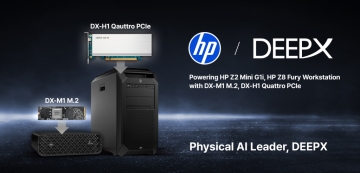
DeepX Proves High-Performance AI PC Compatibility and Real-Time Processing Capabilities
DeepX, an AI semiconductor specialist company (CEO Kim Nok-won), demonstrated high-performance AI PCs with its chipset integrated into HP Workstations, proving the compatibility and real-time processing capabilities of its products.
2025.09.05by 배종인 기자
.jpg)
DeepX surpasses 400 AI semiconductor patents, securing global competitiveness by inheriting ARM and Qualcomm's strategy.
DeepX, a specialist company in on-device AI semiconductors led by CEO Kim Nok-won, has surpassed 400 patents in AI semiconductors, establishing a comprehensive patent portfolio for technological independence and global leadership.
2025.09.26by 배종인 기자
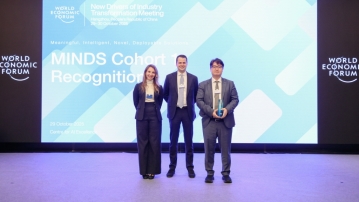
DeepX: "AI must become a 'real-world intelligence' that transforms industry and society, not just a server-side technology."
Kim Nok-won, CEO of DeepX, an ultra-low-power AI semiconductor specialist, was recently invited as an official speaker to the 'New Drivers of Industry Transformation Meeting 2025' hosted by the World Economic Forum (WEF), where he presented the technology vision for 'Physical AI' alongside global innovation leaders.
2025.11.04by 배종인 기자











