



UNIST Develops Smart Contact Lenses That Control Robotic Arms with Eye Movements
 Published2026.04.15 16:41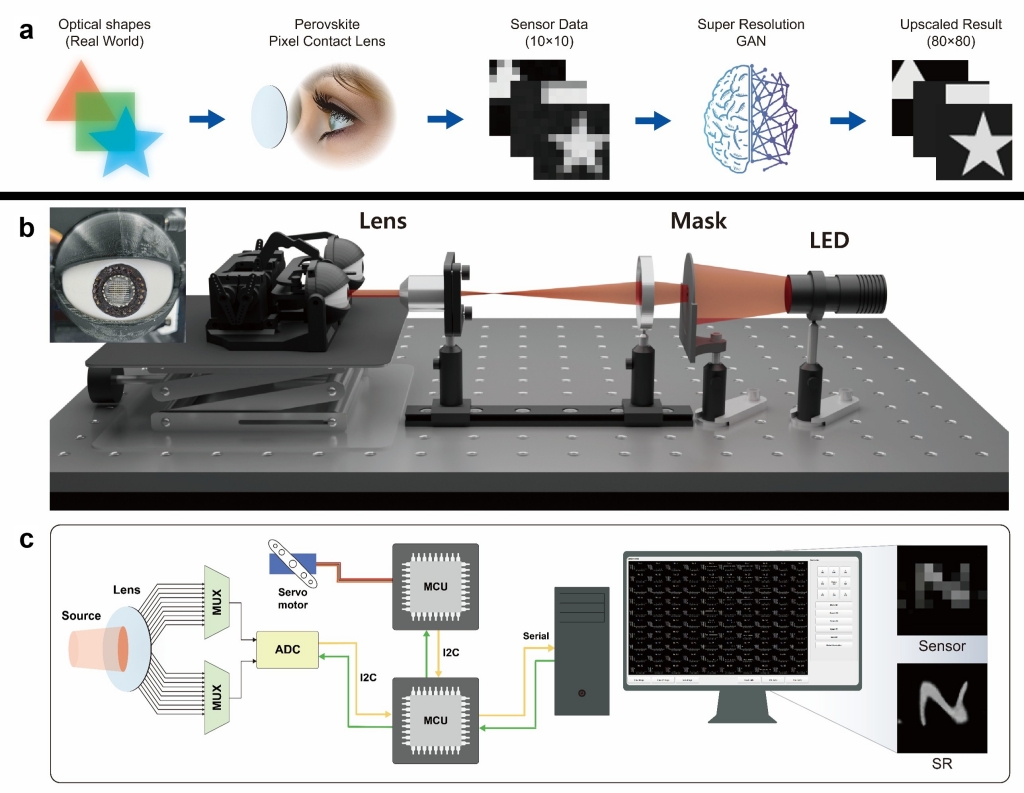
Combining 100 optical sensors on the lens with AI signal restoration
Direction recognition accuracy in eye model experiment: 99.3%
According to UNIST, the results of this study were published in the materials science journal Advanced Functional Materials in March 2026. The title of the paper is 'Meniscus Pixel Printing for Contact-Lens Vision Sensing and Robotic Control'.
This smart contact lens works by tracking the direction of gaze by reading the light distribution that changes according to eye movement through 100 light sensors arranged in a 10×10 array integrated on the lens. It is designed to distinguish not only up, down, left, and right, but also diagonals, and recognizes blinking as a separate command so that the robotic arm can even perform the action of picking up an object.
The research team applied 'meniscus pixel printing (MPP)' technology to directly implement a sensor on the curved surface of a lens. By enabling the formation of sensor patterns on curved surfaces without the need for masks or complex multi-step processes, the focus was on reducing the limitations of existing flat-plane-centered fabrication methods.
The low signal resolution caused by the narrow lens area was compensated for by artificial intelligence. Although there are 100 actual sensors, a deep learning-based super-resolution reconstruction model reconstructed a 10×10 input into 80×80 level optical information, and the latency was presented as 0.03 seconds.
In experiments using an eye model, the robot arm was able to pick up and move an object using only eye movements. The research team stated that the accuracy of recognizing gaze gestures in nine directions was 99.3%. This result is interpreted as demonstrating that control performance can be secured even within a small device like a lens by combining sensor manufacturing and AI signal restoration technology.
The first authors of this study are researchers Gong Byeong-hun and Kim Do-hyeon, and Professor Jeong Im-doo is listed as a co-author. The research was conducted with government support, including from the National Research Foundation of Korea.

Comments
Related news
UNIST Attracts Global Attention with AI Music Learning Technology That Reads Piano Hand Movements
A research team led by Professor Eom Hong-yeol from the Department of Design at UNIST collaborated with ROLI, a British music tech company, to participate in the development of music learning technology that reads a piano player's hand movements in real-time and provides immediate feedback. 'ROLI Piano' and 'ROLI Airwave,' which incorporate this technology, received the CES Innovation Award and the iF Design Award, and were also named in TIME Magazine's 'The Best Inventions.' The approach analyzes hand position, timing, and gesture to provide customized feedback tailored to learners, and is being recognized as having expanded music education into a data-driven interactive experience.
2026.03.18by 배종인 기자
UNIST Develops Single Quantum Light Source with Reduced Energy Fluctuation Even When Controlled by Voltage
UNIST researchers have developed a high-purity single-photon light source that can be turned on and off by voltage while significantly reducing photon energy fluctuations. The research team proposed a structure in which two-dimensional semiconductor WSe₂ is placed on silicon nano pyramids, and a minute air layer and insulating layer are formed between them to reduce the influence of electric fields. Through this method, the Stark effect appearing in the electrical control process was suppressed and single-photon purity was improved. This achievement is evaluated as expanding the possibility of developing chip-type devices in quantum computing, quantum communication, and quantum optical sensor fields combined with silicon processes.
2026.03.23by 배종인 기자
KAERI and UNIST Develop Peel-off Decontamination Coating for Radioactive Cesium Removal
The Korea Atomic Energy Research Institute and UNIST jointly developed a peelable decontamination coating for radioactive cesium removal. According to the research team, the coating demonstrated a removal efficiency of 94.9% in surface experiments on stainless steel and reduced work time from approximately 24 hours compared to existing commercial products to 3 hours. The key innovation involves applying catechol derived from mussel adhesion proteins to polyurethane terminals. The method involves applying the coating to a contaminated surface and peeling off the dried film, and the possibility of post-processing by melting the waste after use to separate radioactive materials was also presented. The research results were published online in the materials science journal Materials Horizons in March 2026.
2026.03.26by 명세환 기자
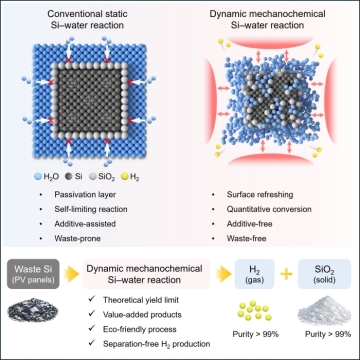
UNIST Develops Technology to Produce Hydrogen and Silica from Waste Solar Panels
A research team at UNIST has developed a technology that simultaneously produces high-purity hydrogen and industrial-grade silica by utilizing silicon from end-of-life solar panels. The technology achieved up to 5 times higher efficiency compared to conventional methods and is noteworthy for securing both economic viability and environmental sustainability. The research results have been published in the international journal Joule, and future industrial applications are anticipated.
2026.04.06by 배종인 기자

UNIST Launches Full-Scale Research on AI Transformation for Shipbuilding… Begins Development of Shipbuilding-Specific Mega-Industry AI
UNIST has been selected as the lead research institution for the shipbuilding sector under the Ministry of Science and ICT's "Mega-scale Industrial AI Research Support Project" and is launching research on artificial intelligence transformation in the shipbuilding industry. This project, which involves a total investment of 40.3 billion won, focuses on developing mega-scale industrial AI by utilizing design, production, and quality data accumulated at shipyards, and applying and validating it in actual field environments. The research team plans to establish a multimodal-based foundation model that jointly learns design drawings, work instructions, video, and sensor data, and will promote automation and optimization of key tasks such as ship design and production planning.
2026.04.13by 배종인 기자











