



Synopsys Emerges as NASA Artemis Technology Partner
 Published2026.04.17 08:21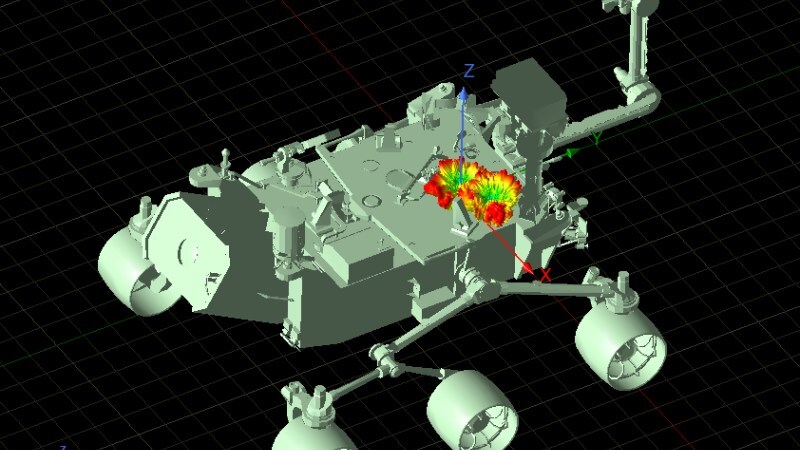
▲ Ansys HFSS™ solution simulating the performance of an antenna mounted on a lunar lander
The role of digital simulation technology in NASA's Artemis program, which is ushering in the next era of lunar exploration, is receiving increasing attention.
Synopsys, a global semiconductor design software company, announced on the 17th that it is expanding technical support in cooperation with NASA for the safety analysis of spacesuits for lunar exploration and the construction of next-generation lunar communication infrastructure.
Synopsys, together with NASA's Johnson Space Center and John Glenn Research Center, is conducting a precise analysis of the impact of the moon's unique extreme environment on astronaut spacesuits.
The key is the phenomenon of charge accumulation and electrostatic discharge occurring in the fine soil and plasma environment of the lunar surface.
These electrical hazards can directly affect life support systems and communication equipment, which is directly related to the safety of long-term exploration missions.
To this end, Synopsys has partnered with EMA, a company specializing in electromagnetic simulation, to analyze the multilayer structure of the Artemis spacesuit in three dimensions.
The goal is to reduce design risk by verifying the possibility of charge transfer and discharge in a virtual environment prior to actual production.
The related analysis includes a simulation capable of integrally interpreting plasma interactions and surface filling.The solution is being utilized, and the results are cross-verified with experimental data.
Collaboration is also continuing in the field of lunar communication technology.
Synopsys, together with Cesium, a spatial data specialist, built a 'Digital Moon' environment based on high-resolution lunar topography data.
In this virtual environment, it is possible to predict in advance not only the performance of antennas to be mounted on spacesuits and rovers, but also communication blind spots caused by craters and rocky terrain.
In particular, the 'Lunar 3GPP' project being pursued by NASA's Glenn Research Center is utilizing this digital twin technology to visualize communication coverage on the lunar surface and seek optimal network design.
The strategy is to increase the probability of mission success by verifying communication reliability before hardware deployment.
Jim Bridenstine, a government project advisor at Synopsys and former NASA administrator, emphasized, “Digital engineering, which iteratively verifies designs in virtual environments, is a key means of simultaneously boosting the speed and safety of space exploration,” adding that it “enables the innovative approach required by the Artemis program.”

Comments
Related news

Will UFS mobile memory rapidly expand beyond smartphones into various markets?
"In high-end mobile devices, UFS will replace eMMC's position." At the 'Mobile & IoT Forum 2017' held on the 28th at Elltower in Yangiae, hosted by the Korea Semiconductor Industry Association (KSIA) and JEDEC, representatives from Samsung Electronics, LG Electronics, Huawei, Micron, MediaTek, and SiTHOS forecasted that UFS will be the direction of next-generation mobile memory technology. UFS is a NAND flash memory solution developed for mobile devices, delivering approximately three times the read speed of eMMC 5.0 (embedded multimedia card), which is currently used in most smartphones, and is evaluated as highly efficient with power consumption at approximately half the level.
2017.08.01by 김지혜 기자

Elektrobit Launches Dedicated Software for Synopsys ARC FS IP
Elektrobit has released 'EB tresos Classic AUTOSAR software exclusively for Synopsys' 'DesignWare ARC EM/HS FS processor. This software provides a hardware-software platform that enables automotive semiconductor companies, automotive manufacturers, and automotive component suppliers to rapidly develop electronic control unit software applications based on the AUTOSAR standard.
2020.09.08by 명세환 기자
Synopsys: 81% of Open Source Projects Vulnerable to Security
Experts have emphasized the importance of establishing comprehensive understanding and continuous management strategies for open source software, which has become an essential element in development. Synopsys Korea, a global application security company, released the 'OSSRA (Open Source Security and Risk Analysis)' report on the 30th and held an online forum to discuss the open source ecosystem and explain business direction and strategy.
2022.06.30by 김예지 기자

Ansys, Synopsys, Samsung Electronics Foundry Productivity Improvement
Ansys has launched a new reference flow for radio frequency integrated circuit (RFIC) design developed in collaboration with Sihelix for Samsung Electronics' Foundry Business Division to support the 14LPU process technology.
2023.10.16by 배종인 기자
Vector and Synopsys Innovate in Virtual ECU-Based SDV Development
Vector Korea, a global company in the automotive network and embedded systems field (Branch Manager Jang Ji-hwan, Vector), has announced an integrated solution based on virtual ECU (vECU) for software-defined vehicle (SDV) development through collaboration with Synopsys. By providing integrated offerings of Vector's 'MICROSAR Classic' and Synopsys' 'Synopsys Silver', it has implemented an environment where ECUs can be generated and tested from the initial development stage without actual hardware.
2025.10.14by 배종인 기자











