


Samsung Electronics and POSTECH Develop Ultra-Thin Display Switchable Between 2D and 3D… Published in Nature
 Published2026.04.27 11:03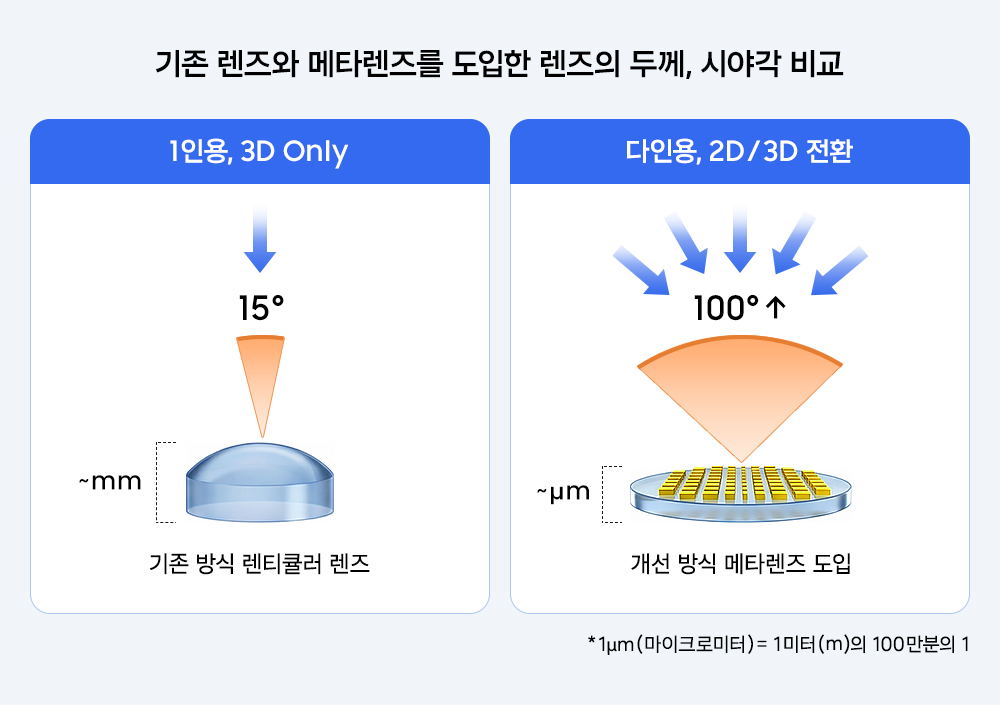
Overcoming the limitations of existing 3D displays with polarization-controlled metalens
Samsung Electronics announced on the 27th that it has developed a 'metasurface lenticular lens-based 2D-3D conversion display' through industry-academia collaboration with POSTECH, and that the paper has been published in Nature. The research involved the Visual Technology Team at Samsung Research and researchers from POSTECH.
This technology utilizes an ultra-thin metasurface lens composed of a nano-scale structure to switch the display between 2D and 3D modes. While existing light field-based 3D displays could provide a sense of depth, their range of applications was limited due to a narrow viewing angle, low resolution, and thick lens structure.
The research team solved the problem by controlling polarization, the direction of light vibration. By designing the metalens so that its optical properties change depending on the polarization state, they enabled the lens function to be switched using only voltage. In 2D mode, it cancels out lens effects to create a clear flat image, and in 3D mode, it enhances the sense of depth.
This technology is distinguished by its ability to selectively implement high-resolution 2D screens and 3D screens with multiple viewpoints on a single display. Another difference from existing methods is that it can create stereoscopic images without a separate eye-tracking device.
Improvements were also made in terms of optical performance. The metalens developed by the research team was manufactured with a thickness of approximately 1.2 mm while securing a maximum field of view of 100 degrees. This represents a significant expansion compared to the field of view of existing 3D displays, providing an environment where multiple users can view stereoscopic images simultaneously.
In addition, the research team verified the technology by combining it with an actual mobile OLED display panel. By fabricating a metalens approximately 50mm in size and confirming its applicability, they demonstrated a level of technology that is close to commercialization, moving beyond the verification of concept.
This research is regarded as a case that expands functionality while reducing the physical limitations of display structures. Its potential for future application in various fields, such as smartphones, tablets, and commercial displays, is being raised.

Comments
Related news
.jpg)
Samsung Electronics Unveils Glasses-Free 3D and Ultra-Large Signage at ISE 2026
Samsung Electronics participated in ISE 2026 held in Barcelona, Spain, showcasing a commercial display lineup including the glasses-free 3D display 'Spatial Signage' and the ultra-low-power 'Color ePaper'. The company announced the global launch of the 85-inch Spatial Signage and unveiled new products including Micro RGB Signage and The Wall All-in-One. Samsung also presented plans to support digital signage operation solution 'Samsung VXT' and AI-based content creation app 'AI Studio'. In the enterprise market, Samsung emphasized video conferencing environment compatibility and installation efficiency through Cisco certification and Logitech collaboration packages.
2026.02.04by 명세환 기자

Kim Jae-young, Managing Director at Qualitas Semiconductor, “Anritsu ShockLine™ VNA 'MS46524B', the Standard for Ultra-High Speed Interconnect Reliability Chosen by Qualitas”
Qualitas Semiconductor Co., Ltd., headquartered in the Republic of Korea, is a leading company in the ultra-high-speed interconnect technology field, providing advanced solutions for next-generation AI, automotive, mobile, and display applications. Based on cutting-edge semiconductor process technology and high-performance circuit design expertise, Qualitas develops highly reliable IP solutions that have undergone silicon verification. These solutions enable customers to accelerate system integration, increase new product development speed, and drive innovation. As ultra-high-speed interface technology advances, achieving maximum PHY IP performance requires consideration not only of chip characteristics but also transmission loss and transmission/reflection characteristics across the entire interconnect channel, including PCBs (printed circuit boards) and sockets. Furthermore, establishing a verification environment with high reproducibility that can accommodate diverse future package and interconnect structures is essential. To address these challenges, Qualitas utilized the Anritsu ShockLine™ Vector Network Analyzer (VNA) MS46524B. Through this, Qualitas strengthened its capability to verify signal integrity across the entire system including PHY IP, thereby ensuring the quality and reliability of solutions provided to customers. Accordingly, this publication conducted an interview with Kim Jae-young, Managing Director, who is actively engaged at Qualitas Semiconductor's optical interconnect R&D center. Questions were posed regarding how Anritsu's test solutions are being utilized in Qualitas' ultra-high-speed interconnect PHY IP solutions and what achievements have been accomplished. This article introduces advanced verification technology for ensuring the reliability of next-generation semiconductor interfaces and a case study of building a quality assurance system for maintaining global market competitiveness.
2026.03.08by 배종인 기자
Samsung Electronics Launches Galaxy S26 and Buds 4 Globally
Samsung Electronics will sequentially launch the Galaxy S26 series and Galaxy Buds4 series in approximately 120 countries, including South Korea, the United States, the United Kingdom, and India starting from the 11th. The Galaxy S26 series has enhanced overall performance, AI, and camera capabilities, with a Privacy Display applied to the Ultra model. AI-based features such as call screening, image editing, and low-light photography have also been expanded. The Buds4 series features high-fidelity sound and ergonomic design, and supports Galaxy integration features including head gesture and real-time interpretation. Samsung Electronics has also introduced accessories and purchase benefits alongside strong pre-order sales.
2026.03.11by 명세환 기자
.jpg)
Lenovo Unveils AI-Powered Gaming Tablet, the LegionTab Y700 5th Gen
Lenovo Korea announced the domestic launch of the Legion Tab Y700 5th Generation, a gaming-specialized tablet, on March 12th. The new product is equipped with Qualcomm Snapdragon 8 Elite 5th Generation processor and a 9000mAh battery, and comes standard with AI features including Gemini and Circle to Search. It supports high-performance gaming environments through an 8.8-inch 3K display, 165Hz refresh rate, and thermal control via a large vapor chamber. Additionally, it provides dedicated software such as Legion Space, Game Assistant, and Smart Connect, along with an expandable ecosystem, and will be first unveiled through Naver Shopping Live on the 16th.
2026.03.12by 명세환 기자
Samsung Electronics Ranks No. 1 in Commercial Displays for 17 Consecutive Years… Competition Expands Beyond Hardware to Solutions
Samsung Electronics maintained its position as the number one player in the global commercial display market for the 17th consecutive year, recording a 35.2% market share by sales volume in 2025. Annual sales volume exceeded 2.5 million units, marking a record high. The company is expanding new product lines including spatial signage that implements three-dimensional stereoscopic effects and ultra-low-power color e-paper, while adding AI-based content creation capabilities to its integrated platform 'Samsung VXT' that supports remote management and content operation, thereby broadening its hardware-focused business into the solutions domain.
2026.03.19by 명세환 기자











