



UNIST Develops 60-Second Micro 3D Printing Technology
 Published2026.04.29 13:29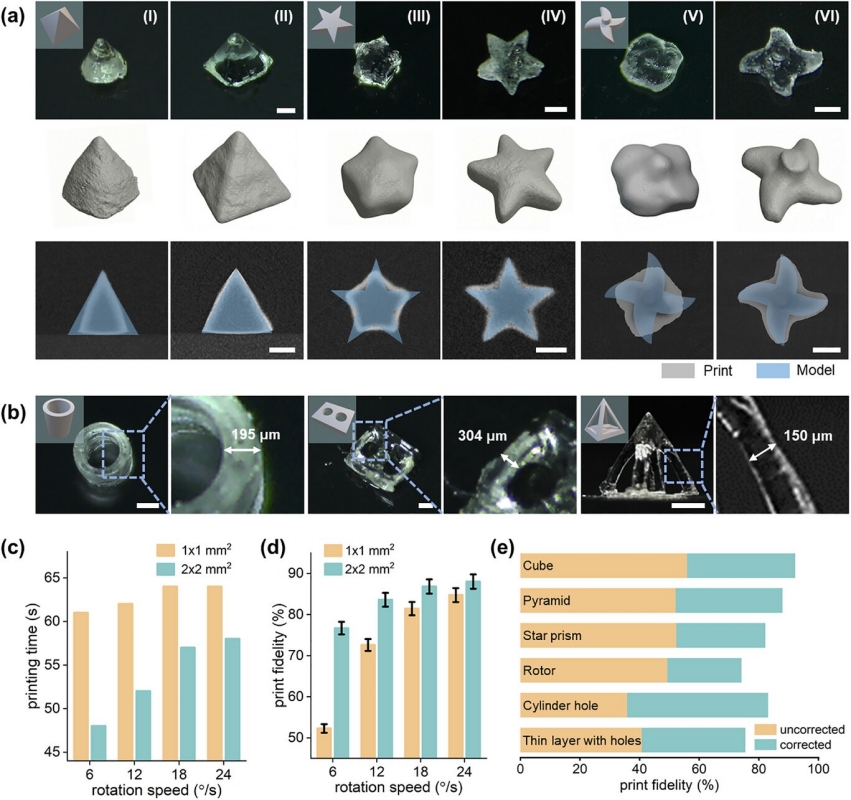
▲ [Research Figure] Printing accuracy of continuous volume additive manufacturing technology within droplets
Professor Im-Doo Jeong's Team Implements Droplet-Based DVAM
Continuously build 10 structures within 10 minutes
UNIST announced on April 29 that a research team led by Professor Im-Doo Jeong of the Department of Mechanical Engineering had developed 'Dispensing Volumetric Additive Manufacturing (DVAM)' technology. The research results were published online in the international journal Advanced Functional Materials on March 21.
DVAM utilizes a drop of photocurable resin formed at the tip of a glass pipette as a printing space. The research team implemented a continuous process by curing a structure by irradiating a rotating droplet with a calculated light pattern, then ejecting the completed structure onto a substrate and supplying the next droplet.
CAL, one of the existing volumetric 3D printing methods, had limitations in continuous production because it required a container for the resin, a medium for correcting the refractive index, and a process for separating the printed material. The research team reduced this process by using the droplet itself as a temporary printing space, and corrected the problem of light refraction occurring in curved droplets using AI-based droplet contour recognition and backlight tracking calculations.
The research team was confirmed to have produced 10 different structures, including the Eiffel Tower, letter shapes, and grid structures, in succession within about 10 minutes. Some reports explained that the single printing time was between 45 and 75 seconds, and the non-printing time was within a few seconds.
This study is evaluated as an approach to increasing fabrication speed and continuous productivity in micro 3D printing. However, as the technology is still in the research phase, further verification is required regarding its actual industrial application scope and mass production stability.

Comments
Related news
KAERI and UNIST Develop Peel-off Decontamination Coating for Radioactive Cesium Removal
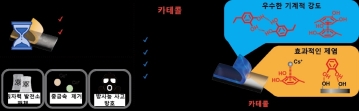
The Korea Atomic Energy Research Institute and UNIST jointly developed a peelable decontamination coating for radioactive cesium removal. According to the research team, the coating demonstrated a removal efficiency of 94.9% in surface experiments on stainless steel and reduced work time from approximately 24 hours compared to existing commercial products to 3 hours. The key innovation involves applying catechol derived from mussel adhesion proteins to polyurethane terminals. The method involves applying the coating to a contaminated surface and peeling off the dried film, and the possibility of post-processing by melting the waste after use to separate radioactive materials was also presented. The research results were published online in the materials science journal Materials Horizons in March 2026.
2026.03.26by 명세환 기자
UNIST Develops Technology to Produce Hydrogen and Silica from Waste Solar Panels
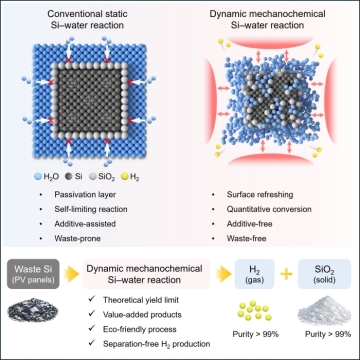
A research team at UNIST has developed a technology that simultaneously produces high-purity hydrogen and industrial-grade silica by utilizing silicon from end-of-life solar panels. The technology achieved up to 5 times higher efficiency compared to conventional methods and is noteworthy for securing both economic viability and environmental sustainability. The research results have been published in the international journal Joule, and future industrial applications are anticipated.
2026.04.06by 배종인 기자

UNIST Launches Full-Scale Research on AI Transformation for Shipbuilding… Begins Development of Shipbuilding-Specific Mega-Industry AI
UNIST has been selected as the lead research institution for the shipbuilding sector under the Ministry of Science and ICT's "Mega-scale Industrial AI Research Support Project" and is launching research on artificial intelligence transformation in the shipbuilding industry. This project, which involves a total investment of 40.3 billion won, focuses on developing mega-scale industrial AI by utilizing design, production, and quality data accumulated at shipyards, and applying and validating it in actual field environments. The research team plans to establish a multimodal-based foundation model that jointly learns design drawings, work instructions, video, and sensor data, and will promote automation and optimization of key tasks such as ship design and production planning.
2026.04.13by 배종인 기자
IBS, UNIST, and POSTECH Improve Room-Temperature Luminescence Performance of 2D Semiconductor Quantum Light Sources
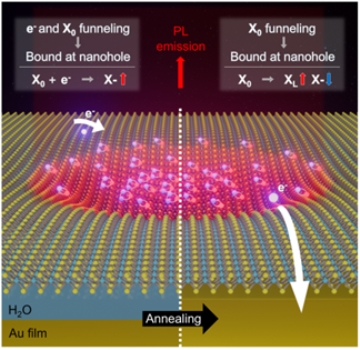
A joint research team from the Institute for Basic Science (IBS), UNIST, and POSTECH has improved the room-temperature luminescence performance of 2D semiconductor-based quantum light sources. The research team confined excitons, which easily diffuse at room temperature, within nanohole structures and reduced excess charges through heat treatment to improve light emission conditions. As a result, exciton confinement efficiency reached approximately 98%, and luminescence efficiency increased by approximately 130 times compared to previous results. The research results were published in the international journal Science Advances on March 13. This achievement demonstrates the potential to lead to research on photonic quantum devices with reduced cryogenic dependence and room-temperature single-photon light sources.
2026.04.14by 배종인 기자
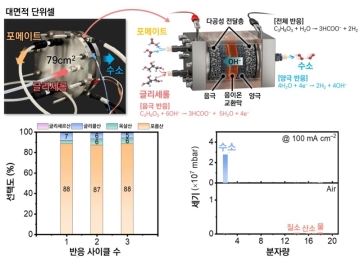
KIMS and UNIST Develop Electrochemical System for Simultaneous Production of Hydrogen and Formate Using Waste Glycerol
A joint research team from the Korea Institute of Materials Science and UNIST has developed an electrochemical system that produces hydrogen and formate simultaneously by utilizing glycerol, a biodiesel byproduct. The research team implemented an anion exchange membrane electrolysis system that applies glycerol oxidation reaction instead of the conventional oxygen evolution reaction in water electrolysis. Using a copper-cobalt-based non-precious metal catalyst, the team achieved 110 mA/cm² at 1.31 V, with formate selectivity of approximately 96%, and confirmed stable operation even in a large-area cell of 79 cm². The related research was published in the international academic journal Joule on March 18, 2026.
2026.04.14by 배종인 기자











