


UNIST Develops High-Sensitivity MXene Sensor That Detects Body Temperature and Pulse
 Published2026.05.11 14:51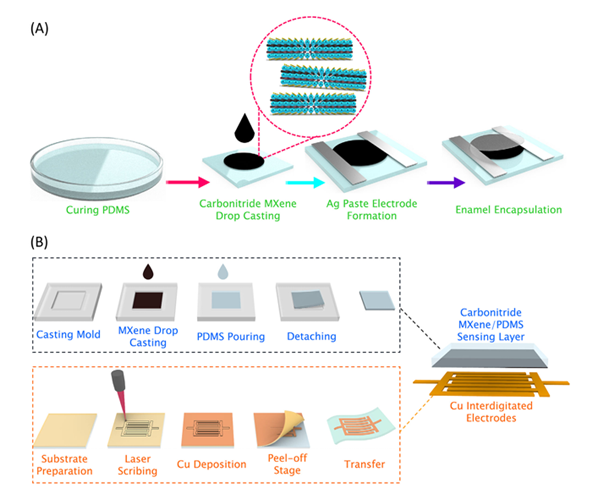
Simultaneous detection of temperature and pressure, up to 4 times higher sensitivity compared to existing materials
A research team led by Professors Su-Hyun Kim and Soon-Yong Kwon of the UNIST Graduate School of Semiconductor Materials and Components announced on the 11th that they have developed a titanium carbonitride-based MXene material capable of detecting both temperature and pressure changes.
MXene is a nanomaterial in which metals are bonded to carbon or nitrogen in a layered structure. It is thin, flexible, and has high electrical conductivity, so it has been studied as a material for wearable devices and healthcare sensors.
The material developed by the research team is a nitrogen-containing titanium carbonitride MXene. Compared to existing carbide-based MXenes, its sensitivity to temperature changes has increased by approximately three times, and its sensitivity to pressure stimulation has increased by more than four times. The explanation is that even small stimuli cause significant changes in electrical resistance, enabling the conversion of biological signals into more distinct electrical signals.
Performance improvement was achieved through nitrogen concentration control. The research team controlled electron density and lattice vibration characteristics by finding the optimal nitrogen concentration, thereby enhancing responsiveness to external stimuli. This principle was confirmed through density functional theory calculations and synchrotron-based X-ray absorption microstructure analysis.
In the experiment, sensors attached to the neck distinguished subtle vocal cord movements associated with speaking, swallowing, and coughing. Eye blinking was measured in real-time around the eyes, pulse waveforms at the wrists, and it was also possible to analyze walking patterns by attaching sensors to the heels of shoes.
Non-contact temperature sensing performance was also confirmed. The sensor detected infrared heat from a smartphone camera flash at a distance of 1 to 2 mm and recognized temperature changes upon approach even without direct contact with a finger.
Professor Kim Su-hyeon explained that this research could lead to next-generation human-machine interfaces and intelligent robotic electronic skin technology, as it enables precise simultaneous detection of temperature and pressure while controlling signal interference. He also stated that the scope of application could be expanded beyond healthcare to advanced nanomaterial fields such as energy storage, catalysts, and electromagnetic shielding.
The results of this research were published online on April 12 in the materials science journal *Advanced Functional Materials*. The research was conducted with support from the Ministry of Science and ICT, the National Research Foundation of Korea, and the InnoCore project.

Comments
Related news
UNIST Develops Technology to Produce Hydrogen and Silica from Waste Solar Panels
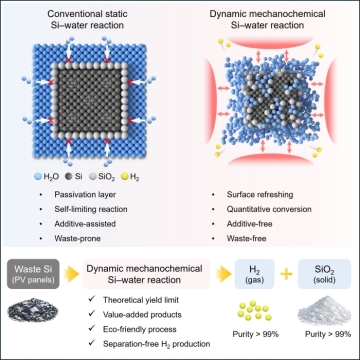
A research team at UNIST has developed a technology that simultaneously produces high-purity hydrogen and industrial-grade silica by utilizing silicon from end-of-life solar panels. The technology achieved up to 5 times higher efficiency compared to conventional methods and is noteworthy for securing both economic viability and environmental sustainability. The research results have been published in the international journal Joule, and future industrial applications are anticipated.
2026.04.06by 배종인 기자

UNIST Launches Full-Scale Research on AI Transformation for Shipbuilding… Begins Development of Shipbuilding-Specific Mega-Industry AI
UNIST has been selected as the lead research institution for the shipbuilding sector under the Ministry of Science and ICT's "Mega-scale Industrial AI Research Support Project" and is launching research on artificial intelligence transformation in the shipbuilding industry. This project, which involves a total investment of 40.3 billion won, focuses on developing mega-scale industrial AI by utilizing design, production, and quality data accumulated at shipyards, and applying and validating it in actual field environments. The research team plans to establish a multimodal-based foundation model that jointly learns design drawings, work instructions, video, and sensor data, and will promote automation and optimization of key tasks such as ship design and production planning.
2026.04.13by 배종인 기자
IBS, UNIST, and POSTECH Improve Room-Temperature Luminescence Performance of 2D Semiconductor Quantum Light Sources
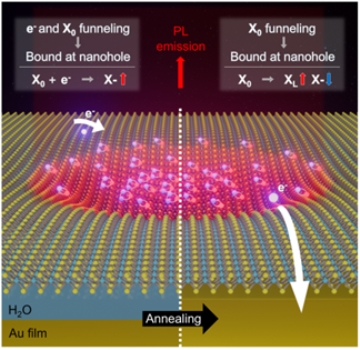
A joint research team from the Institute for Basic Science (IBS), UNIST, and POSTECH has improved the room-temperature luminescence performance of 2D semiconductor-based quantum light sources. The research team confined excitons, which easily diffuse at room temperature, within nanohole structures and reduced excess charges through heat treatment to improve light emission conditions. As a result, exciton confinement efficiency reached approximately 98%, and luminescence efficiency increased by approximately 130 times compared to previous results. The research results were published in the international journal Science Advances on March 13. This achievement demonstrates the potential to lead to research on photonic quantum devices with reduced cryogenic dependence and room-temperature single-photon light sources.
2026.04.14by 배종인 기자
KIMS and UNIST Develop Electrochemical System for Simultaneous Production of Hydrogen and Formate Using Waste Glycerol
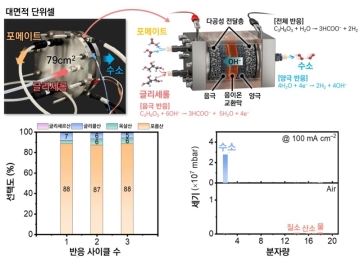
A joint research team from the Korea Institute of Materials Science and UNIST has developed an electrochemical system that produces hydrogen and formate simultaneously by utilizing glycerol, a biodiesel byproduct. The research team implemented an anion exchange membrane electrolysis system that applies glycerol oxidation reaction instead of the conventional oxygen evolution reaction in water electrolysis. Using a copper-cobalt-based non-precious metal catalyst, the team achieved 110 mA/cm² at 1.31 V, with formate selectivity of approximately 96%, and confirmed stable operation even in a large-area cell of 79 cm². The related research was published in the international academic journal Joule on March 18, 2026.
2026.04.14by 배종인 기자
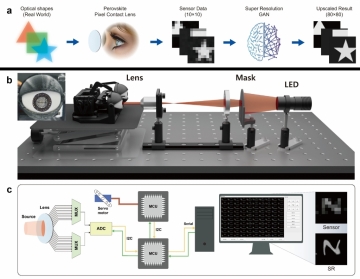
UNIST Develops Smart Contact Lenses That Control Robotic Arms with Eye Movements
A research team led by Professor Jeong Im-du from the Department of Mechanical Engineering at UNIST has developed a smart contact lens that enables control of a robotic arm through eye movement alone. The lens surface features 100 optical sensors directly implemented on it that read gaze changes, and AI restores these into high-resolution information and converts it into control signals. The research results were published in Advanced Functional Materials in March 2026, and in eye model experiments, the system recognized nine-directional gaze gestures with 99.3% accuracy.
2026.04.15by 배종인 기자











