



Google Search Bar, 25 Years Old, Completely Overhauled into 'Search Agent'
 Published2026.05.20 09:36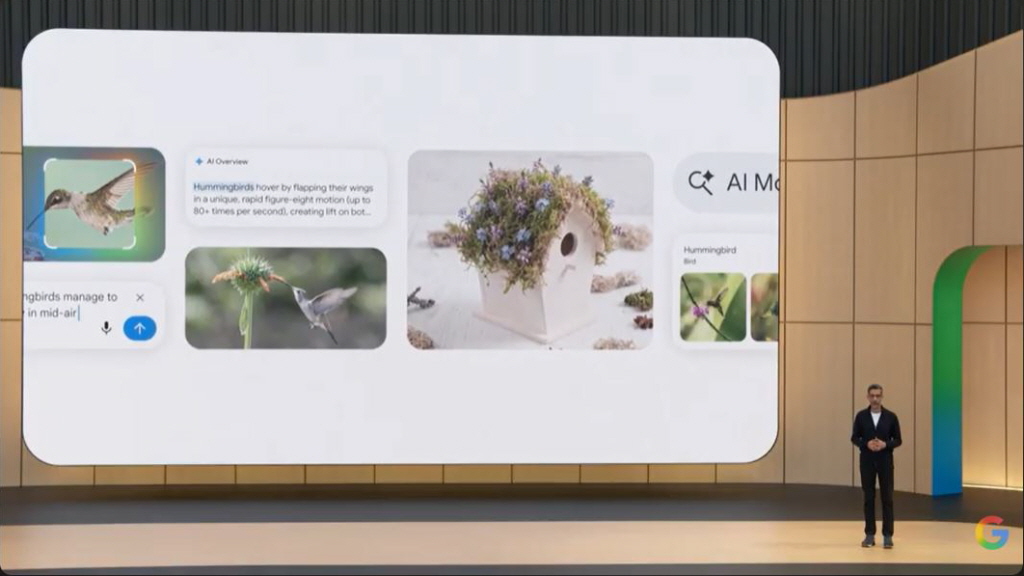
Search agent, automatic collection of user preset interest information notifications
Google officially announced a technology transition centered on 'agentic AI' by unveiling a large number of next-generation AI strategies at this year's developer event, I/O 2026. AI that goes beyond simple question-and-answer to understand user intent and perform tasks autonomously has begun to be applied across the entire Google ecosystem.
Google held its annual developer conference, 'Google I/O 2026,' at the Shoreline Amphitheater in Mountain View, California, on the 19th (local time).
The most notable change at this event is the complete overhaul of the search bar for the first time in 25 years.
Google introduced the 'Intelligent Search Bar,' designed to refine questions based on various inputs—including not only text but also images, files, and browser tabs—and provide context-appropriate suggestions.
With the addition of a 'search agent' that browses the web 24 hours a day, a feature has also been added that automatically collects information of interest pre-set by the user and provides notifications.
The AI model has also been significantly strengthened.
Google DeepMind has unveiled 'Gemini Omni,' a multimodal model based on a 'world model' that understands the laws of physics.
This model integrates the processing of text, image, audio, and video inputs, and can perform complex tasks such as video editing, background changes, and character insertion using only natural language.
The generated content is automatically marked with a 'SynthID' watermark, allowing for authenticity verification.
Another key announcement is the 'Gemini 3.5 Flash'.
Google emphasized that this model has significantly improved speed and coding performance compared to the previous version, and that its output speed per second is four times faster than competing models.
The upcoming '3.5 Pro' has already passed internal testing. It is known to be in use.
'Gemini Spark,' which serves as a personal assistant, was also unveiled.
Spark automatically handles repetitive tasks in the background, such as organizing emails, analyzing schedules, and summarizing documents, even when the user closes the device.
It integrates with external services to perform tasks such as reservations and orders, but is designed to require user approval for sensitive actions such as payments.
Changes also continued in the hardware sector.
Google unveiled its AI smart glasses, currently under development in collaboration with Samsung Electronics and Gentle Monster.
It will be released in two forms: voice-based 'audio glasses' and 'display glasses' that project information into the field of view, and offers various functions such as real-time translation, navigation, photography, and AI editing.
This product, built on Android XR, is scheduled to be released this fall.
Through this announcement, Google declared a transition beyond its 'AI First' strategy to the era of 'Agent AI,' where AI takes direct action.
As a structure in which AI takes the lead across all domains—from search and models to platforms and hardware—becomes fully established, the view that the central axis of future technological competition will shift to 'active AI' is gaining traction.

Comments
Related news
Google Cloud Introduces Real-Time Commentary Service for MLB Apps… Analyzes Game Context with Gemini
Google Cloud has partnered with Major League Baseball (MLB) to introduce 'MLB Scout Insight,' a generative AI-based real-time commentary service. The service is integrated into the 'Game Day' feature within the official MLB app, providing real-time information on player matchups, statistics, and unique facts during games. Utilizing Gemini, BigQuery, and AlloyDB, the system pre-generates insights tailored to the day's game flow and connects relevant information within two seconds of an actual event occurring. The service also incorporates a concept of "unexpectedness" that selects content likely to captivate fans, going beyond simple statistical delivery.
2026.04.06by 명세환 기자
Intel and Google Accelerate Construction of Large-Scale AI Systems Combining CPUs and IPUs
Intel and Google are pursuing a strategic partnership that strengthens the roles of CPUs and custom-built IPUs (Infrastructure Processing Units) to efficiently operate increasingly complex cloud environments.
2026.04.10by 배종인 기자
Korea & Company Adopts 'Gemini Enterprise'
Google Cloud announced that Korea N Company has adopted its AI solution 'Gemini Enterprise.' This collaboration focuses on integrating data across the entire company—including marketing, production, and logistics—and strengthening AI-driven decision-making. Specifically, through the establishment of a single AI platform, the company plans to reduce existing data silos between departments and expand application to predictive supply chain management and customer experience improvement. Korea N Company intends to increase operational efficiency across its mobility business and establish a mid-to-long-term growth foundation through this initiative.
2026.04.27by 명세환 기자
Kaspersky Confirms 'SparkCat' Variant Bypassing App Store and Google Play
Kaspersky has announced that it has identified a new variant of 'SparkCat,' a cryptocurrency theft malware distributed through official app stores. The malware disguises itself as a legitimate application to access the photo gallery on users' devices, then utilizes OCR technology to analyze text within images and search for wallet recovery phrases. A notable characteristic is that Android-based searches focus on Asian language keywords, while iOS-based searches center on English language keywords. Although some infected apps have already been removed, distribution through third-party channels has also been confirmed. Security experts have analyzed that cases of bypassing official store review processes are increasing as advanced techniques such as obfuscation and code virtualization are being applied.
2026.04.27by 배종인 기자
Google Cloud Provides Conversational AI to Weverse Customer Support
Weverse has applied Google Cloud's conversational AI technology to its customer support system to address the increasing volume of global fan inquiries. The new system was built as an automated response mechanism to handle 24-hour processing of inquiries related to ticket reservations, MD purchases, and platform features. Following its earlier migration of the data analytics platform to Google Cloud BigQuery, Weverse has now begun utilizing AI technology in the customer support domain. Since its introduction in March, the system has processed inquiries from 245 countries and regions, with plans to increase processing efficiency throughout the year.
2026.05.06by 배종인 기자











