


KIMS Develops TiAl Alloy Capable of Withstanding 950℃… Secures Lightweight Material Technology for Aircraft Engines
 Published2026.05.20 10:12
.jpg)
Dr. Kim Sung-woong's Team Selected as 'World's No. 1 Technology' for 2025
KIMS announced that the 'TiAl material technology for gas turbines rated at over 950°C,' developed by Dr. Kim Sung-woong's research team at the Institute of Extreme Materials, was selected as the 'World's No. 1 Technology' for 2025 following internal and external reviews and public verification. This system is a procedure for selecting world-class or world-first source technologies held by KIMS, involving a comprehensive review of patents, technology transfer, and industrial application performance.
TiAl alloy is a lightweight heat-resistant material based on titanium and aluminum. It is lighter than nickel-based superalloys, making it advantageous for lightweighting aircraft engines, but existing materials had limitations in maintaining performance at around 750–800°C. In particular, at temperatures above 900℃, the internal microstructure became unstable, and there was a problem with reduced strength and durability.
To overcome this limitation, the research team newly designed the alloy element composition and microstructure control process. Niobium (Nb) and tungsten (W) suppress atomic diffusion at high temperatures to enhance microstructure stability, while silicon (Si) and carbon (C) play a role in reducing microstructure boundary migration and microstructure coarsening.
In addition, the research team manufactured an alloy based on vacuum melting and precision casting processes, and implemented a process that uniformly controls the microstructure with only a single heat treatment. Through this, they secured tensile strength, creep life, and fatigue characteristics even in an ultra-high temperature environment of 950°C, and confirmed oxidation resistance that forms a protective oxide layer even under high-temperature oxidation conditions.
This technology can be applied to fields requiring both ultra-high temperature and lightweight characteristics, such as aircraft low-pressure turbine blades, power generation gas turbine blades, hypersonic vehicles, and reusable spacecraft components. It is also significant in that it reduces dependence on existing nickel-based superalloys and expands the domestic technological foundation for aerospace materials.
Principal Researcher Kim Seong-woong explained that this technology is a material technology that simultaneously secures the ultra-high temperature and lightweight characteristics required in the fields of aircraft engines and space launch vehicle propulsion systems.

Comments
Related news
.jpg)
KIMS Shares Techniques for Industrial Application of Casting Technology
The Korea Institute of Materials Science held a casting technology seminar at its headquarters in Changwon, South Gyeongsang Province, and introduced core process technologies utilized in industrial applications. The seminar covered fundamental principles of casting processes and defect control methods, lightweight-oriented die-casting technology, and trends in aluminum casting alloys for mobility applications. At the conclusion of the event, consultations on industrial technical challenges were also conducted, providing an opportunity to expand the interface between research institutions and industry.
2026.03.25by 명세환 기자
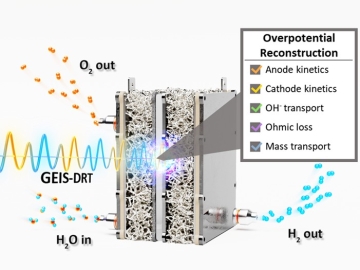
KIMS and Pusan National University Develop Real-Time Diagnosis Technology for Water Electrolysis Performance Degradation
A joint research team from the Korea Institute of Materials Science and Pusan National University has developed a two-electrode-based diagnostic technique that can analyze the causes of performance degradation in anion exchange membrane water electrolysis (AEMWE) systems in real-time during actual operation. The research team presented a method to separate and quantify voltage loss causes by category by combining electrochemical impedance spectroscopy (EIS) data with distribution of relaxation times (DRT) analysis. This technology enables more specific identification of performance degradation causes in actual unit cell environments, and is expected to be utilized in future water electrolysis system design and operation optimization.
2026.04.09by 명세환 기자
.jpg)
KIMS and Hyundai IFC Establish Joint Research Center for Core Materials for Nuclear Power Plants and Aviation Engines
The Korea Institute of Materials Science and Hyundai IFC will establish a joint research center to secure core material technologies in the nuclear and aeroengine sectors. The two parties plan to cooperate focusing on characteristic evaluation of heat-resistant steel for small modular reactors, optimization of nickel alloy forging processes, and development of titanium alloy-based closed-die forging processes. Based on a cooperative framework linking R&D, testing and evaluation, and technology transfer, the plan is to enhance industrial field applicability and establish a mid-to-long-term technology cooperation foundation.
2026.04.13by 명세환 기자
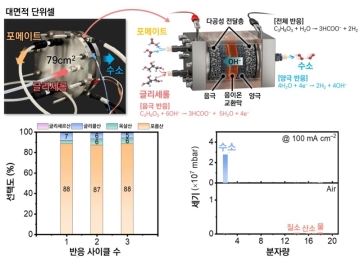
KIMS and UNIST Develop Electrochemical System for Simultaneous Production of Hydrogen and Formate Using Waste Glycerol
A joint research team from the Korea Institute of Materials Science and UNIST has developed an electrochemical system that produces hydrogen and formate simultaneously by utilizing glycerol, a biodiesel byproduct. The research team implemented an anion exchange membrane electrolysis system that applies glycerol oxidation reaction instead of the conventional oxygen evolution reaction in water electrolysis. Using a copper-cobalt-based non-precious metal catalyst, the team achieved 110 mA/cm² at 1.31 V, with formate selectivity of approximately 96%, and confirmed stable operation even in a large-area cell of 79 cm². The related research was published in the international academic journal Joule on March 18, 2026.
2026.04.14by 배종인 기자
Improvement of carbon dioxide adsorption performance without chemical processes
The Korea Institute of Materials Science (KIMS) announced on the 17th that a research team involving senior researcher Lee Hee-jeong has jointly developed with research groups from Kyungpook National University and Yeungnam University a technology to control the internal pore structure of MOFs using laser.
2026.04.17by 배종인 기자











