



STT GDC: “Korea Leads in AI Adoption, But Challenges Exist in Expansion Phase”
 Published2026.05.27 16:41
A survey has revealed that while Korea is considered a leader in the Asian region regarding the adoption of artificial intelligence (AI), challenges remain in the expansion phase concerning workforce, operational structure, and regulatory compliance. In particular, although the achievements of AI projects have been confirmed, a gap was found in the process of disseminating them throughout the organization.
ST Telemedia Global Data Centres (STT GDC) announced on the 27th that it has released the results of a survey on Korea as part of its report, 'Mind the Gap: Bridging the AI Infrastructure Readiness Divide,' which analyzes the status of AI infrastructure readiness in Asia. The survey was conducted by Ecosystm and involved over 600 corporate and digital organization leaders across nine Asian countries, including Korea.
According to the report, Korea was analyzed to be among the top in Asia in terms of AI adoption levels. However, based on infrastructure maturity, the early and intermediate stages accounted for a high proportion.
The breakdown was 1% for the exploration stage, 67% for the implementation stage, and 32% for the integration and leading stage; in particular, the proportion of companies in the leading stage remained at approximately 2%.
This can be interpreted to mean that while they are proactive in adopting AI, the extent to which they translate it into overall organizational competitiveness is limited.
On the other hand, 75% of respondents answered that AI projects are generating value beyond expectations. This figure significantly exceeds the Asian average of 34%. The report analyzed that this indicates domestic companies have already confirmed the results of AI utilization.
Difficulties in the AI expansion process were also identified.
52% of respondents stated that they lacked the internal expertise to manage and optimize high-density AI infrastructure, while 48% identified the burden of initial investment and operating costs as a major challenge. 52% cited data sovereignty and regulatory compliance as constraints.
The explanation is that operational complexity and the issue of securing specialized personnel are acting as major obstacles. It is analyzed that a capability gap has emerged during the actual operation phase of AI infrastructure.
A gap between perception and practice was also observed regarding sustainability. While 31% of responding companies stated that they actively consider sustainability when making decisions about AI infrastructure, the weight given to this factor in actual colocation provider evaluations was only about 15%. Similarly, although approximately 48% of respondents said they were reviewing or adopting liquid cooling technology, the survey found that it was not sufficiently reflected in partner selection criteria.
The report analyzed that changes are also appearing in the methods of securing infrastructure. Companies moving from the integration stage to the leadership stage tend to choose to secure expertise through strategic partnerships rather than possessing their own infrastructure.
Heo Cheol-hoe, Representative of STT GDC Korea, stated, “Korea has moved beyond the AI experimentation stage,” adding, “In the future, the key challenge will be how to expand and operate the established AI environment.” He further added, “Partnerships to secure expertise and infrastructure design that considers the regulatory environment will become crucial.”

Comments
Related news
STT GDC to Build Second Data Center in Seoul
South Korea is continuously implementing digital infrastructure through advanced ICT infrastructure and investments in 5G, artificial intelligence, and cloud. In 2019, it commercialized the world's first 5G network, and currently more than one-quarter of all mobile communications operate on 5G. South Korea's public cloud market is also experiencing growth, with projections showing expansion from $1.5 billion in 2018 to $3.1 billion in 2023, making data center infrastructure expansion essential.
2022.06.08by 명세환 기자

The KKR-Singtel consortium has acquired an 82% stake in STT GDC, valuing the company at $10.9 billion.
Global investment firm KKR and Singapore telecommunications group Singtel have formed a consortium to acquire an 82% remaining stake in STT GDC, a global data center operator. In this transaction, STT GDC was valued at approximately $10.9 billion in enterprise value. Upon completion of the deal, KKR and Singtel will hold 75% and 25% stakes respectively. STT GDC operates over 100 data centers across 12 countries and secures approximately 2.3GW of IT load capacity. The acquisition was executed within the context of increased investment flows in data center infrastructure driven by growing AI and cloud demand, and the company is expected to accelerate its market entry into Korea alongside future global expansion.
2026.02.05by 명세환 기자
STT GDC Acquires Tier 3 Design Certification for 'STT Seoul 1'
STT GDC has obtained Uptime Institute Tier III Certified Design (TCDD) for STT Seoul 1, the company's first domestic data center. The certification is a verification procedure for design structure that enables maintenance of critical infrastructure such as power and cooling without service interruption. STT Seoul 1 is under construction in Gasan-dong, Geumcheon-gu, Seoul, and is designed as an AI-ready data center supporting up to 30MW IT load, with a targeted service launch in June.
2026.05.19by 명세환 기자
[e4ds Tech Day 2026 ⑨] Sim Sang-gyu, Autocrypt CTO: "In the Physical AI Era, Automotive Security Must Extend Beyond the Vehicle"
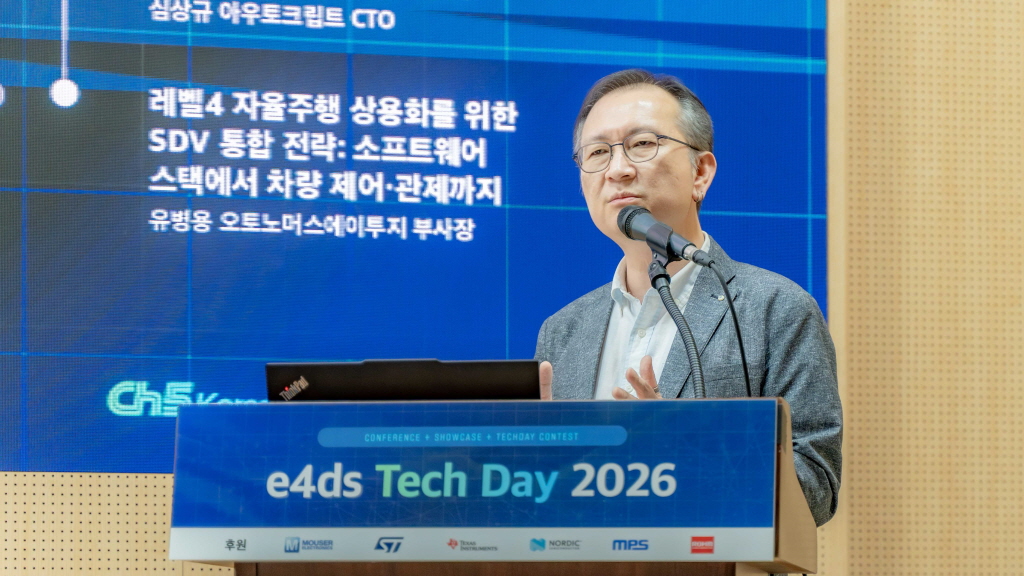
At e4ds Tech Day 2026, Sim Sang-gyu, CTO of Autocrypt, explained automotive cybersecurity strategies in the era of Physical AI and SDV (Software-Defined Vehicle). Automobiles are evolving as part of an ecosystem connected to AI, cloud, chargers, IoT, and robots, and he emphasized that the scope of security must expand beyond the vehicle interior to the entire connected environment. In particular, AI model tampering, adversarial attacks, OTA updates, and EV charger hacking were identified as major threats. He explained that response measures require zero trust, AI model integrity protection, intrusion detection, Security by Design and Default, and full lifecycle security management, and that proactive security system establishment beyond regulatory compliance is critical for securing future mobility competitiveness.
2026.10.12by 배종인 기자
NVIDIA to Invest $1 Billion in U.S. Science Over Next Five Years
NVIDIA has announced plans to invest $1 billion over the next five years to strengthen U.S. scientific and technological competitiveness. The company will enhance cutting-edge artificial intelligence research and development capabilities in key areas including quantum computing, healthcare, and energy security, while expanding support for higher education research institutions and cloud service providers. NVIDIA is participating as a major industry partner in the White House Office of Science and Technology Policy's Genesis Mission, and is promoting supercomputer construction in collaboration with national laboratories including Argonne and Los Alamos.
2026.10.12by 배종인 기자











