


UNIST Develops Event Camera Correction Technology
 Published2026.06.01 15:14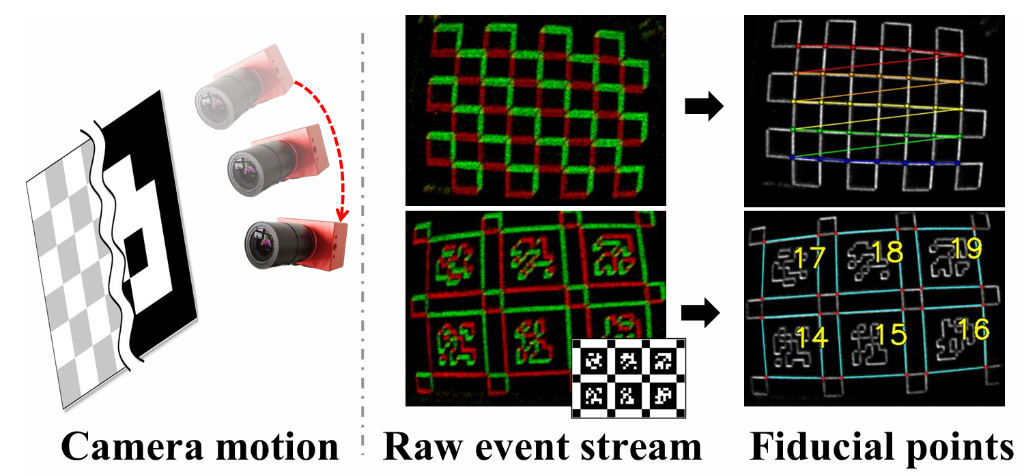
Implementing precise correction by directly detecting checkerboard reference points
Professor Kyung-Don Joo's team at the UNIST Graduate School of Artificial Intelligence announced on the 1st that they have developed a computer vision calibration technology that detects reference points of event cameras using a checkerboard calibration plate. This research was co-authored by UNIST researcher Tae-Hoon Ryu as the first author and researcher Chang-Woo Kang.
Camera calibration is the process of reducing perception errors caused by lens distortion. In standard cameras, the degree of distortion is calculated based on the vertices of a checkerboard grid captured from various angles.
The event camera does not save the entire screen frame by frame, but records only the point where a brightness change occurs as an event. While it is advantageous for fast movements, the existing method was difficult to apply because events rarely occur at the vertices of the checkerboard.
The research team first analyzed grid lines where events were relatively distinct, and then calculated the point with the fewest events in the area where the lines intersect as a reference point. They utilized the characteristic that brightness changes at the vertices cancel each other out, resulting in less event information.
The problem of grid lines becoming blurry due to movement was also addressed. The research team made the grid lines sharper by aligning events occurring at different points in time to a single reference point.
This technology was also applied to AprilTag detection, which is used for location recognition in robots or AR/VR devices. The research team identified the shape and number of the markers using only event data and detected markers that were visible even when partially obscured.
Researcher Ryu Tae-hoon explained, “This technology can improve correction accuracy by finding a reference point within the signal recorded by the event camera itself.”
Professor Joo Kyung-don stated, “Accurate camera calibration is the starting point for various vision technologies,” adding, “I expect it to serve as a foundation for expansion into robots, autonomous driving, and AR/VR systems.”
This research has been selected as a highlight paper for CVPR, an international conference in the field of computer vision, which will be held in Denver, USA, for five days starting on the 3rd. Highlight papers account for only about 3.5% of all submitted papers.

Comments
Related news
UNIST Develops Smart Contact Lenses That Control Robotic Arms with Eye Movements
A research team led by Professor Jeong Im-du from the Department of Mechanical Engineering at UNIST has developed a smart contact lens that enables control of a robotic arm through eye movement alone. The lens surface features 100 optical sensors directly implemented on it that read gaze changes, and AI restores these into high-resolution information and converts it into control signals. The research results were published in Advanced Functional Materials in March 2026, and in eye model experiments, the system recognized nine-directional gaze gestures with 99.3% accuracy.
2026.04.15by 배종인 기자
Lee Chang-ho and Lee Se-dol Discuss Human Capabilities in the AI Era at UNIST
UNIST will host an open talk concert on May 6 featuring Lee Chang-ho, a Go master, and Lee Se-dol, UNIST Distinguished Professor. The event will be held under the theme of human judgment, creativity, and perseverance in the AI era, and will serve as an occasion to introduce the educational direction of the newly established GRIT School of Talent Convergence.
2026.04.29by 명세환 기자
UNIST Develops 60-Second Micro 3D Printing Technology
A research team led by Professor Jung Im-du at ULSAN National Institute of Science and Technology (UNIST) has developed a droplet-based volumetric additive manufacturing technology that cures and dispenses structures within droplets in a single step. The research results were published in Advanced Functional Materials on March 21st, and the research team presented experimental results demonstrating continuous fabrication of different microstructures at approximately 60-second intervals.
2026.04.29by 명세환 기자
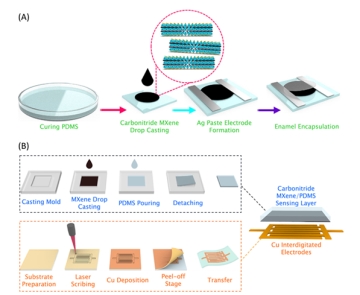
UNIST Develops High-Sensitivity MXene Sensor That Detects Body Temperature and Pulse
UNIST researchers have developed a MXene-based sensor material that can be attached to the skin to detect minute biosignals such as body temperature, pulse, and cough. The new material exhibits sensitivity to temperature changes and pressure stimuli that is approximately 3 times and 4 times or higher, respectively, compared to conventional MXene. The research team improved sensing performance by utilizing a carbonitride structure containing nitrogen, and demonstrated potential applications in wearable healthcare, e-skin, and human-machine interface fields.
2026.05.11by 명세환 기자
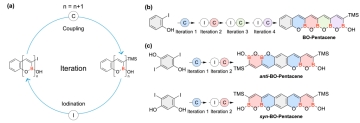
UNIST Inserts Boron-Oxygen Bond into Pentacene Backbone… Develops Organic Semiconductor Synthesis Method
UNIST researchers have developed a synthetic method for repeatedly inserting boron-oxygen bonds into the molecular backbone of organic semiconductor pentacene. While conventional approaches have primarily involved attaching functional groups to the exterior of the molecular skeleton to modulate physical properties, this research is differentiated by enabling stepwise modification of the backbone itself. The research team synthesized three pentacene derivatives with different bonding arrangements, and all exhibited fluorescence quantum yields exceeding 0.70.
2026.05.18by 배종인 기자











