


Mouser Supplies Synaptics Astra Machina SL2600 Development Kit
 Published2026.06.09 11:58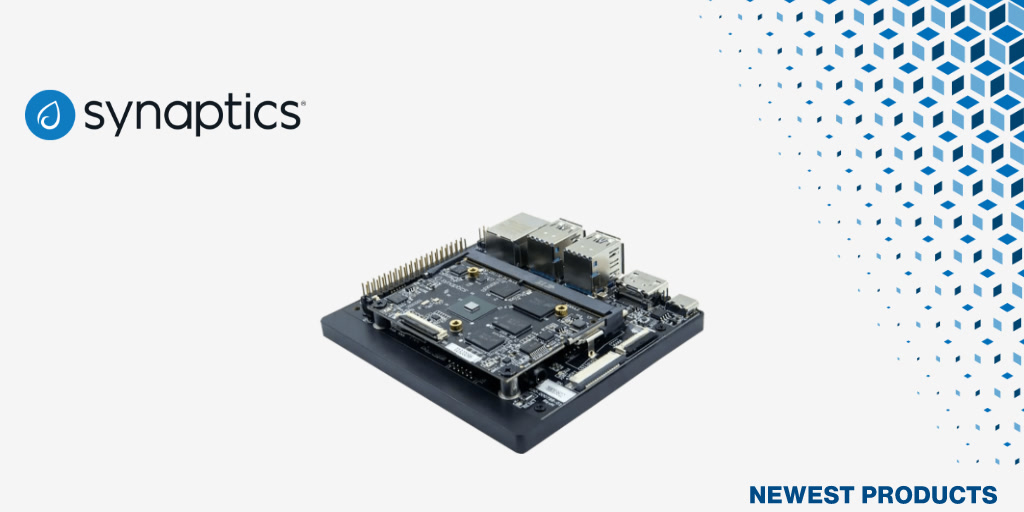
Aiming to develop multimodal AI prototypes based on Coral Open NPU
Mouser announced on the 9th that it is supplying the development kit through its distribution network. The SL2600 is an edge AI development kit designed to run multimodal and transformer-class inference on embedded IoT hardware.
This kit is based on Synaptics' AI-native Torq edge AI platform. Torq is configured to run AI models, such as Vision Transformers and multimodal pipelines, by utilizing Google's RISC-V-based Coral Open NPU.
The software environment is centered around Yocto Linux and IREE·MLIR-based compilers and runtimes. Through this, Synaptics presented a structure that reduces dependence on proprietary toolchains or specific models.
The SL2600 features a modular hardware architecture consisting of a computing module, an I/O baseboard, and an expandable daughter card. Developers can configure vision system prototypes by utilizing integrated connectivity, programmable I/O, and interfaces tailored to real-world product environments.
Daughter card interfaces include MIPI DSI, MIPI CSI-2, a 40-pin JTAG header, and a 4-pin PoE+ connector. This configuration is applicable to the development of various edge AI systems, such as camera-based vision processing, industrial equipment, robots, and smart devices.
This supply aligns with the trend of expanding AI inference capabilities from a cloud-centric architecture to field terminals. As demand for real-time processing, reduced latency, and alleviated data transmission burdens increases in industrial equipment and smart devices, the scope of application for edge AI development platforms is also expanding.
More information about the Astra Machina SL2600 development kit can be found on the Mouser product page.

Comments
Related news

Mouser, “Industrial Cybersecurity Rapidly Emerges as a Social Responsibility Area in the NIS2 Era”
We heard from Mouser Electronics about why industrial cybersecurity is important in the NIS2 era.
2026.04.30by 배종인 기자
.jpg)
Mouser Begins Supplying Delta 48V DIN Rail Power Supply 'Force-GT'
Mouser Electronics has begun supplying Delta Electronics' 48V three-phase DIN rail power supply product line 'Force-GT'. The product is designed for use in electric vehicle charging infrastructure, semiconductor equipment, smart manufacturing, and industrial robotics applications. The lineup consists of 480W and 960W output models, supporting a maximum power conversion efficiency of 96% and an operating range of -40°C to 70°C. The specifications are characterized by features that consider stable operation in industrial environments, including protective coating, surge resistance, and constant current circuitry.
2026.05.06by 명세환 기자

Mouser Signs Global Distribution Agreement with Transtector
Mouser Electronics announced on May 11 that it has entered into a global distribution agreement with Transtector and is expanding the supply of surge protection products. Through this agreement, Mouser will provide SPD products for data and power infrastructure protection to global customers. The supplied products include indoor DPR, outdoor ALPU, DIN rail type I2R, and panel mount APEX IMAX. These products are used in industrial facilities, utilities, security, transportation, and telecommunications networks.
2026.05.11by 명세환 기자
Mouser Adds Infineon KP497 to Lineup… Expands Battery Anomaly Detection Component Group
Mouser Electronics is supplying Infineon Technologies' smart barometric sensor 'XENSIV KP497'. The KP497 is a sensor for BMS that integrates pressure, acceleration, and temperature sensing functions along with a digital interface in a single package. It can detect pressure changes inside high-voltage battery packs to identify signs of thermal runaway, and also supports low-power autonomous operation. As regulations on electric vehicle battery safety strengthen and demand for battery state monitoring sensors expands, integrated sensor-based diagnostic functions are expected to broaden their application scope in the automotive and industrial control sectors.
2026.05.13by 명세환 기자
Mouser, “Cybersecurity Evolving with AI”
Poornima Apte of Mouser Electronics discusses five practical ways AI is strengthening cybersecurity.
2026.05.19by 편집부











