



Hanwha Systems Promotes Localization of Defense Semiconductors with Seoul National University and Sungkyunkwan University
 Published2026.07.15 13:03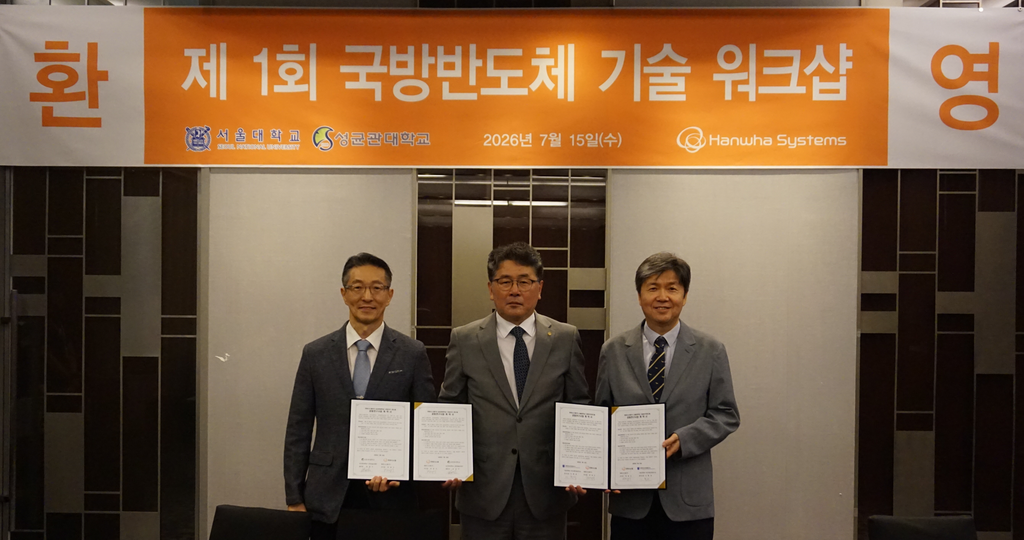
Hanwha Systems announced on the 15th that it held a 'Defense Semiconductor Technology Workshop' with Seoul National University and Sungkyunkwan University and signed detailed contracts for the development of semiconductor chips for radar, seekers, synthetic aperture radar (SAR) satellites, satellite and tactical communications, and HPM.
Following the establishment of 'Joint Defense Semiconductor Research Centers' at both universities in March of this year, the plan is to accelerate practical development cooperation through this agreement.
The Hanwha Systems-Seoul National University Joint Research Center is embarking on the development of a 'High Linearity semiconductor chip' for satellite terminals.
It is a technology that minimizes signal distortion and interruption between space and the ground, and is a key component that contributes to improving communication quality and miniaturizing and lightweighting terminal equipment.
The goal is to secure technological sovereignty by independently developing communication semiconductors for space and defense applications, which are subject to strict overseas export control regulations.
Hanwha Systems explained that it plans to sequentially apply the technology to satellite terminals from this year through 2028, and then expand the scope of application to low-orbit satellite communication payloads and next-generation communication base stations.
The Hanwha Systems-Sungkyunkwan University Joint Research Center is focusing on securing design technology for Monolithic Microwave Integrated Circuits (MMICs).
MMIC is a technology that integrates multiple signal amplification and conversion components required for radar transmission and reception into a single chip, and it is considered a key component that determines the performance of Active Electronically Scanned Array (AESA) radars and small satellites.
Through this collaboration, Hanwha Systems overseas It is expected that this will enable the internalization of core semiconductor components on which there was high dependence and lay the foundation for rapidly responding to the requirements of modern warfare.
Hanwha Systems announced that it is also considering introducing a foundry process for the mass production of defense semiconductors.
"This collaboration is a process of establishing a virtuous cycle value chain leading from design to verification to expansion to commercialization of defense semiconductors," said Kwak Jong-woo, Head of the Basic Research Institute at Hanwha Systems. "Based on the technology secured, we will enhance our competitiveness in the global defense market."

Comments
Related news
.jpg)
Hanwha Systems and ETRI join hands to take the lead in the 6G space internet market
Hanwha Systems signed a memorandum of understanding (MOU) with the Electronics and Telecommunications Research Institute (ETRI) at the Hanwha Building located in Jung-gu, Seoul for "6G Low Earth Orbit Satellite Communication System Technology Development."
2025.03.21by 배종인 기자
Hanwha Systems, 1st quarter performance up… Sales 690.1 billion, up 27% YoY
Hanwha Systems (CEO Jae-il Son) achieved solid performance in the defense sector during the first quarter of 2025, with large-scale exports and mass production projects showing stable growth. Based on consolidated financial statements, sales reached 690.1 billion won, representing a 26.8% increase compared to the same period last year, and operating profit reached 58.2 billion won, a 27.9% increase year-over-year.
2025.04.28by 명세환 기자
.jpg)
Hanwha Systems and Northrop Grumman join hands for 'integrated air defense system'
Hanwha Systems (CEO Jae-il Sohn) has signed a memorandum of understanding on "Integrated Air Defense System Technology Cooperation" with American defense contractor Northrop Grumman, and is launching joint projects targeting the global integrated air defense system market in earnest. Under this agreement, the two companies plan to develop and supply a "seamless multi-layered defense solution" by integrating Northrop Grumman's IBCS (Integrated Air and Missile Defense Battle Command System) with Hanwha Systems' KAMD Operations Center (KAMDOC), Central Air Defense Control Center (MCRC), and air defense C2A system technologies based on C4I command and control capabilities.
2025.06.23by 배종인 기자
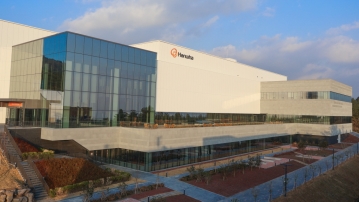
Hanwha Systems completes construction of Korea's largest space center, Jeju Space Center, to produce 100 satellites annually starting next year.
Hanwha Systems held a completion ceremony for the 'Jeju Space Center,' announcing a new leap forward for Korea's space industry.
2025.12.02by 배종인 기자
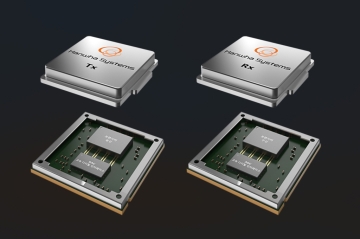
Hanwha Systems Launches Development of Korea's First Space Semiconductor
Hanwha Systems (CEO Son Jae-il), a leader in secondary batteries, defense, and space technology in the Republic of Korea, has initiated the development of space semiconductors for satellites for the first time domestically. This project is a key initiative for achieving technological independence in defense space, with the goal of independently developing transceiver space semiconductors required to implement military low earth orbit satellite communications.
2025.12.03by 배종인 기자











