


ETRI Localizes Core Components for Aerial Holograms… Implements Non-Contact Touch Interface
 Published2026.07.21 11:05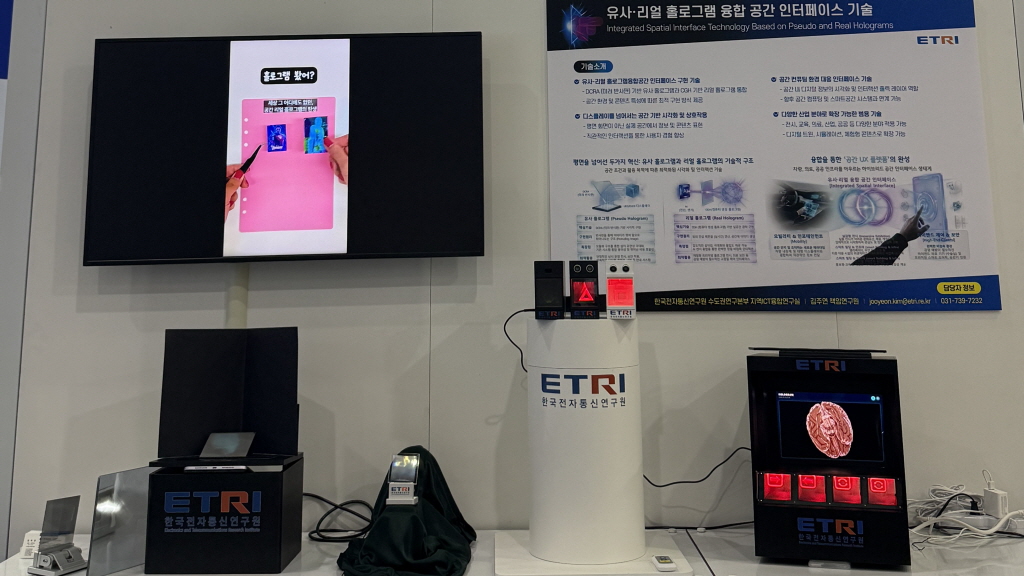
 The Electronics and Telecommunications Research Institute (ETRI) has completed a prototype of a non-contact interface technology that allows users to directly manipulate images projected in mid-air with their fingers by replacing core components of aerial holograms, which have been exclusively supplied by Japanese companies, with domestic source technology. It is assessed that a technological foundation has been laid for next-generation user interfaces (UI) free from infection concerns, along with the localization of materials and components that previously relied heavily on imports.
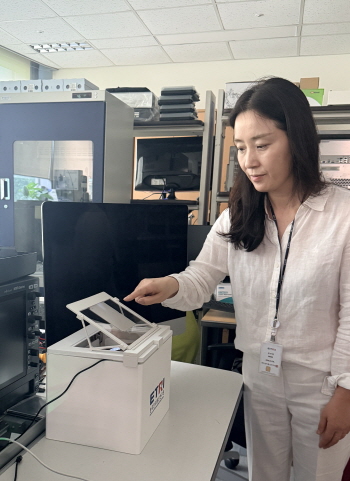
ETRI announced on the 21st that it has developed 'Hovering Hologram' technology, which allows users to manipulate a screen in mid-air with their fingers by combining it with a spatial touch sensor.
The key is the localization of mirror reflector sheets, which have previously relied entirely on imports.
The research team produced a high-resolution mirror reflector sheet measuring 10cm × 10cm using a proprietary manufacturing method that combines polymer materials with photolithography and imprinting processes.
Pseudo-holograms are a technology that reproduces light generated from a display in mid-air through a mirror reflector.
You can visually check images floating in the air without separate glasses or a screen, and if linked with a spatial touch sensor, you can operate them directly with your finger.
The research team also succeeded in producing a prototype that creates aerial holographic images using a self-developed sheet, and the technology was recently unveiled at the 'WIS 2026 ICT Technology Exhibition Festival'.
Applications of this technology include surgical wound tracking monitors, glasses-free medical displays, contactless guidance systems for public facilities, elevator buttons, and smart massage chair control devices.
With the increasing demand to reduce contact with shared touchscreens following the spread of infectious diseases, it is reported that there is high potential for application, particularly in medical institutions and multi-use facilities.
“It is significant that we have localized core components of pseudo-holograms, which were previously entirely dependent on overseas sources, using domestic technology,” said Kim Ju-yeon, a principal researcher at ETRI. “By advancing the integration technology with spatial touch sensors, users can freely [view] aerial images."We will continue to improve the level of perfection to the point where it can be manipulated," he said.
This research was conducted with support from the Ministry of Trade, Industry and Energy's Electronic Components Industry Technology Development Project, specifically the 'Development and Demonstration of New Market Creation Display Technology' task.
The research team plans to further develop spatial touch functions to conduct pilot tests at domestic public institutions and explore entering the global market through overseas exhibitions in the Middle East and the United States.

Comments
Related news
ETRI Realizes 'Capacitor-Free DRAM' Using Oxide Semiconductors for Displays
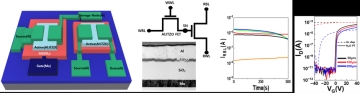
Electronics and Telecommunications Research Institute (ETRI) has successfully implemented a 2T0C DRAM structure that stores data without a capacitor by utilizing oxide semiconductors for displays. The research team reduced leakage current and minimized stored charge loss through Al:ITZO thin-film transistors, N2O plasma processing, and channel ratio optimization. As a result, data retention time exceeded 1,000 seconds, and memory window improved by approximately 13 times. This is significant as a structural alternative that can address the scaling limitations of conventional DRAM, where capacitor formation is becoming increasingly difficult.
2026.04.14by 명세환 기자
ETRI Presents Blueprint for 'AI Highway'... Full-scale Construction of 6G-Based National AI Infrastructure Begins
The Electronics and Telecommunications Research Institute (ETRI) has unveiled a strategy for building an 'AI Superhighway' to secure national competitiveness in the AI era. On the 13th, ETRI held a forum at Seoul's L Tower and presented a direction for national AI infrastructure that integrates data, computing, and networks based on 6G and AI networks. Researchers emphasized the necessity of a network-centric architecture that can connect the entire process from AI model development through training, inference, and service. The forum discussed next-generation infrastructure technologies including AI-RAN, 6G, data center networks, and AI security technologies, as well as industrial ecosystem and policy challenges.
2026.05.13by 배종인 기자
ETRI Appoints New President Park Se-woong… Presents Research Direction Centered on AI and DX
The Electronics and Telecommunications Research Institute (ETRI) is launching a full-scale research strategy centered on artificial intelligence (AI) and digital transformation (DX) with the inauguration of new director Park Se-woong.
2026.05.20by 배종인 기자
ETRI Develops 2,500 PPI Micro LED Bonding Technology for AI and XR
The Electronics and Telecommunications Research Institute (ETRI) has developed ultra-fine bonding technology for implementing ultra-high-resolution micro LED displays for AI and XR devices. The research team realized a process connecting approximately 920,000 bumps at a 10㎛ pitch, securing ultra-high-density bonding technology exceeding the level of high-bandwidth memory (HBM4). This achievement received the 'People's Choice Award' in the micro LED category at SID Display Week 2026, and the related research was published in the international academic journal 'Microsystems & Nanoengineering'.
2026.06.11by 명세환 기자
.jpg)
ETRI Takes Lead in International Standards for AI Smart Cities… Inaugural Chair of ITU Focus Group
The Electronics and Telecommunications Research Institute (ETRI) has taken the lead in establishing the AI Smart Sustainable Cities Focus Group (FG-AI4SSC) under the International Telecommunication Union - Telecommunication Standardization Sector (ITU-T) and has secured the position of inaugural chairman. The new working body is an international standardization organization that discusses interconnection and operational standards for AI technologies applied across urban services including transportation, energy, environment, and safety. Building on its accumulated standardization experience in the smart city and digital twin sectors, ETRI has expanded discussions on AI-based urban operation systems, and is expected to strengthen its influence in the process of establishing global smart city standards in the future.
2026.06.16by 명세환 기자











