


ETRI Adopts ITU-T and MPEG International Standards for Biosignal Compression Technology
 Published2026.07.29 15:02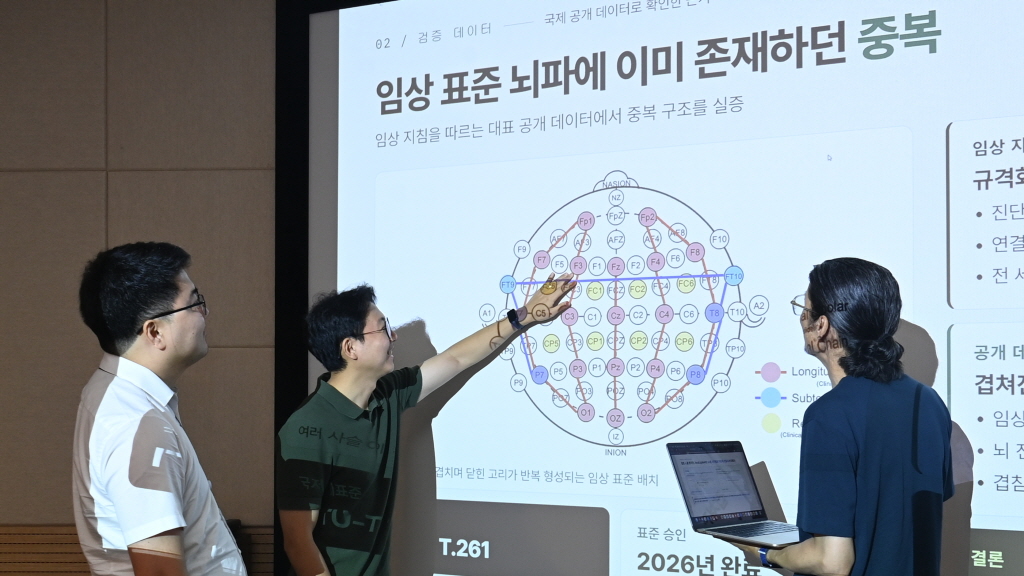
The Electronics and Telecommunications Research Institute (ETRI) announced on the 29th that two core biosignal compression technologies it developed in-house have been incorporated into the International Standard for Bio- and General Waveform Compression (H.BWC), which was simultaneously approved as an ITU-T recommendation (T.261) and MPEG-D Part 8.
ETRI did not stop at proposing technology but took on the role of editor for the standard document to lead the standardization process, and also secured two related international standard patents.
The first technology reflected in this standard is predictive-based encoding.
Biosignals have the characteristic of repeating patterns similar to the previous value.
The research team reduced the amount of information subject to compression itself by predicting the next value based on the previous signal and encoding only the difference between the predicted and actual values.
The second is electrode placement-based channel encoding technology.
When measuring multi-channel EEG, information recorded redundantly between electrodes is identified solely by the electrode connection relationships, preventing unnecessary redundant data storage and efficiently restoring signals.
It is characterized by having almost no additional computational burden.
Both technologies were adopted as standard technologies after undergoing international joint verification.
H.BWC is the first international standard to fill the gap in the field of biosignals, such as electroencephalography (EEG), electrocardiogram (ECG), and electromyogram (EMG), where there was no international compression standard, unlike DICOM, the medical imaging standard.
ETRI predicted that the introduction of this technology would improve the efficiency of storing and transmitting large volumes of medical data and be widely utilized in telemedicine, wearable healthcare, and AI-based precision medical diagnosis.
OwlIt is applicable to general waveform data compression, such as industrial sensor data collection and vibration analysis, and has also been adopted in MPEG’s Audio for Machines standard (ACoM).
"It is significant that the technology has been officially recognized as a core component of an international standard, going beyond the level of merely proposing it," said Kang Jung-won, Head of the Media Encoding Research Lab at ETRI. "We will continue to advance compression technology in the fields of biosignals and immersive media and lead international standardization."
Lee Tae-jin, Head of the Media Systems Research Division, also stated, “We will strive to create new value in the medical and various industrial fields based on international standards.”
This research was conducted with support from ETRI's 'Development of Real-Virtual Convergence Spatial Media and Interaction Technology' project.

Comments
Related news
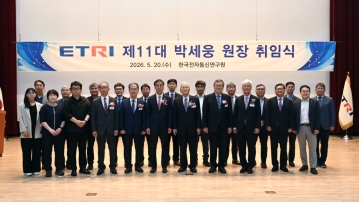
ETRI Appoints New President Park Se-woong… Presents Research Direction Centered on AI and DX
The Electronics and Telecommunications Research Institute (ETRI) is launching a full-scale research strategy centered on artificial intelligence (AI) and digital transformation (DX) with the inauguration of new director Park Se-woong.
2026.05.20by 배종인 기자
ETRI Develops 2,500 PPI Micro LED Bonding Technology for AI and XR
The Electronics and Telecommunications Research Institute (ETRI) has developed ultra-fine bonding technology for implementing ultra-high-resolution micro LED displays for AI and XR devices. The research team realized a process connecting approximately 920,000 bumps at a 10㎛ pitch, securing ultra-high-density bonding technology exceeding the level of high-bandwidth memory (HBM4). This achievement received the 'People's Choice Award' in the micro LED category at SID Display Week 2026, and the related research was published in the international academic journal 'Microsystems & Nanoengineering'.
2026.06.11by 명세환 기자
.jpg)
ETRI Takes Lead in International Standards for AI Smart Cities… Inaugural Chair of ITU Focus Group
The Electronics and Telecommunications Research Institute (ETRI) has taken the lead in establishing the AI Smart Sustainable Cities Focus Group (FG-AI4SSC) under the International Telecommunication Union - Telecommunication Standardization Sector (ITU-T) and has secured the position of inaugural chairman. The new working body is an international standardization organization that discusses interconnection and operational standards for AI technologies applied across urban services including transportation, energy, environment, and safety. Building on its accumulated standardization experience in the smart city and digital twin sectors, ETRI has expanded discussions on AI-based urban operation systems, and is expected to strengthen its influence in the process of establishing global smart city standards in the future.
2026.06.16by 명세환 기자
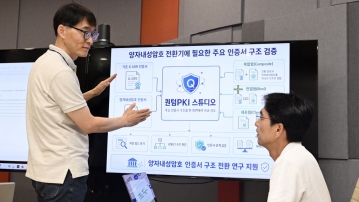
ETRI Develops Verification Tool for Quantum-Resistant Cryptography Joint Certificates
ETRI developed an integrated platform called "Quantum PKI Studio" on the 22nd to conduct advance testing and validation of next-generation joint authentication certificate systems in preparation for the quantum computing era. It generates, analyzes, and verifies RSA and ECC-based X.509 certificates and NIST and KPQC post-quantum cryptography (PQC) algorithms, as well as composite, concatenated, and embedded hybrid certificates in a single environment. By visually diagnosing ASN.1 structure and electronic signature status through GUI, it supports verification-based preparation for post-quantum cryptography transition across PKI systems including certification authorities and HSMs. The project, commissioned by the Ministry of Science and ICT and IITP, involved participation from KISA, CryptoLab, and Kookmin University.
2026.06.22by 배종인 기자
.jpg)
ETRI Launches AI Data Center Network 'HINT Forum'
The Electronics and Telecommunications Research Institute (ETRI) launched the 'Hyper Service Interconnect (HINT) Forum' on June 24th to advance development and standardization of ultra-high-speed, ultra-low-latency interconnection technology for AI data centers (AIDC). As the proliferation of generative and large-scale AI increases demand for large-scale computing resource sharing and real-time data transmission, the forum is researching lossless optical transmission networks between AIDCs and open-source transmission fabric operating systems. The inaugural general meeting held at Gongji-am Resort on the 11th was attended by 90 representatives from industry, academia, and research institutions, and the forum is promoting international standardization and industrialization with TTA support under the Ministry of Science and ICT's ICT Standardization Project.
2026.06.24by 배종인 기자











