



Gartner: “AI Inference Will Be the Main Cause of Privacy Breaches in 2029”
 Published2026.08.03 11:04
Gartner announced on the 3rd that by 2029, most privacy breaches will result from inferences generated by AI about individuals, rather than the direct leakage of personally identifiable information (PII).
It was also projected that spending on data integrity protection would reach the same level as investment in confidentiality protection by 2028.
Bart Willemsen, a senior analyst at Gartner, stated, “The nature of privacy breaches is shifting from data leaks to insight leaks,” adding that “AI can recreate deep personal insights without being constrained by existing data controls.”
He added, “Inference attacks are even more dangerous because they are often not detected by existing detection systems,” explaining that “even if actual records are not leaked, sensitive information can be revealed through conclusions derived by AI.”
Gartner analyzed that as companies reduce the amount of personal data they retain due to regulatory and cost burdens, threat actors have gained the means to conduct AI-based inference-based attacks.
To address emerging inference-based privacy risks, Gartner recommends: applying privacy-by-design principles throughout the entire AI development and deployment process and regularly checking for algorithmic bias and unintended inference risks; adopting Privacy Enhancement Technologies (PET), such as differential privacy technologies, synthetic data, and privacy-preserving machine learning; limiting data collection to necessary scope and minimizing the attack surface through strict access controls and timely deletion; strengthening advanced monitoring and anomaly detection capabilities to identify inference-based threats; and AIIt recommended measures such as mandating a 'human in the loop' to verify loan results before processing sensitive data. "In the future, privacy risks will depend more heavily on how AI interprets data than on how companies store data," said analyst Willemsen.

Comments
Related news
.jpg)
Gartner identifies 'semantic foundation' as key condition to boost AI agent performance.
Gartner has identified a semantic foundation as a key requirement for improving the accuracy and cost efficiency of AI agents. The analysis indicates that AI agents can deliver contextually appropriate results only when the meaning, relationships, and rules of data within an organization are clearly defined.
2026.05.12by 배종인 기자
Gartner Identifies Deepfakes and Prompt Injection as Top 4 Cyber Threats in the AI Era
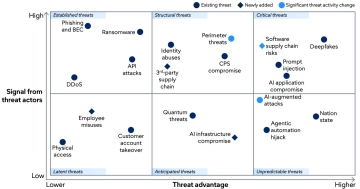
Gartner has identified deepfakes, AI application breaches, prompt injection, and software supply chains as key threats where attackers could gain an advantage in the cyber threat landscape between 2026 and 2027. Gartner explained that with the widespread adoption of generative AI and agentic AI, the attack surface that corporate security teams must manage is expanding. Accordingly, Gartner advised that cybersecurity leaders should establish a multi-layered defense strategy that includes identity verification, AI application protection, LLM security testing, and development pipeline controls.
2026.06.09by 명세환 기자
.jpg)
Gartner: “AI Data Center Power Demand Surges, Power Consumption to Increase by 26% by 2026”
Gartner projects that global data center power consumption will increase by approximately 26% year-over-year before 2026, and analysis indicates that power procurement has emerged as a key factor in AI competition.
2026.06.12by 배종인 기자
Gartner, "10% of Companies to Transition to AI First by 2030"
Gartner announced six major data and analytics (D&A) trends that enterprises should reflect in their strategies over the next two years on June 17, forecasting that more than 10% of global enterprises will transition to "AI-first" companies by 2030, where AI serves as a core benchmark for all decision-making and investments, thereby securing competitive advantage. The firm identified AI agents, semantics, and integrated D&A platforms as key drivers, and presented sovereign AI acceleration and governance, agentic data streaming for real-time response, and GraphRAG, which combines knowledge graphs and LLMs, as major trends.
2026.06.17by 명세환 기자
.jpg)
Gartner: “NeoCloud to Capture 20% of AI Cloud Market by 2030”
Gartner forecasted on the 24th that as GPU-intensive computing demand surges due to generative AI proliferation, neocloud providers specializing in AI and high-performance workloads will capture 20% of the $267 billion AI cloud market by 2030. With legacy hyperscalers unable to keep pace with GPU demand and data sovereignty requirements serving as growth drivers, Gartner recommended that IT leaders evaluate sovereign neoclouds and diversify their cloud strategies to address GDPR and EU AI Act compliance.
2026.06.24by 명세환 기자











