



Korea Institute of Machinery and Materials Develops Next-Generation Heat Pump Enabling Cooling Using Low-Temperature Waste Heat
 Published2026.08.05 09:49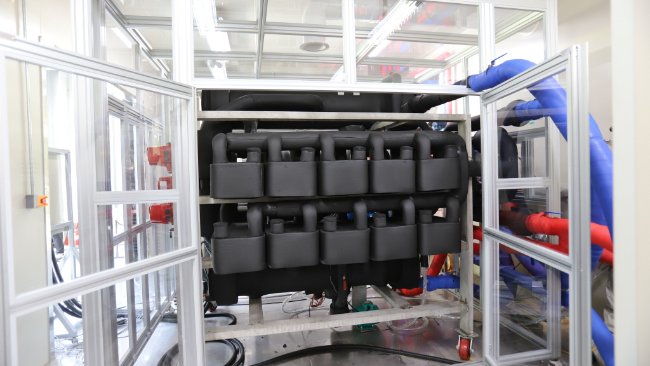
Utilizing 40℃ Level Waste Heat from Factories and Data Centers, Realizing Heat Pump Cooling System
On the 5th, the research team led by Dr. Kim Young, principal researcher at the Heat Pump Research Center of the Korea Institute of Machinery and Materials, announced the development of a next-generation heat pump system capable of cooling using only low-temperature waste heat around 40℃.
The research team explained that this system differs from conventional methods in that it implements cooling by directly utilizing low-grade waste heat emitted from industrial facilities without a separate high-temperature heat source.
Currently, waste heat of around 40℃ generated from industrial facilities such as factories and data centers has low utilization value, and is mostly released into the atmosphere.
Existing heat pump technology finds it difficult to directly use such low-temperature heat sources for cooling, requiring separate energy input.
The newly developed system realizes cooling by using only waste heat in that temperature range as the driving source, and the research team stated that it can contribute to improved energy efficiency in industrial facilities.
For technical inquiries regarding this research, contact Dr. Kim Young, principal researcher at the Heat Pump Research Center (042-868-7626).
Based on this achievement, the Korea Institute of Machinery and Materials plans to continue pursuing the practical application of industrial waste heat recycling technology.

Comments
Related news
KIMM, “How AI is utilized determines manufacturing competitiveness”
The Korea Institute of Machinery and Materials has published "Mechanical Technology Policy" No. 123, which analyzes the AX and DX strategies of Japan's automotive industry. The report analyzes that Toyota and Honda are utilizing AI not as an automation technology but as a means to support on-site decision-making and organizational capabilities. The Korea Institute of Machinery and Materials recommends that Korea's manufacturing industry should also develop an AX strategy based on on-site operations, organization, and ecosystem, moving beyond a technology adoption-centered approach.
2026.05.14by 명세환 기자
KIMM and Korean Register Publish Safety Review Report on Hydrogen Fuel Propulsion Ships
The Korea Institute of Machinery and Materials and Korean Register have published a technical report summarizing major risk factors and safety mitigation measures for hydrogen fuel propulsion vessels. The report addresses safety issues that must be reviewed during ship application, including hydrogen storage and supply systems, fire and explosion hazards, cryogenic risks, and hydrogen embrittlement. It is expected to be utilized in design and safety reviews by the shipbuilding and shipping industries in conjunction with the International Maritime Organization's approval process for interim safety guidelines on hydrogen fuel propulsion vessels.
2026.06.08by 배종인 기자
.png)
Rising Demand for AI Data Center Cooling… KIMM: “Need to Foster Heat Pumps”
The Korea Institute of Machinery and Materials has proposed that industrial high-temperature, large-capacity heat pumps and data center waste heat utilization technologies should be strategically fostered to respond to increased data center cooling demand due to artificial intelligence (AI) proliferation and industrial process decarbonization. In Issue No. 124 of "Mechanical Technology Policy," the institute analyzed that the global heat pump market will expand from $75.8 billion in 2024 to $162.6 billion by 2030, and presented natural refrigerants, digital heat pumps, and data center waste heat utilization as key technology competition areas. The report stated that research and development investment, demonstration infrastructure construction, and institutional framework establishment are necessary.
2026.06.15by 명세환 기자
.jpg)
KIMM Develops AI-Based Intelligent System for 2D Semiconductor Plasma Process
The Korea Institute of Machinery and Materials (KIMM) announced on June 17 that a research team led by Senior Researcher Kim Hyung-woo has developed an AI-driven plasma-based integrated process intelligence system that autonomously analyzes and controls next-generation 2D semiconductors with atomic-layer thickness. As precision control at the atomic-layer level has become critical due to semiconductor miniaturization, the research team integrated plasma processing and diagnostics into a single platform and incorporated AI to enable real-time interpretation of process data and automatic adjustment of conditions. This enables the system to diagnose and respond to process states without human intervention, thereby enhancing the precision and autonomy of next-generation semiconductor processes.
2026.06.17by 배종인 기자
KIMM Localizes Key Components for Next-Generation Rotary-Wing Aircraft Power Transmission Systems
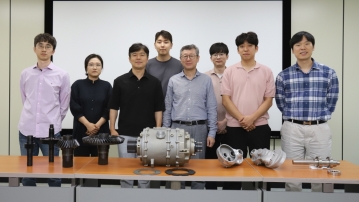
The Korea Institute of Machinery and Materials (KIMM) announced on the 22nd that the research team led by Director Yi Han-min has secured Korea's first indigenous core technologies for design and analysis of clutches, gears, housings, and bearings—key components of next-generation rotorcraft power transmission systems. The power transmission system is a device that transfers engine power to the rotor, and has traditionally had high barriers to entry in design and analysis, resulting in significant dependence on overseas technology. The research team fabricated prototypes and conducted performance verification through testing and evaluation, and the secured technologies will be applied to the development of next-generation rotorcraft.
2026.06.22by 배종인 기자











