This page was machine-translated and may differ from the original. View original
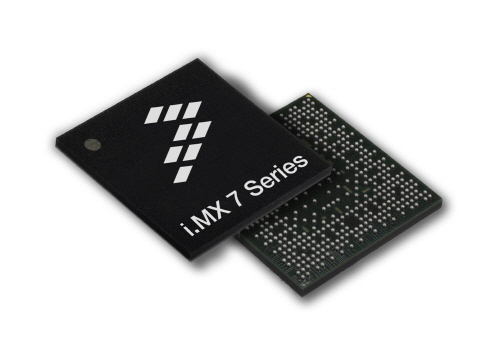
Freescale Unveils i.MX 7 Series, Ultra-Low Power, High Performance Application Processors Optimized for IoT

- The multi-functional multicore i.MX 7 series achieves high performance with one-third the power of the existing i.MX 6 series, with the operating system standby power consumption in maximum sleep mode being only 250μW.
- The industry's first ARM Cortex-A7 and Cortex-M4-based general-purpose application processors are expected to lead the IoT market with superior security features and best-in-class power efficiency.
July 7, 2015, Seoul, Korea – Global semiconductor company Freescale (www.freescale.co.kr, Korea Representative Director Yeonho Hwang) unveiled the i.MX 7 series, a new generation of multi-functional, energy-saving application processors featuring a low-power architecture based on the existing widely used i.MX platform, today (the 7th) at the Ritz-Carlton Hotel in Seoul.
The conference on this day was attended by about 20 domestic semiconductor journalists and related personnel, and featured a presentation by Deputy General Manager Kim Myung-cheol of the Freescale MCU Marketing Team.
"The biggest feature of the i.MX 7 is its industry-leading power efficiency and excellent security features suitable for the IoT field," said Kim Myung-cheol, Deputy General Manager of the Freescale Microprocessor Marketing Team. "We expect it to deliver outstanding performance in various fields such as IoT, e-books, point-of-sale (POS), building automation, and patient monitoring in the future."

The i.MX 7 series features world-class core power efficiency of 15.7 DMIPS/mW and a new 250μW LPSR (Low Power State Preservation) mode, and It is the industry's first general-purpose microprocessor product that integrates ARM Cortex-A7 and Cortex-M4 cores into a single chip. The technologies applied in i.MX 7, along with Freescale's new PF3000 PMIC family, are expected to trigger the possibility for the development of highly innovative, secure, and power-efficient end products in the fields of wearable computing and the Internet of Things (IoT).
The first products in this series are the new i.MX 7Solo and i.MX 7Dual families, equipped with Cortex-A7 cores operating up to 1 GHz and Cortex-M4 cores operating up to 266 MHz. The Cortex-A7 and Cortex-M4 have processor core efficiencies of 100 μW/MHz and 70 μW/MHz, respectively. All cores are powered individually so that they can be operated as needed. Through this Performance-on-Demand (PoD) architecture, the i.MX 7 series utilizes one or both of the Cortex-A7 cores to meet transient high-performance demands for running Linux, graphical user interfaces, wireless stacks, or other high-bandwidth data transmissions. Power gating of the Cortex-A7 cores is possible, as tasks can be switched to the smaller, low-power Cortex-M4 cores when high-performance processing is not required.
LPSR mode, through advanced 28nm process technology and discrete power domain architecture, supports DDR self-refresh mode, GPIO-on, and memory state preservation while consuming only 250μW, which is 48% lower than competitors. Creating systems equipped with high-power processing and low-power maximum power saving modes requires smaller batteries, enabling the development of a new class of lighter and cheaper performance-on-demand (PoD) and battery-operated products.
Freescale's i.MX 7 series processors are suitable for a number of applications, such as wearable devices, security POS equipment, smart home controllers, industrial products, and a wide range of innovative Internet of Things (IoT) solutions. In addition, the i.MX 7 Series integrates an advanced 4th generation e-paper display controller, continuing Freescale's industry-leading support for the e-book market.
Ron Martino, Vice President of Application Processors and Advanced Technology Adoption at Freescale MCU Group, said, “Freescale’s i.MX 7 series achieves industry-leading dynamic and static power efficiency figures compared to competitor devices,” adding, “To provide new and innovative features, such as a new battery saver mode consuming only 250μW, we combined an ultra-low power PoD architecture with the ARM Cortex-A7, the most energy-efficient ARM processor ever, to achieve a threefold improvement in performance, including minimized restart time without Linux reboots.”
High-bandwidth connectivity is provided through various interfaces such as PCIe and AVB-supported dual Gigabit Ethernet, and excellent performance and power efficiency are supported through support for various external memory interfaces, including eMMC 5.0 and LowPower-DDR3, to meet higher bandwidth applications.
Outstanding security features for the future of the internet
To address the increasingly stringent security requirements of POS and IoT applications, the i.MX 7 series products integrate Elliptic Curve Cryptography (ECC) technology, active tamper detection, secure boot, and other hardware-assisted features to protect sensitive information. In addition, the i.MX 7 architecture features individually controlled and protected resource domains that isolate security threats and enable the use of hardware firewalls.
Driving i.MX 7 with Low Power: Freescale's New PF3000 PMIC
The PF3000 Power Management IC (PMIC) was developed alongside the i.MX 7 series and specifically optimized for it to provide the best possible overall system power efficiency. Equipped with up to four buck converters, six linear regulators, an RTC power supply, and a coin cell charger, the PF3000 is designed to support all specified i.MX 7 use cases and conditions. The PF3000 PMIC is a fully integrated solution that improves power efficiency at the system level by optimizing power delivery to the processor, peripherals, and various system memory resources within a total component solution size of less than 100mm². The PMIC supports One-Time Programmable (OTP) memory to control startup sequences and output voltages without the need for external components. It maximizes industry-leading low-power performance with user-programmable Standby – Sleep/LPSR – Off power modes and superior light-load efficiency. In addition, the PF3000 PMIC, which is scalable across multiple cores, operating frequencies, and memory types and applied to various i.MX 7 reference designs, enables increased development efficiency and lowers overall material costs.
Development environment
Freescale provides a comprehensive development environment for the i.MX 7 series and enables customers to shorten time-to-market through a wide range of ARM-linked systems. SABRE boards for smart devices in the i.MX 7 series are equipped with a PF3000 PMIC, Wi-Fi 11ac/abgn, Bluetooth 4.1, and come with an SD card running Linux®. The Android™ operating system is also available for download from the website.
Supply situation
Samples of the i.MX 7Solo and i.MX 7Dual application processors are currently available for limited purchase, with mass production scheduled for November 2015. The PF3000 PMIC is currently being sold by Freescale (www.freescale.co.kr) or its domestic distributors. Currently, two PF3000 board designs are available: the KITPF3000FRDMEVM evaluation board and the KITPF3000FRDMPGM programming board. For additional pricing or other information, please contact Freescale or its domestic distributors.
본 기사에 대한 정정·반론·추후보도 청구는 보도 청구 안내를, 그간 게재된 보도문은 정정·반론보도 모아보기를 참고해 주세요.